Preview
 Send
Send Share
Share
 Details
 Guide
Guide

 Download
 Similars
 X-Ray
X-Ray Diaporama
 Stats
StatsJohn Fuller
 Acrylic On Canvas
- WallArt
- Atmospheric Impressionism
 128.0 x 103.0 cm
 The Royal Institution
 Read More
Hand Made Oil Reproduction
Hand-painted oil on canvas in your size and frame, made to order by our artists. ( Switch to Print Switch to Digital Image)




P118B $10

P118H $10

P118W $10

P438Z $10

P508JH $12

P508YH $12

P805H $10

P805Z $10

P919BZ $10

P919G $10

P919XJ $10

P959ZH $10

P968JZ $12

W106C $8

W218G $10

W218JH $8

W218Y $10

W307PJ $10

W316G $10

W316PJ $8

W316Y $10

W398PJ $8

W4111J $10

W500HY $15

W500JH $15

W692G $12

W849H $8

W940BG $15

W953PJ $8




Pick from our preset sizes that match the artwork's original proportions.

Type the width and the height you need, to fit your frame or your wall. This is hand-painted, so for a size with a different shape the artist can paint a bit more around the picture, or cut a bit — you choose. We send you a digital mockup to approve before the painting starts. The picture shown on this page does not show the real result — only the mockup does.
After order, AllPaintingsStore.com team will email client for instructions and provide a mockup preview
Worldwide Delivery () in 3/4 weeks instead of standard 5 weeks. (22 October). No compromise on quality.

Free Worldwide Express Shipping

High-Quality Linen Canvas

Full Shipping Insurance

Customs Tax Refund Guarantee

True Color Matching Guarantee

100-Day Return Policy (Defects Only)

100% Money-Back Guarantee

Bulk Discount Offer
 Glass option is only available in size under 110 CM

John Fuller
Reproduction Medium
Reproduction Size
-


Total Price
$ 258
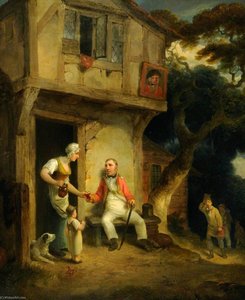
A Study in Restraint and Observation – Henry Singleton’s John Fuller
Henry Singleton's portrait of John Fuller, completed around 1830, stands as a testament to the Romantic era’s fascination with psychological realism. Executed on canvas using oil paint—a technique favored by artists of the time for its ability to capture subtle nuances of light and texture—the painting depicts Fuller seated in a chair, legs crossed, radiating an aura of contemplative calm. This image resides within the Royal Institution's collection, offering visitors a glimpse into Victorian intellectual life alongside artistic achievement.- Subject Matter: The portrait focuses on John Fuller (1757-1834), a prominent figure in British science and philosophy during his lifetime. Singleton skillfully portrays him as an individual engaged in quiet reflection, emphasizing intellect and dignity.
- Style & Technique: Singleton’s approach aligns closely with the tonalist movement—a reaction against the flamboyant styles of earlier Romantic painters—prioritizing atmospheric effects over dramatic poses. The muted palette—dominated by browns, creams, and subtle greens—creates a sense of serenity and reinforces Fuller's contemplative demeanor.
- Composition: Singleton employs a balanced composition, placing Fuller centrally within the frame while utilizing flanking chairs to provide visual stability. The inclusion of a book in Fuller’s hand symbolizes his scholarly pursuits and intellectual engagement.
- Symbolism: The crossed legs symbolize composure and control—qualities associated with intellect and philosophical contemplation.
- Emotional Impact: Singleton's masterful use of tonal shading evokes a feeling of quiet introspection, inviting viewers to contemplate Fuller’s inner life and intellectual pursuits.
Questions & Answers
What is the dominant color of "John Fuller" by Henry Singleton?
quinacridone magenta (#775d4c) is the leading color of "John Fuller" by Henry Singleton.
Which print setup is suggested for "John Fuller" by Henry Singleton?
For "John Fuller", the recommended print setup is a large size and a portrait orientation.
Is "John Fuller" a famous Atmospheric Impressionism artwork?
Within the Atmospheric Impressionism movement, "John Fuller" has a recognized popularity level.
Related Artworks


Artist Biography
The Legacy of a Master Miniature and Portraitist
Born into the vibrant artistic tapestry of London in 1766, Henry Singleton was destined for a life defined by the brush and the palette. His early years were shaped by a profound familial connection to the arts; following the untimely loss of his father when he was just an infant, Singleton was raised under the watchful eye of his uncle, William Singleton. This mentorship provided more than just familial stability; it offered a direct lineage to the prestigious traditions of English miniature painting, having been trained under the esteemed Ozias Humphry. Growing up in an environment where art was the primary language—surrounded by uncles and sisters who were all recognized exhibitors at the Royal Academy—Singleton’s development was an organic progression of inherited skill and burgeoning individual talent.
As a young man, Singleton demonstrated a precocious command over both scale and subject. His formal education at the Royal Academy Schools began in his late teens, and by 1784, he had already secured the silver medal, signaling his arrival as a formidable talent. The pinnacle of his early academic recognition came in 1788, when his ambitious painting depicting John Dryden’s Alexander’s Feast earned him the prestigious gold medal. This achievement highlighted a period in his career where he sought to transcend the delicate confines of miniature work to tackle grand, sweeping historical and scriptural compositions. His ability to weave complex narratives from the Bible, Shakespeare, and contemporary history allowed him to command attention on the large-scale canvases demanded by the era's most significant institutions.
A Career of Enduring Presence
While his early ambitions leaned toward the monumental, Singleton’s professional journey was marked by a remarkable versatility that ensured his longevity in the competitive London art scene. He became a fixture of the Royal Academy, exhibiting approximately 300 works between 1784 and 1839. There is a poignant irony in his storied career: despite being commissioned by the Royal Academy in 1793 to paint a massive group portrait of forty academicians, he never attained the formal status of a member or an associate himself. Nevertheless, his presence was so constant and his skill so respected that he eventually became the Royal Academy's oldest living exhibitor, a testament to a lifetime of unwavering dedication to his craft.
His repertoire was as diverse as it was technically proficient, spanning several distinct modes of painting:
- Portraiture: A mainstay of his career, where his ability to capture character and status made him a sought-after artist for the English elite.
- Miniatures: Carrying on the family tradition, these intimate works showcased his precision and delicate touch.
- Historical and Scriptural Works: Large-scale compositions that utilized dramatic lighting and narrative depth to explore religious and literary themes.
Beyond the Royal Academy, Singleton’s influence extended to the British Institution and the Society of British Artists, ensuring his work reached a broad spectrum of collectors and connoisseurs. His life came to a close in London in 1839, leaving behind a body of work that serves as a vital window into the aesthetic values of the late 18th and early 19th centuries. Through his portraits and historical scenes, Singleton captured not just the faces of his contemporaries, but the very spirit of an era defined by classical grandeur and the intimate beauty of the miniature.

Henry Singleton
1766 - 1839 , United States of America
Quick Facts
- Full Name: Henry Singleton
- Nationality: English
- Date Of Birth: 1766
- Date Of Death: 1839
- Place Of Birth: Texas, United States of America
- Notable Artworks:
- Paul I granting Liberty to Kosciuszko
- The Death of Captain Alexander Hood after capturing the French 74 L'Hercule
- Artistic Movement Or Style: Rococo
- Artists Who Influenced This Artist:
- Ozias Humphry
- Joseph Singleton
- Artists Or Movements Influenced By This Artist: ['Shakespeare']
Related Articles

Oil on Canvas: The Professional Guide to Durable, High-Quality Art Reproductions for Hospitality and Large-Scale Interior Projects
A professional guide for hotel designers and procurement managers on selecting durable, high-quality oil on canvas reproductions. Learn about material longevity, custom multi-panel layouts, and efficient bulk ordering solutions for large-scale hospitality projects.