Preview
 Send
Send Share
Share
 Details
 Guide
Guide

 Download
 Similars
 X-Ray
X-Ray Diaporama
 Stats
StatsMontrose
 1859
1859 113.0 x 186.0 cm
 Read More
Giclée / Art Print
Museum-quality giclée or canvas print with fast production and flexible finish options. ( Buy Hand Made Painting Switch to Digital Image)




































Pick from our preset sizes that match the artwork's original proportions.

Type the width and the height you need, to fit your frame or your wall. A print can only be cut, never made bigger than the picture, so a size with a different shape loses a part of the image. We send you a digital mockup to approve before we print anything. The picture shown on this page does not show the real cut — only the mockup does.
Worldwide Delivery () in 2 weeks instead of standard 4/5 weeks. (24 October)

Free Worldwide Express Shipping

High-Quality Linen Canvas

Full Shipping Insurance

Customs Tax Refund Guarantee

True Color Matching Guarantee

100-Day Return Policy (Defects Only)

100% Money-Back Guarantee

Bulk Discount Offer
 Glass option is only available in size under 110 CM

Montrose
Giclée / Art Print
Reproduction Size
-


Total Price
$ 65
Historical Significance
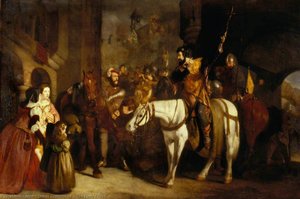
The painting depicts a lively scene with people gathered around a horse-drawn carriage, showcasing the excitement and anticipation of the crowd. The use of colors and composition creates a sense of energy and movement, drawing the viewer's eye to the center of the image. This painting is not only a beautiful work of art but also provides a glimpse into the history and culture of Scotland during the 19th century. Key Elements of the painting include the prominent horse near the center, the flags held by some individuals, and the handbags carried by others. These details add to the overall sense of excitement and bustle in the scene. For more information on James Drummond and his works, visit /art/list/?Filter=AS83Y7-James-Drummond-Montrose.Scottish Culture and Art
The National Galleries of Scotland is home to a vast collection of artworks, including paintings by other notable Scottish artists such as Colvin Smith and John Watson Gordon. Their works can be found at /art/list/?Filter=AQVFMH-Colvin-Smith-Alexander-Cowan-(1775-1859)-Paper-Maker-and-Philanthropist and /art/list/?Filter=AQUCCM-John-Watson-Gordon-Thomas-de-Quincey-(1785-1859)-Author-and-Essayist. For more information on Scottish culture and the significance of tartan, visit https://en.wikipedia.org/wiki/Tartan.Some notable points about the painting and its context include:
- The use of oil on canvas as a medium, which was common during the 19th century.
- The depiction of everyday life in Scotland during that time period.
- The cultural significance of the National Galleries of Scotland in preserving and showcasing Scottish art.
Questions & Answers
Where can I find a guide to "Montrose"?
The Guide page of "Montrose" by James Drummond offers a printable two-sheet factsheet: the artwork with its identity table, a decade band placing it in the artist's lifetime, other works by the artist, the measured color palette, and ready-to-copy citations in four styles.
What is the color identity of "Montrose" by James Drummond?
"Montrose" by James Drummond uses an earthy palette, with walnut (#674a33) as the dominant color.
At what age did James Drummond make "Montrose"?
James Drummond made "Montrose" at the age of 43. The artist was born in 1816 and the work is dated 1859.
Related Artworks


Artist Biography
A Legacy Forged in Edinburgh
Born into the noble traditions of Edinburgh in 1816, James Drummond was a man whose very existence was intertwined with the historical fabric of Scotland. His journey began at the prestigious Trustees Academy, where he studied under the watchful eye of Sir William Allan. This classical apprenticeship instilled in him a profound respect for meticulous detail and the mastery of traditional technique, yet Drummond’s spirit was far from static.He possessed a Romantic soul that sought to breathe life into the past, transforming historical records into vibrant, emotional tapestries. His lineage provided more than just social standing; it offered a deep-seated reverence for heritage that would become the heartbeat of his entire artistic oeuvre. Through his eyes, the shadows of the past were not merely memories but living, breathing entities waiting to be rediscovered through the stroke of a brush.
The Intersection of Light and History
Beyond the canvas, Drummond was a pioneer of visual documentation, finding an unexpected ally in the burgeoning medium of photography. Around 1843, his collaboration with the legendary Hill & Adamson allowed him to explore the ephemeral beauty of the Scottish landscape and the architectural grandeur of Edinburgh through a new lens. This fascination with capturing the fleeting moment complemented his scholarly pursuits as a dedicated member of the Society of Antiquaries of Scotland.Whether through the silver nitrate of early photography or the rich oils of his paintings, Drummond was obsessed with the preservation of culture. His work often functioned as a bridge between the documented reality of his era and the imagined grandeur of centuries prior, creating a seamless narrative of Scottish identity that blended scientific observation with profound artistic intuition.
Masterpieces of Romantic Drama
The true essence of Drummond’s genius lies in his ability to reconstruct history with unparalleled dramatic fervor. He did not merely paint events; he staged them. In works such as The Return of Mary Queen of Scots to Edinburgh, the viewer is thrust into the celebratory tension of 1561, where the textures of silk and velvet are rendered with breathtaking precision. His canvases pulsate with an energy that captures the emotional intensity of political upheaval and conflict, from the harrowing The Porteous Mob to the monumental Battle of the Nile.As the curator of the National Gallery of Scotland from 1868 to 1877, his influence extended far beyond his own brushstrokes, shaping the very institution that preserves the nation's visual soul. His legacy remains a testament to the power of art to act as a living, breathing chronicle of a people’s triumphs and tragedies, ensuring that the monumental moments of Scottish history are never truly lost to time.

James Drummond
1816 - 1877 , United Kingdom
Quick Facts
- Full Name: James Drummond RSA FSA
- Nationality: British
- Date Of Birth: 1816
- Date Of Death: 1877
- Place Of Birth: Edinburgh, United Kingdom
- Notable Artworks:
- Montrose
- George Wishart on His Way to Execution
- Artistic Movement Or Style: Romanticism
- Artists Who Influenced This Artist: ['William Allan']
- Artists Or Movements Influenced By This Artist: ['Baroque']