


 Preview
 Send
Send Share
Share
 Details
 Guide
Guide

 Download
 Similars
 X-Ray
X-Ray Diaporama
 Q&A
Q&A Stats
StatsMasks Fighting over a Hanged Man

 Read More
Giclée / Art Print
Museum-quality giclée or canvas print with fast production and flexible finish options. ( Buy Hand Made Painting Switch to Digital Image)




P118B $10

P118H $10

P118W $10

P438Z $10

P508JH $12

P508YH $12

P805H $10

P805Z $10

P919BZ $10

P919G $10

P919XJ $10

P959ZH $10

P968JZ $12

W106C $8

W218G $10

W218JH $8

W218Y $10

W307PJ $10

W316G $10

W316PJ $8

W316Y $10

W398PJ $8

W4111J $10

W500HY $15

W500JH $15

W692G $12

W849H $8

W940BG $15

W953PJ $8




Pick from our preset sizes that match the artwork's original proportions.

Type the width and the height you need, to fit your frame or your wall. A print can only be cut, never made bigger than the picture, so a size with a different shape loses a part of the image. We send you a digital mockup to approve before we print anything. The picture shown on this page does not show the real cut — only the mockup does.
Worldwide Delivery () in 2 weeks instead of standard 4/5 weeks. (10 November)

Free Worldwide Express Shipping

High-Quality Linen Canvas

Full Shipping Insurance

Customs Tax Refund Guarantee

True Color Matching Guarantee

100-Day Return Policy (Defects Only)

100% Money-Back Guarantee

Bulk Discount Offer
 Glass option is only available in size under 110 CM

Masks Fighting over a Hanged Man
Giclée / Art Print
Reproduction Size
-


Total Price
$ 65
A Descent into Darkness: Exploring James Ensor’s Masks Fighting Over a Hanged Man
James Ensor's “Masks Fighting Over a Hanged Man” isn’t merely a painting; it’s an unsettling plunge into the subconscious, a visual embodiment of anxiety and confrontation that cemented Ensor’s place as one of Expressionism’s most distinctive voices. Created in 1893, this monumental canvas transcends simple representation, opting instead for a deliberately distorted perspective to convey a profound psychological drama. The artist meticulously crafted his vision using oil on canvas, employing thick impasto—a technique characterized by heavily textured paint—to heighten the sense of physicality and emotional intensity. This textural richness mirrors the turbulent energy of the scene itself, mirroring the struggle between figures locked in a desperate battle for dominance.- Subject Matter: The artwork depicts a chaotic tableau featuring several masked individuals engaged in violent conflict over the corpse of a hanged man. The figure hanging prominently dominates the composition, symbolizing death and judgment – a motif frequently explored by Ensor throughout his career.
- Style & Technique: Ensor’s Expressionist style prioritizes emotional impact above realistic depiction. Bold colors—primarily reds, yellows, and blacks—are juxtaposed to create jarring visual contrasts that amplify the painting's unsettling atmosphere. The distorted figures and exaggerated poses contribute to a feeling of unease and disorientation, mirroring the psychological turmoil experienced by the subjects.
Historical Context: Expressionism’s Roots in Angst and Uncertainty
“Masks Fighting Over a Hanged Man” emerged during a period of significant social and intellectual upheaval—the late 19th century—marked by anxieties surrounding industrialization, urbanization, and the decline of traditional values. Expressionist artists like Ensor reacted against Impressionism’s focus on capturing fleeting moments of beauty, instead delving into darker themes and exploring the inner workings of human emotion. Influenced by thinkers such as Nietzsche and Freud, Expressionists sought to depict the irrational forces shaping human experience, mirroring the anxieties prevalent in society at the time. The painting reflects a broader cultural preoccupation with mortality and the confrontation between humanity and its own demons.Symbolism: Masks, Death, and the Struggle for Control
The pervasive use of masks throughout “Masks Fighting Over a Hanged Man” is laden with symbolic significance. Masks represent concealment, deception, and the suppression of identity—themes central to Ensor’s artistic vision. They underscore the idea that appearances can be misleading and that individuals often hide their true selves beneath layers of social convention. The hanged man himself embodies death, but also represents judgment and sacrifice – concepts explored extensively in religious iconography. Furthermore, the violent struggle between the figures symbolizes the inherent conflict within human nature—the battle for dominance waged both internally and externally.Emotional Impact: A Portrait of Psychological Turmoil
“Masks Fighting Over a Hanged Man” commands attention not merely through its visual dynamism but also through its profound emotional resonance. Ensor’s masterful manipulation of color and form compels the viewer to confront uncomfortable truths about human existence—fear, aggression, and despair. The painting's unsettling atmosphere lingers long after viewing, prompting contemplation on themes of mortality, guilt, and the inescapable burden of consciousness. It serves as a powerful reminder that art can transcend mere representation, achieving instead an uncanny ability to evoke visceral feelings and provoke introspection.Questions & Answers
Can I order an oil reproduction of "Masks Fighting over a Hanged Man"?
Hand-painted copies of "Masks Fighting over a Hanged Man" by James Ensor are sold on this website: a hand-painted oil reproduction on linen canvas, ordered from its Hand-Painted Reproduction page.
What size and orientation are recommended for a print of "Masks Fighting over a Hanged Man" by James Ensor?
large size, landscape orientation: that is the print setup suggested for "Masks Fighting over a Hanged Man" by James Ensor.
What is "Masks Fighting over a Hanged Man" about?
The themes present in "Masks Fighting over a Hanged Man" by James Ensor include masks, conflict, death, carnival, psychological, distortion, symbolism. Together they summarize the artwork's subject matter.
Related Artworks


Artist Biography
Early Life, Family and Artistic Training
James Ensor was born on April 13, 1860, in Ostend, Belgium. His identity was shaped by a specific cultural intersection: his father, James Frederic Ensor, was born in Brussels to English parents, while his mother, Maria Catherina Haegheman, was Belgian. This dual heritage provided a foundation for a perspective that often sat outside the narrow confines of local tradition. Growing up, the artist lived within the walls of a souvenir shop operated by his parents in Ostend. This environment was not merely a place of residence but a repository of the strange and the ornamental. The shop was filled with shells, carnival masks, and peculiar objects that provided a visual vocabulary for his later work.
His formal education in art was a process of trial and error. Before entering the structured environment of the academy, he began his artistic training under two local painters. This early instruction provided the technical groundwork that he would later manipulate and distort. From 1877 to 1880, he attended the Académie Royale des Beaux-Arts in Brussels. Even within these academic walls, his interests remained distinct from the rigid expectations of the institution. He was not a student of the status quo; he was a student of the objects that surrounded him in Ostend.
The Evolution of His Artistic Style
Ensor’s early output lacked the psychological friction that defines his mature work. In pieces like Russian Music (1881) and The Drunkards (1883), he worked within a somber, realistic framework. These compositions relied on muted tones and traditional depictions of everyday life. They show an artist still tethered to the gravity of realism before his visual language underwent a radical shift. He eventually abandoned this restraint, opting instead for a palette that brightened significantly as his subject matter grew increasingly bizarre.
The shift toward the grotesque was driven by a specific fascination with the mask. He was drawn to the plastic forms and the intense colors of the carnival masks found in his family's souvenir shop. These objects were not mere props; they became central to his aesthetic. He integrated them into his still lifes to introduce a theatrical quality, using them to disrupt the domesticity of the scene. This move toward the irrational allowed him to move beyond simple representation into a space of psychological tension.
- The Scandalized Masks (1883)
- The Oyster Eater (1882/1883)
- The Man of Sorrows (1891)
Key Works and Major Themes
Ensor’s preoccupation with the mask and the grotesque provides a direct link to the psychological tensions of the modern era. In The Scandalized Masks (1883), he established an early interest in the power of disguise, using the carnival motif to strip away social pretenses. This fascination with the theatrical and the unsettling was not a mere stylistic choice but a method of exploring identity. His 1882 work The Oyster Eater demonstrates a different facet of his ability to handle light and color, depicting his sister Mitche in a scene that challenged the conservative sensibilities of the Antwerp Salon. The painting’s rejection by the establishment highlights the friction between his vision and the rigid norms of the time.
The artist’s shift toward more aggressive, expressive forms is most evident in his monumental compositions. Christ's Entry Into Brussels (1888-1889) functions as a forerunner of twentieth-century Expressionism, utilizing a chaotic, brightly-colored procession of grotesque figures to parody modern society. This sense of existential struggle is furthered in The Man of Sorrows (1891), an oil painting that combines the suffering of Christ with the jarring imagery of a Japanese Noh theatre mask. Such works reveal a man using religious and allegorical themes to express a profound frustration with human behavior and societal indifference.
Mortality and the absurdity of existence remain central to his output. Skeletons Fighting over a Hanged Man (1891) uses skeletal figures to confront the viewer with the reality of decay and death. These recurring themes of sin, temptation, and the fragility of appearances ensure his work remains a potent subject for study. His ability to synthesize these dark, often uncomfortable truths into a coherent visual language is what defines his contribution to the transition toward modernism.
Where to See His Works Today
Ensor’s presence in major international collections confirms his lasting impact on the development of modernism. In Antwerp, the Royal Museum of Fine Arts holds two significant works: The Man of Sorrows and The Oyster Eater. These pieces demonstrate the technical range of an artist who could move from religious tension to domestic scenes. His influence extends across the Atlantic, where the Museum of Modern Art in New York City preserves Tribulations of Saint Anthony. This work remains a primary example of his shift toward the bizarre and the psychological.
The reach of his imagery is global. The Getty Center in Los Angeles houses Entry of Christ into Brussels, a massive composition that captures his most aggressive social critiques. Meanwhile, the Kimbell Art Museum in Fort Worth maintains Skeletons Warming Themselves. These scattered locations ensure that his visual language, defined by its refusal to adhere to academic norms, remains accessible to a diverse audience of scholars and observers.
- The Man of Sorrows
- The Oyster Eater
- Tribulations of Saint Anthony
- Entry of Christ into Brussels
- Skeletons Warming Themselves
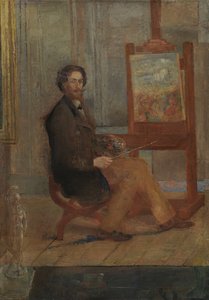
James Ensor
1860 - 1949 , Belgium
Quick Facts
- Artistic Movement Or Style:
- Symbolism
- Expressionism
- Artists Or Movements Influenced By This Artist:
- Expressionism
- Surrealism
- Artists Who Influenced This Artist:
- Pieter Bruegel the Elder
- Francisco Goya
- James Abbott McNeill Whistler
- Full Name: James Sidney Edouard Ensor
- Nationality: Belgian
- Notable Artworks:
- Christ's Entry into Brussels
- The Man of Sorrows
- The Oyster Eater
- Tribulations of Saint Anthony
- Skeletons Fighting over a Hanged Man
- Place Of Birth: Ostend, Belgium
- Date Of Birth: 1860
- Date Of Death: 1949
Related Articles

James Ensor's Grotesque Visions: Social Commentary & Artistic Innovation
Explore the unsettling yet captivating world of James Ensor, a pioneer of Expressionism. Discover his satirical masterpieces, symbolic imagery & lasting influence on modern art. High-quality reproductions available at AllPaintingsStore.
Figurative Expressionism: Emotional Intensity & Subjective Reality in 20th-Century Art
Explore the powerful world of Figurative Expressionism with AllPaintingsStore. Discover key artists like Kirchner & Beckmann, understand its emotional depth, and learn how to collect this influential 20th-century art movement.
Unveiling the Mystery: A Journey Through the World's Most Iconic Mask Artworks
Embark on a profound journey through the world's most iconic mask artworks. Explore the spiritual depth, intricate craftsmanship, and rich cultural heritage of global traditions, from Chhau to Gomira, in this expert-led exploration of ancestral artistry and symbolic beauty.

Masterpieces of the English Countryside: Top 25 Sir Alfred James Munnings Artworks
Explore 25 iconic Sir Alfred James Munnings masterpieces. Discover timeless equine art on AllPaintingsStore.com.
Whistler's Masterpieces: Explore 25 Iconic Paintings & Aesthetic Art for Your Home
Journey through 25 iconic James Abbott McNeill Whistler paintings! Explore his masterpieces of Aestheticism, from 'Nocturne in Black and Gold' to captivating portraits. Find museum-quality art reproductions & elevate your home decor with AllPaintingsStore.com. Discover the full collection online.


