


 Preview
 Send
Send Share
Share
 Details
 Guide
Guide

 Download
 Similars
 X-Ray
X-Ray Diaporama
 Stats
StatsNature morte au geranium

 Read More
Purchase a high-resolution, enhanced digital image, far superior to the online preview.
Each file is meticulously prepared by our in-house specialists using advanced tools and expert manual retouching. We ensure every image has exceptional clarity, precise color accuracy, and fine detail.
The final file is delivered via email within 72 hours, optimized for immediate use in professional, editorial, and print environments. This is the same quality trusted by top-tier design studios, publishers, and galleries.
Digital Image
Download a high-resolution file for personal display, printing, and creative projects. ( Switch to Print Buy Hand Made Painting)
Included in Every Digital Image Order
Expert Digital Delivery, Guaranteed
When you choose AllPaintingsStore.com, you're not just getting an image - you're receiving a professionally enhanced digital artwork, crafted with precision and backed by a satisfaction guarantee. Here's everything that comes with your order, automatically:

Fast Email Delivery
Your high-resolution digital image file will be emailed to you within 72 hours of ordering - ready for immediate use.

AI-Enhanced Digital File
Your artwork is professionally optimized using advanced AI tools and manual editing, ensuring maximum detail, clarity, and color accuracy.

Free Lifetime Re-Delivery
Accidentally deleted or lost your file? No worries - we'll resend it to you anytime, free of charge.

No Import Fees - Ever
Enjoy your artwork instantly with zero customs, duties, or delivery fees - digital downloads are always tax-free.

Color Accuracy Guarantee
We ensure your digital image reflects the original colors as closely as possible using professional tools and color management.

100-Day Satisfaction Guarantee
If you're not satisfied with your digital image, we'll revise it or refund 100% within 100 days - no questions asked.

100% Money-Back Guarantee
Not satisfied? Get a full refund within 100 days of receiving your digital file - no questions asked.

Bulk Order Discounts
Buy 3 images, save 10% - Buy 5, save 15% - Buy 10+, save 20%. Great for creative projects, galleries, and agencies.
A World Within Vases: James Ensor’s *Nature Morte au Geranium*
James Ensor's Nature Morte au Geranium isn’t merely a still life; it’s a carefully constructed portal into the artist’s uniquely unsettling and profoundly personal world. Painted in the early 20th century, this oil on canvas offers a glimpse into the mind of a Belgian painter who relentlessly challenged artistic conventions, forging his own path through a landscape of masks, shadows, and an almost palpable sense of unease. The painting immediately draws the eye with its vibrant yet deliberately discordant arrangement – a red geranium boldly asserting itself against a backdrop of muted greens and browns, punctuated by the cool blues and whites of porcelain vases and bottles. It’s a scene both familiar and profoundly strange, hinting at a deeper narrative beyond the simple depiction of floral arrangements.
Expressionist Roots: Color, Form, and Emotional Resonance
Ensor's style firmly places Nature Morte au Geranium within the burgeoning Expressionist movement. Rejecting the objective representation favored by earlier artistic traditions, Ensor prioritized conveying emotion and psychological states through distorted forms, jarring colors, and a deliberate manipulation of space. Notice the thick, impasto brushstrokes – not used to smoothly blend colors but rather to build texture and emphasize the physicality of each object. The bold reds and yellows are intensified, almost vibrating with an inner energy, while the surrounding tones remain deliberately subdued, creating a visual tension that mirrors the emotional complexity within the painting. This isn’t about capturing beauty in a traditional sense; it's about revealing something raw and perhaps uncomfortable beneath the surface.
Symbolism of Decay and Renewal
The specific elements within the composition are laden with symbolic weight. The geranium, often associated with remembrance and mourning, sits alongside the vases – vessels that can represent both life-giving potential and the fragility of existence. The inclusion of two bottles, one positioned between the left plant and a large vase, adds an element of mystery and perhaps even a suggestion of intoxication or altered perception. The arrangement itself feels poised on the edge of decay and renewal; the vibrant flowers juxtaposed with the muted tones create a visual dialogue about the transient nature of beauty and life. Ensor’s use of light is particularly effective in this regard, casting dramatic shadows that heighten the sense of drama and uncertainty.
A Belgian Visionary: Context and Legacy
Understanding James Ensor requires acknowledging his unique biography and artistic context. Born in Ostend, a port city steeped in maritime history and cultural exchange, Ensor’s upbringing profoundly shaped his artistic sensibility. His father's souvenir shop, overflowing with exotic objects and theatrical masks, provided an early immersion into the world of disguise and performance – themes that would become central to his work. While initially hesitant to embrace academic training, Ensor ultimately found himself drawn to Brussels’ Académie Royale des Beaux-Arts, but quickly recognized its limitations. He sought a more expressive and personal approach, one that allowed him to explore the darker corners of human experience. His legacy extends beyond this single painting; it resides in his fearless experimentation with form, color, and subject matter – a testament to an artist who refused to be confined by convention.
Bringing *Nature Morte au Geranium* Home
AllPaintingsStore offers meticulously crafted hand-painted reproductions of James Ensor’s Nature Morte au Geranium , allowing you to experience the power and emotional depth of this iconic artwork in your own space. These reproductions capture not only the visual details but also the artist's distinctive brushwork and evocative atmosphere. Whether adorning a gallery wall or adding a touch of unsettling beauty to an interior design scheme, a reproduction of this painting is a captivating addition for art lovers, collectors, and anyone seeking a piece that transcends mere decoration – it’s a window into the soul of a truly original artist.
Questions & Answers
What is the perceived brightness of "Nature morte au geranium" by James Ensor?
In terms of perceived brightness, "Nature morte au geranium" by James Ensor is balanced.
Where should a reproduction of "Nature morte au geranium" by James Ensor be hung?
The square format of "Nature morte au geranium" by James Ensor is recommended for a living room. Format and space together guide the placement of a reproduction.
Where can I buy a digital image of "Nature morte au geranium" by James Ensor?
To get a digital file of "Nature morte au geranium" by James Ensor, order a high-resolution digital image download on its Digital Image page.
Related Artworks


Artist Biography
A Life Immersed in Masks and Shadows: The World of James Ensor
Born in Ostend, Belgium, in 1860, James Sidney Edouard Ensor emerged from a fascinating confluence of cultures—his father English, his mother Belgian. This duality perhaps foreshadowed the artist’s lifelong fascination with masks and disguise, themes that would come to dominate his unsettling yet captivating oeuvre. Growing up amidst the bustling energy of a seaside resort town, young James was deeply affected by the atmosphere of carnivals and curiosities. His parents operated a souvenir shop brimming with shells, carnival masks, and peculiar objects—a veritable cabinet of wonders that ignited his imagination and provided a rich visual vocabulary for his future art. Though initially hesitant to embrace traditional academic pursuits, Ensor eventually enrolled at the Académie Royale des Beaux-Arts in Brussels, but found its rigid structure stifling to his burgeoning artistic vision. He quickly realized he needed to forge his own path, one that would lead him far beyond conventional boundaries.
From Somber Realism to Grotesque Visions
Ensor’s early paintings reflected a more traditional approach, depicting scenes of everyday life rendered in somber tones. Works like *Russian Music* (1881) and *The Drunkards* (1883) reveal a nascent talent grappling with realism, but even within these early pieces, hints of the unsettling imagery to come are present. A pivotal shift occurred as Ensor’s palette brightened and his subject matter grew increasingly bizarre. He began to populate his canvases with carnivals, skeletons, puppets, and allegorical figures—a world steeped in fantasy and often bordering on the grotesque. This wasn't merely a stylistic change; it was a deliberate exploration of the darker aspects of human existence, a rejection of societal norms, and an embrace of the irrational. His style became instantly recognizable for its bold brushwork, vibrant colors, and theatrical quality—a visual language uniquely his own. The influence of his childhood surroundings is undeniable: those carnival masks weren’t simply decorative elements; they were symbols of hidden identities, social critique, and the fragility of appearances.
Masterpieces of Disquiet: Key Works and Recurring Themes
Throughout his career, Ensor produced a series of works that continue to shock and fascinate audiences today. *The Scandalized Masks* (1883) stands as an early testament to his fascination with the power of disguise and its ability to reveal hidden emotions. Perhaps his most controversial work, *Christ's Entry into Brussels* (1888-1889), remains a powerful satire of religious hypocrisy and societal indifference—a painting initially met with harsh criticism but now celebrated as a masterpiece. The unsettling image of Christ entering a city teeming with grotesque masked figures is a potent commentary on the disconnect between spiritual ideals and human behavior. *Skeletons Fighting over a Hanged Man* (1891) offers a stark meditation on mortality, decay, and the absurdity of life, while *Tribulations of Saint Anthony* (1887) delves into complex allegorical themes of temptation, sin, and spiritual struggle. Recurring throughout his work are explorations of death, social critique, religious satire, and the boundless power of imagination—themes that resonate with a timeless relevance.
A Pioneer of Modernism: Influences and Legacy
While Ensor resisted easy categorization, his artistic lineage is complex and fascinating. He acknowledged influences from masters like Pieter Bruegel the Elder, whose crowded scenes and moralizing narratives resonated with his own vision, as well as Francisco Goya, whose dark humor and unflinching depictions of human suffering left a lasting impression. James Abbott McNeill Whistler’s emphasis on aestheticism also played a role in shaping Ensor's artistic sensibilities. However, Ensor was not merely an imitator; he synthesized these influences into something entirely new and original. He is now widely recognized as a pivotal figure in the transition from 19th-century Symbolism to early 20th-century Expressionism and Surrealism—a true pioneer of modern art. His fearless exploration of the subconscious, his embrace of grotesque imagery, and his rejection of academic conventions paved the way for future generations of artists who dared to challenge artistic norms. Despite facing initial resistance, Ensor eventually gained recognition in his later years, being named a Baron by King Albert I in 1929 and awarded the Légion d'honneur in 1933. He died in Ostend in 1949, leaving behind a body of work that continues to captivate, disturb, and inspire. His legacy endures as a testament to the power of art to confront uncomfortable truths and explore the depths of the human condition.
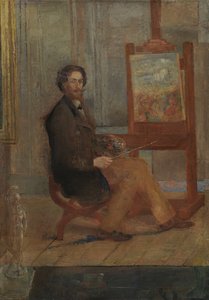
James Ensor
1860 - 1949 , Belgium
Quick Facts
- Artistic Movement Or Style:
- Symbolism
- Expressionism
- Surrealism
- Artists Or Movements Influenced By This Artist:
- Expressionism
- Surrealism
- Artists Who Influenced This Artist:
- Pieter Bruegel the Elder
- Francisco Goya
- James Abbott McNeill Whistler
- Full Name: James Sidney Edouard Ensor
- Nationality: Belgian
- Notable Artworks:
- Christ's Entry into Brussels
- The Man of Sorrows
- The Oyster Eater
- Skeletons Fighting over a Hanged Man
- Place Of Birth: Ostend, Belgium
- Date Of Birth: 1860
- Date Of Death: 1949

