Money-Back Guarantee · 100 days Free Worldwide Delivery
449,587artworks 30,613artists 4,660museums 32languages
Currency
    Language
      Atelier · Est. 2015 · Paris, France
      AllPaintingsStore
      allpaintingsstore.com
      Catalogue entry

      The Annunciation

      1440. Oil On Canvas. Thyssen-Bornemisza Museum.

      Fig. 1. Jan van Eyck, The Annunciation, 1440. Shown as the reproduction you are specifying: , .

      § 1Catalogue data

      § 2Abstract

      Collectible Description

      The use of perspective and naturalism is particularly noteworthy in this piece.

      Artist Biography

      A pioneer of Early Netherlandish painting and the Arnolfini Portrait. Discover his revolutionary oil techniques and masterpieces today.

      § 3Commentary

      A Moment Frozen in Time: The Profound Beauty of Van Eyck’s “The Annunciation”

      Jan van Eyck's "The Annunciation," painted around 1440, isn’t merely a depiction of a biblical narrative; it’s an exquisitely crafted window into the burgeoning world of Early Netherlandish art and a testament to the artist’s revolutionary techniques. This painting, now largely lost to history but meticulously reconstructed through surviving details and stylistic analysis, captures a pivotal moment – the Archangel Gabriel announcing to Mary that she will conceive and bear the son of God. It's a scene brimming with quiet reverence, meticulous detail, and an almost palpable sense of divine presence, qualities that continue to resonate powerfully with viewers centuries later.

      Van Eyck’s genius lay not just in his skill with pigment but in his pioneering use of oil paint. Unlike the tempera paints favored by many of his contemporaries, oil allowed for a level of layering and blending previously unimaginable. This enabled him to achieve an astonishing luminosity – a shimmering quality that seems to emanate from within the painted surfaces. The meticulous rendering of textures, from the velvet drapery to the delicate folds of Mary’s garments, is a direct consequence of this technique. Notice how light catches on the fabrics, creating a sense of depth and realism rarely seen in art of that era. The use of glazing – applying thin layers of translucent paint over dried underlayers – further enhances this effect, building up color and form with breathtaking subtlety.

      The Language of Symbols: Decoding the Visual Narrative

      “The Annunciation” is a rich tapestry of symbolism, each element carefully chosen to convey theological meaning. The two angels, positioned on either side of the composition, represent divine messengers – one pointing towards heaven and the other gesturing towards Mary. Their crossed arms, holding miniature crosses, symbolize Christ’s sacrifice and the promise of salvation. The birds, a dove above the left angel and a lark near the right, are traditional symbols of the Holy Spirit and prophecy respectively. The inclusion of a skull beneath the lilies – a common motif in Northern European art – subtly alludes to mortality and the necessity of faith.

      Mary’s pose is particularly significant. She kneels in prayer, her hands clasped together in a gesture of humility and receptivity. Her expression is one of serene contemplation, reflecting on the momentous announcement she has just received. The architectural setting – a simple room with a window offering a glimpse of the outside world – grounds the scene in reality while simultaneously elevating it to a realm of spiritual significance. The careful placement of objects within the room, such as the book and the small table, further reinforces the narrative and adds layers of symbolic meaning.

      A Window into a World Transformed: Historical Context

      Painted around 1440, “The Annunciation” emerges from a period of immense artistic innovation in Flanders. Jan van Eyck was not merely an artist; he was a polymath – a skilled goldsmith, armourer, and instrument maker as well as a painter. This diverse skillset undoubtedly informed his approach to art, fostering a meticulous attention to detail and a deep understanding of materials. The painting reflects the growing wealth and sophistication of Bruges, a major trading center at the time, which provided a fertile ground for artistic patronage.

      Furthermore, Van Eyck’s work represents a crucial turning point in the history of art. His mastery of oil paint laid the foundation for subsequent generations of artists, influencing the development of Renaissance painting and beyond. “The Annunciation” is therefore not just a beautiful devotional image; it's a pivotal document in the evolution of Western art, demonstrating a radical shift in technique and artistic vision.

      Bringing “The Annunciation” Home: A Reproduction for Today

      AllPaintingsStore offers meticulously crafted hand-painted reproductions of Jan van Eyck’s "The Annunciation," capturing the essence of this iconic masterpiece with unparalleled accuracy and artistry. Our skilled artisans utilize traditional techniques, mirroring Van Eyck's revolutionary approach to oil paint, to faithfully recreate every detail – from the shimmering textures to the subtle nuances of color.

      • Authentic Reproduction: Each reproduction is created by hand using archival-quality pigments and canvas, ensuring lasting beauty and vibrancy.
      • Museum-Quality Detail: We meticulously replicate Van Eyck’s intricate details, capturing the luminosity and depth of his original work.
      • Versatile Sizes & Materials: Available in a range of sizes and framed or unframed to suit your space and style.
      • A Timeless Masterpiece: Bring the profound beauty and spiritual significance of “The Annunciation” into your home – a testament to one of art history’s greatest innovators.

      Explore our collection today and discover the perfect reproduction to enrich your interior space with a touch of artistic brilliance.

      Questions & Answers

      What aliases or alternate names does Jan van Eyck have?

      Jan van Eyck appears under the alternate names Hubert Van Eyck, Johannes De Eyck.

      Where does "The Annunciation" fall in Jan van Eyck's career?

      Within Jan van Eyck's career, "The Annunciation" falls in the Early Netherlandish. The phase helps compare it with the artist's other works.

      How does "The Annunciation" by Jan van Eyck connect Early Netherlandish Painting to the artist's home country?

      "The Annunciation" connects the Early Netherlandish Painting movement with Netherlands through its creator's birthplace.
      § 4The artist

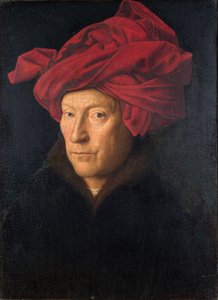
      Jan van Eyck

      Jan van Eyck

      1390 - 1441, Netherlands

      Quick facts about Jan van Eyck

      • Artistic Movement Or Style: Early Netherlandish painting
      • Artists Or Movements Influenced By This Artist:
        • Early Netherlandish painting
        • Generations of painters
      • Full Name: Jan van Eyck
      • Nationality: Flemish
      • Notable Artworks:
        • Ghent Altarpiece
        • Arnolfini Portrait
        • Dresden Triptych
        • Man in a Blue Turban
      • Place Of Birth: Maastricht, Netherlands
      • Date Of Birth: 1390
      • Date Of Death: 1441

      Artist Biography

      The Alchemist of Light

      To look at a Jan van Eyck painting is to witness the moment Western art stopped pretending and started observing. We often hear the myth that he invented oil paint, but the truth is more grounded and far more impressive: he mastered it. By applying thin, translucent glazes of pigment over one another, he achieved a depth of color and a precision of texture that tempera simply could not sustain. He did not just paint surfaces; he captured how light interacts with them. When you see the gleam of a single candle or the heavy weight of a velvet robe in his work, you are seeing the result of a technical revolution that changed the visual language of Europe.

      His career was built on more than just brushwork. Van Eyck operated within the high-stakes environment of the Burgundian court, serving Philip the Good. This position required him to be much more than a craftsman; he functioned as a diplomat, traveling to places like Portugal and Spain on official missions. This access to power provided the financial stability necessary for his technical experiments. He was a man of intellect and discretion, qualities that allowed him to move between the worlds of high politics and fine art with ease.

      The Precision of the Northern Eye

      The work of Van Eyck is defined by an almost obsessive attention to the minute details of the physical world. In his portraits, he does not merely record a face; he records the texture of skin, the individual strands of hair, and the specific way light hits a turban. This level of realism was driven by a shift in focus toward the individual and the tangible. His ability to render atmospheric perspective—the way distant landscapes soften into a blue haze—showed a sophisticated understanding of how the human eye perceives depth.

      His most significant technical achievements can be seen in several key works:

      • The Ghent Altarpiece: A massive twelve-panel polyptych that demonstrates his ability to manage complex religious symbolism alongside realistic figures.
      • The Arnolfini Portrait: A 1434 work where every object, from the dog representing fidelity to the discarded shoes on holy ground, carries specific weight. The mirror in the background reflects a whole other layer of reality.
      • Portrait of a Man (Self Portrait?): A 1433 oil painting that features his personal motto, "Als ich kan" (As well as I can), etched directly onto the frame.

      A Lasting Technical Standard

      The influence of Jan van Eyck is not found in a vague sense of inspiration, but in the concrete standards he set for the medium. He moved the needle from the matte, flat surfaces of the medieval era toward a luminous, three-dimensional reality. His signature, "JOHANNES DE EYCK," and his frequent use of his motto served as a direct challenge to his contemporaries. He was not interested in the anonymity common to many medieval painters; he wanted his technical prowess to be recognized and attributed.

      Even after his death in Bruges in 1441, the methods he perfected continued to dictate how artists approached light and texture for generations. His work remains a benchmark because it represents the successful marriage of scientific observation and artistic skill. He transformed pigments into something that feels alive, leaving behind a body of work that remains as sharp and clear today as it was in the fifteenth century.

      § 5Comparanda

      § 6Questions

      Quick Facts

      • Medium: Oil on wood
      • Artistic style: Realistic, detailed
      • Subject or theme: Annunciation event
      • Notable elements: Angels, birds, oil paint
      • Year: 1440

      Art Quiz

      There is only one correct answer for each question.

      Question 1:
      The Annunciation, painted by Jan van Eyck around 1440, is significant primarily for which reason?
      Question 2:
      What symbolic objects are prominently displayed by the angels in Jan van Eyck's 'The Annunciation'?
      Question 3:
      The presence of birds in 'The Annunciation' likely represents:
      Question 4:
      Jan van Eyck's innovative use of oil paint in 'The Annunciation' allowed him to achieve which characteristic?
      Question 5:
      Considering Jan van Eyck's background, where would he most likely have received his early artistic training?

      § 7Cite this entry

      AllPaintingsStore.com, “Jan van Eyck, The Annunciation (1440)”, https://allpaintingsstore.com/en/art/jan-van-eyck-the-annunciation-D3K6H7-en/ (accessed 2 October 2026).

      § 8The reproduction

      Hand Made Oil Reproduction

      Hand-painted oil on canvas in your size and frame, made to order by our artists. ( Switch to Print Switch to Digital Image)

      It is specified on the order sheet in the margin; the present state of that sheet reads as follows.

      The Annunciation

      Reproduction Medium

      Reproduction Size

      -

      Elite Senior Artist

      More detail, finesse, and extra production time

      -

      Reproduction Frame

      -

      -

      For artworks or reproductions larger than 105 cm (approximately 41 inches) on any side, the frame will be shipped as a kit, disassembled. This method ensures safe delivery and prevents damage during transport.

      Professional assembly required - this is not a DIY product.
      The kit must be assembled and the canvas stretched by an experienced professional framer, using wood glue (not supplied), a canvas stretching plier and clamps to hold the bars square while the glue dries. Incorrect assembly or uneven canvas tension can permanently damage the artwork and is not covered by our warranty.

      • All solid wood bars are included, precisely cut to size.

      • Assembled with the screws provided, plus wood glue for the corner joints, which is not supplied and must be sourced by your framer.

      • Professional tools are required and not included: a canvas stretching plier (tensioner) and clamps to hold the bars square while the glue dries.

      Important:
      The corner joints require wood glue, the bars must be held with clamps until the glue is fully dry, and tightening the canvas on the assembled frame requires a canvas stretching plier. None of these are included in the kit. Please arrange an experienced professional framer before ordering this size.

      Nameplate

      -

      -

      Protective Varnish

      Glossy Varnish (enhances colors, protects against light/moisture)

      -

      Customize My Artwork

      Examples of what can be changed: Replace face with customer photo; Add pet (e.g., replace cat with dog); Include hidden message in background; Change background landscape or elements.

      -

      Urgent

      Worldwide Delivery () in 3/4 weeks instead of standard 5 weeks. (30 October). No compromise on quality.

      -

      Express Shipping

      Worldwide Delivery () in 5 weeks. (6 November).

      Included

      Total Price

      $ 258

      Included with every order

      • Free Worldwide Express Shipping
      • High-Quality Linen Canvas
      • Full Shipping Insurance
      • Customs Tax Refund Guarantee
      • True Color Matching Guarantee
      • 100-Day Return Policy (Defects Only)
      • 100% Money-Back Guarantee
      • Bulk Discount Offer
      Order sheet