Preview
 Send
Send Share
Share
 Details
 Guide
Guide

 Download
 Similars
 X-Ray
X-Ray Diaporama
 Stats
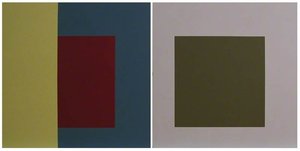
StatsStudy for 'Double Square'
 1992
1992 36.0 x 71.0 cm
 Chelsea College of Art
 Read More
The artwork displayed on this page is protected by copyright law, which means we cannot legally create or sell an identical reproduction. This protection is enforced under international agreements such as the Berne Convention and by national laws, including those outlined by the U.S. Copyright Law - Title 17.
This method fully complies with copyright regulations because it does not involve copying or duplicating the protected artwork. Instead, it is a creative reinterpretation - a new painting that is influenced by the original but not identical to it.
Giclée / Art Print
Museum-quality giclée or canvas print with fast production and flexible finish options. ( Buy Hand Made Painting Switch to Digital Image)




































Pick from our preset sizes that match the artwork's original proportions.

Type the width and the height you need, to fit your frame or your wall. A print can only be cut, never made bigger than the picture, so a size with a different shape loses a part of the image. We send you a digital mockup to approve before we print anything. The picture shown on this page does not show the real cut — only the mockup does.
Worldwide Delivery () in 2 weeks instead of standard 4/5 weeks. (27 October)

Free Worldwide Express Shipping

High-Quality Linen Canvas

Full Shipping Insurance

Customs Tax Refund Guarantee

True Color Matching Guarantee

100-Day Return Policy (Defects Only)

100% Money-Back Guarantee

Bulk Discount Offer
 Glass option is only available in size under 110 CM

Study for 'Double Square'
Giclée / Art Print
Reproduction Size
-


Total Price
$ 65
Related Artworks


Artist Biography
Jean Spencer: Bridging Mathematics and Emotion in Abstract Sculpture
Jean Spencer (1942-1998) remains a singular voice within the British Systems Group, an influential collective that championed abstraction as a vehicle for exploring fundamental concepts of geometry and perception. Born in Liverpool, Spencer’s artistic journey began with a fascination for both mathematics – specifically topology – and a deep sensitivity to visual form, a combination that would define her distinctive style and propel her to prominence on the international art scene.- Early Influences: Spencer's formative years were marked by exposure to Bauhaus principles and Constructivist aesthetics, particularly through the work of artists like Josef Albers and László Moholy-Nagy. These influences instilled in her a belief that artistic expression could be rigorously structured yet simultaneously imbued with emotional resonance.
- Systems Group Formation: In 1963, Spencer joined Systems Group alongside fellow sculptors John Moores and Peter Smithson, establishing a studio in Birkenhead. This collaborative endeavor fostered an environment of intellectual exchange and experimentation, where participants wrestled with challenging questions about representation and materiality.
Sculptural Exploration: Topology and Relief Forms
Spencer’s sculptural output centered on exploring topological concepts – specifically Klein bottles and Möbius strips – translating abstract mathematical ideas into tangible three-dimensional forms. Her sculptures eschewed traditional figurative approaches, prioritizing geometric precision alongside textural surfaces that invited tactile engagement. She meticulously crafted reliefs from materials like bronze and limestone, manipulating their contours to create mesmerizing patterns and illusions of movement. The resulting pieces are characterized by a remarkable balance between intellectual rigor and sensual beauty.- Notable Works: Among Spencer’s most celebrated sculptures include “The Spiral” (1968), a monumental bronze spiral that embodies the Group's fascination with recursive patterns, and “Continuum” (1970), a limestone relief depicting intersecting planes that captures the essence of topological transformation.
- Technique: Spencer’s sculptural technique involved painstaking carving and polishing processes, demanding considerable skill and patience. She employed sophisticated tools to achieve exceptional surface finishes, highlighting the interplay between light and shadow and enhancing the sculptures' visual impact.
Recognition and Legacy
Spencer’s work gained international acclaim through exhibitions at institutions such as Tate Modern and the John Moores University Art Gallery. Her inclusion in the 1968 John Moores Exhibition solidified her position as a leading figure in British abstract art, demonstrating the enduring relevance of Systems Group's conceptual framework.- Critical Acclaim: Critics lauded Spencer’s sculptures for their intellectual depth and aesthetic sophistication, praising her ability to synthesize mathematical precision with expressive visual language. Her oeuvre continues to inspire artists and scholars alike, serving as a testament to the transformative potential of interdisciplinary collaboration.
- Continuing Influence: Spencer's exploration of topology and relief forms has resonated across generations of sculptors, influencing contemporary artists who seek to grapple with complex geometric concepts while maintaining an emotional connection to their art.
Concluding Thoughts
Jean Spencer’s artistic legacy extends beyond her individual sculptures; it resides in the enduring spirit of Systems Group's commitment to pushing boundaries and redefining artistic conventions. Her work stands as a powerful reminder that profound beauty can emerge from rigorous intellectual inquiry, demonstrating the transformative power of merging mathematics and emotion into a singular creative vision.
Jean Spencer
1942 - 1998
Quick Facts
- Full Name: Jean Spencer
- Nationality: British
- Date Of Birth: 1942
- Date Of Death: 1998
- Artistic Movement Or Style: Systems Group abstraction