- Home

- Oil Painting Reproduction
- Joan Miró
- Painting

 Buy print
 Send
Send Share
Share
 Details

 Download
 Similars
 X-Ray
X-Ray Diaporama
Painting


 Read More
Hand Made Oil Reproduction
Hand-painted oil on canvas in your size and frame, made to order by our artists.




P118B $10

P118H $10

P118W $10

P438Z $10

P508JH $12

P508YH $12

P805H $10

P805Z $10

P919BZ $10

P919G $10

P919XJ $10

P959ZH $10

P968JZ $12

W106C $8

W218G $10

W218JH $8

W218Y $10

W307PJ $10

W316G $10

W316PJ $8

W316Y $10

W398PJ $8

W4111J $10

W500HY $15

W500JH $15

W692G $12

W849H $8

W940BG $15

W953PJ $8




Pick from our preset sizes that match the artwork's original proportions.

You may enter your own dimensions to fit a specific frame or space. If your selected size does not match the original image's proportions, we will either crop the artwork or extend the painting with additional hand-painted elements. A digital mockup will be sent for your approval before production begins.
Please note that the on-screen preview does not reflect the actual cropping or extension. Only the mockup will accurately show the final composition.
While custom sizes are available, we recommend selecting a dimension from the predefined list to preserve the original proportions.
After order, AllPaintingsStore.com team will email client for instructions and provide a mockup preview
Worldwide Delivery () in 3/4 weeks instead of standard 5 weeks. (16 July). No compromise on quality.

Free Worldwide Express Shipping

High-Quality Linen Canvas

Full Shipping Insurance

Customs Tax Refund Guarantee

True Color Matching Guarantee

60-Day Return Policy (Defects Only)

100% Money-Back Guarantee

Bulk Discount Offer
 Glass option is only available in size under 110 CM

Painting
Reproduction Medium
Reproduction Size
-


Total Price
-
Artwork Description
A Reflection Within Reflections: Joan Miró’s ‘Painting’ (1943)
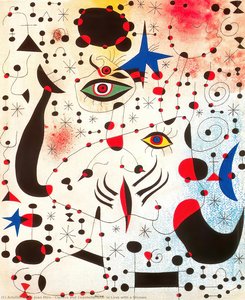
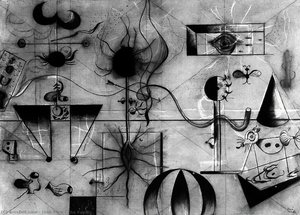
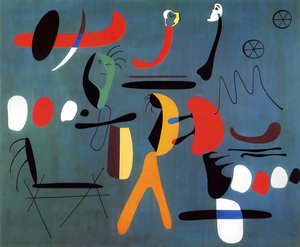
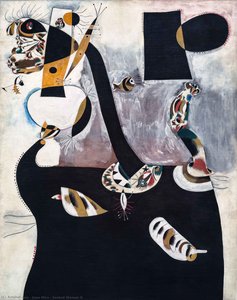
Joan Miró's “Painting,” created in 1943, is more than simply a depiction of a frame and its contents; it’s an intricate meditation on perception, memory, and the layered nature of artistic representation itself. This captivating work, rendered in a stark black and white palette, immediately draws the viewer into a world where boundaries blur and meaning shifts with every glance. The image presents a painting within a picture frame, a classic motif that Miró masterfully exploits to create a sense of infinite regression – an invitation to question what is ‘real’ and what is merely a constructed illusion.
- Subject Matter: At the heart of this piece lies a solitary female figure, presented in a dynamic pose with outstretched arms. This evocative gesture suggests movement, action, or perhaps even a yearning – emotions that resonate deeply within the viewer’s own experience.
- Style & Technique: Miró's signature style is powerfully evident here. The work leans heavily into his mature period, characterized by biomorphic forms, playful abstraction, and a deliberate rejection of representational accuracy. The application of paint is loose and gestural, creating a textured surface that adds to the painting’s tactile quality. The use of black and white amplifies this effect, stripping away any distraction from the core shapes and allowing for a heightened focus on form and composition.
Historical Context & Catalan Identity
Created in 1943, during a period of significant upheaval – including the Second World War – “Painting” reflects Miró’s ongoing engagement with themes of displacement and resilience. Born in Barcelona in 1893, Miró was deeply rooted in Catalan culture and identity, which he consistently explored through his art. The influence of Antoni Gaudí's organic architectural forms is subtly present, suggesting a connection to the rich artistic heritage of Catalonia. This piece can be seen as a quiet assertion of cultural pride amidst global conflict, a testament to the enduring power of local traditions.
- Miró’s Barcelona: Miró's early life in Barcelona was formative, exposing him to the city’s vibrant artistic scene and its unique architectural style. This influence is palpable in his work, particularly in the use of curved lines and organic shapes.
- Thematic Resonance: The image’s exploration of movement and gesture aligns with Miró's broader concerns about human experience – the search for meaning, the struggle against adversity, and the importance of intuition.
Symbolism & Emotional Impact
The nested frames within “Painting” are laden with symbolic weight. They represent not just a picture within a picture, but also layers of interpretation, memory, and consciousness. The central female figure can be interpreted as an archetype – a representation of the feminine principle, a symbol of hope, or perhaps even a self-portrait reflecting Miró’s own artistic journey. The stark monochrome palette contributes to the work's emotional intensity, evoking feelings of introspection, mystery, and quiet contemplation. The overall effect is one of profound stillness, inviting viewers to lose themselves in its intricate details.
- Infinite Regression: The repeated framing creates a sense of infinite regression, prompting questions about the nature of reality and the limits of perception.
- Emotional Resonance: The work’s ambiguity allows for multiple interpretations, fostering a deeply personal connection between the viewer and the artwork.
A Timeless Masterpiece – A AllPaintingsStore Reproduction
This exceptional reproduction captures every nuance of Miró's original vision, utilizing archival-quality materials and meticulous hand-painting techniques to ensure lasting beauty and authenticity. Whether adorning a gallery wall or enhancing your interior design, this artwork offers a unique opportunity to own a piece of art history – a testament to Joan Miró’s genius and his profound exploration of the human condition. Contact AllPaintingsStore today to commission your bespoke reproduction.


Artist Biography
A Catalan Visionary: The Life and Art of Joan Miró
Joan Miró i Ferrà, born in Barcelona in 1893, stands as one of the most significant figures in 20th-century art. His journey was not merely a progression through styles but an exploration of inner worlds, translating dreams, memories, and Catalan identity onto canvas with a uniquely poetic visual language. From humble beginnings marked by illness and initial parental reservations about his artistic pursuits, Miró persevered, driven by an innate need to express the intangible—the emotions, sensations, and subconscious currents that lie beneath the surface of reality. His early life was steeped in the traditions of Barcelona, a city brimming with architectural marvels thanks to Antoni Gaudí, whose organic forms would subtly influence Miró’s later abstractions. The goldsmithing profession of his father instilled an appreciation for meticulous craftsmanship, while the rugged Catalan landscape became a recurring motif and source of inspiration throughout his career.Early Influences and the Path to Surrealism
Miró's formal artistic training began at La Llotja in Barcelona, where he honed his skills in traditional techniques. However, it was exposure to the avant-garde movements sweeping through Paris that truly ignited his creative evolution. The vibrant colors of Fauvism and the fragmented forms of Cubism resonated deeply, prompting him to move to Paris in 1920. This period proved pivotal as he encountered artists like Pablo Picasso and began experimenting with increasingly abstract compositions. Yet, Miró didn’t simply adopt these styles; he synthesized them, forging a path toward his own distinctive aesthetic. He sought to distill forms to their essence, stripping away representational details in favor of symbolic shapes and evocative colors. This exploration led him to the Surrealist group in 1924, aligning him with artists such as Max Ernst and Salvador Dalí. While embracing the Surrealist interest in the subconscious, Miró maintained a unique sensibility—his work was less about shocking imagery or Freudian symbolism than it was about creating a world of playful forms and poetic suggestion.The Language of Symbols: Key Works and Artistic Innovations
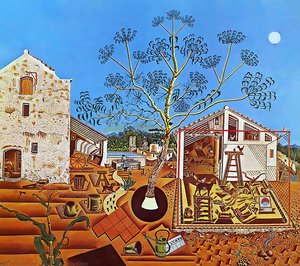
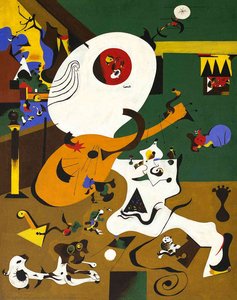
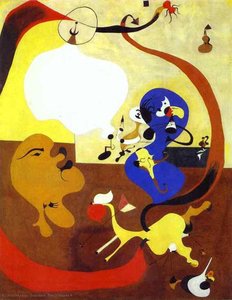
Throughout the 1920s and 30s, Miró developed his signature visual vocabulary—a universe populated by biomorphic shapes, floating forms, and vibrant colors. The Farm (1922), often considered a cornerstone of his oeuvre, exemplifies this transition. It’s not merely a depiction of rural life but an evocation of Catalan identity and a symbolic representation of the natural world. His collaborative spirit led to innovative techniques like *grattage*, pioneered with Max Ernst in 1926 for designs intended for Sergei Diaghilev's ballet, where textures were revealed by scraping paint across canvas. The Dutch Interiors (1928) series demonstrated his ability to reinterpret the Old Masters through a distinctly modern lens, transforming domestic scenes into dreamlike abstractions. Painting (1933), with its bold colors and simplified forms, encapsulates Miró’s exploration of the subconscious and his rejection of conventional artistic boundaries. Beyond painting, Miró fearlessly experimented with sculpture, ceramics, and printmaking, expanding his creative horizons and demonstrating a remarkable versatility.Legacy and Enduring Influence
Joan Miró's impact on 20th-century art is undeniable. He wasn’t simply a painter; he was a visionary who challenged the very definition of artistic expression. His work paved the way for abstract expressionism and continues to inspire artists across disciplines. He established two foundations—the Fundació Joan Miró in Barcelona (1975) and the Fundació Pilar i Joan Miró in Palma de Mallorca (1981)—ensuring that his legacy would endure, providing spaces for artistic exploration and education. Throughout his long career, he remained committed to pushing boundaries, questioning conventions, and exploring the depths of human imagination. Miró’s art is a testament to the power of abstraction, symbolism, and poetic expression—a vibrant celebration of life, dreams, and the enduring spirit of Catalan culture. His work continues to resonate with audiences worldwide, inviting us to enter a world where anything is possible and the boundaries between reality and fantasy blur into a captivating dance of color and form.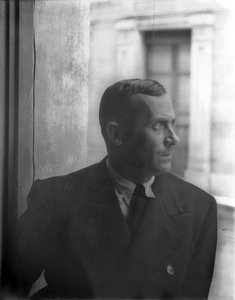
Joan Miró
1893 - 1983 , Spain
Quick Facts
- Artistic Movement Or Style: Surrealism, Abstract Art
- Artists Or Movements Influenced By This Artist:
- Surrealism
- Abstract Art
- Artists Who Influenced This Artist:
- Van Gogh
- Cézanne
- Date Of Birth: 1893
- Date Of Death: 1983
- Full Name: Joan Miró i Ferrà
- Nationality: Spanish
- Notable Artworks:
- The Farm
- Dutch Interiors
- Painting
- Place Of Birth: Barcelona, Spain
Related Articles
Goya's Masterpieces: Explore 25 Iconic Paintings & Art Prints | AllPaintingsStore
Delve into the world of Francisco Goya with AllPaintingsStore. Explore 25 iconic paintings – from 'The Third of May' to his haunting Black Paintings. Discover the stories, techniques & emotions behind these Spanish masterpieces. Find museum-quality art reproductions for your home at AllPaintingsStore.com!

Surrealist Expressionism's 10 Defining Masterpieces | AllPaintingsStore
Journey into the dreamlike world of Surrealist Expressionism! Explore 10 defining masterpieces by Dali, Magritte & Miró. Discover their stories and find museum-quality art reproductions to elevate your home decor on AllPaintingsStore.com.

The Subtleties of Shade: Exploring Black, White & Gray Abstraction in Modern Interior Design
Explore the power of black, white & gray abstraction in modern interior design. Discover how minimalist art impacts spatial perception & creates sophisticated hotel spaces. Expert insights for designers.

Kazimir Malevich: 25 Masterpieces of Suprematism & Abstract Art | AllPaintingsStore
Explore 25 iconic artworks by Kazimir Malevich, pioneer of Suprematism & abstract art. Discover the stories behind 'Black Square' and more! Find museum-quality prints & elevate your home decor with AllPaintingsStore.com.
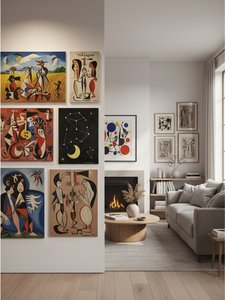
Joan Miró's Masterpieces: 25 Iconic Paintings for Art Lovers & Home Decor
Explore 25 iconic Joan Miró paintings! Discover the stories behind his Surrealist masterpieces, vibrant colors & unique style. Find museum-quality Miro reproductions and elevate your home decor with AllPaintingsStore.com. Explore the full collection online.