Preview
 Send
Send Share
Share
 Details
 Guide
Guide

 Download
 Similars
 X-Ray
X-Ray Diaporama
 Stats
StatsA Symphony
 Oil On Canvas
- WallArt
- Romanticism
 1852
1852- 19th Century
 169.0 x 100.0 cm
 Neue Pinakothek
 Read More
Hand Made Oil Reproduction
Hand-painted oil on canvas in your size and frame, made to order by our artists. ( Switch to Print Switch to Digital Image)




P118B $10

P118H $10

P118W $10

P438Z $10

P508JH $12

P508YH $12

P805H $10

P805Z $10

P919BZ $10

P919G $10

P919XJ $10

P959ZH $10

P968JZ $12

W106C $8

W218G $10

W218JH $8

W218Y $10

W307PJ $10

W316G $10

W316PJ $8

W316Y $10

W398PJ $8

W4111J $10

W500HY $15

W500JH $15

W692G $12

W849H $8

W940BG $15

W953PJ $8




Pick from our preset sizes that match the artwork's original proportions.

Type the width and the height you need, to fit your frame or your wall. This is hand-painted, so for a size with a different shape the artist can paint a bit more around the picture, or cut a bit — you choose. We send you a digital mockup to approve before the painting starts. The picture shown on this page does not show the real result — only the mockup does.
After order, AllPaintingsStore.com team will email client for instructions and provide a mockup preview
Worldwide Delivery () in 3/4 weeks instead of standard 5 weeks. (25 October). No compromise on quality.

Free Worldwide Express Shipping

High-Quality Linen Canvas

Full Shipping Insurance

Customs Tax Refund Guarantee

True Color Matching Guarantee

100-Day Return Policy (Defects Only)

100% Money-Back Guarantee

Bulk Discount Offer
 Glass option is only available in size under 110 CM

A Symphony
Reproduction Medium
Reproduction Size
-


Total Price
$ 258
The Grand Resonance of Performance
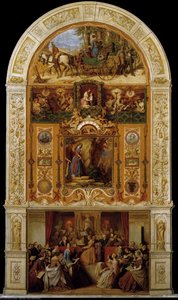
To stand before A Symphony is to be enveloped by an audible silence, even in its painted form. This magnificent oil on canvas transports the viewer directly into the heart of musical ecstasy. It captures not merely a group of musicians, but the very moment where disparate talents coalesce into a single, breathtaking wave of sound. The composition is rich with life; one can almost feel the vibration emanating from the polished wood of the instruments and the collective breath held by the assembled artists. From the foreground figures, poised with their bows raised, to the depth suggested by the grand archway framing the scene, every element contributes to a sense of monumental occasion.
A Tapestry Woven in Romanticism
Painted in 1852, this work sits squarely within the vibrant currents of mid-19th century Romanticism. The artist, Moritz von Schwind, was more than just a painter; he was a poet translating emotion into pigment. This period celebrated heightened feeling, the sublime power of nature, and the profound impact of art on the human spirit. In A Symphony, that celebration finds its perfect outlet in music itself. The varied attire of the orchestra members hints at an era where artistic roles were deeply symbolic, blending historical costume with the universal language of musical passion. It speaks to a time when culture was viewed as a grand, almost operatic spectacle.
Mastery of Light and Ensemble
Technically, the painting showcases a masterful handling of light against deep, dramatic backdrops. The artist uses varying tones—the rich blacks of the stage curtains contrasting with the warm glow illuminating the musicians' faces—to create incredible depth. Observe how the figures are arranged; they do not stand in rigid rows but flow organically, suggesting the natural ebb and flow of a musical movement itself. This careful orchestration within the painting mirrors the very subject matter: the controlled yet explosive energy of a full orchestra at its peak performance. It is a study in dynamic balance.
Bringing Concert Hall Grandeur Home
For the discerning collector or designer, A Symphony offers more than mere decoration; it offers an atmosphere. Imagine this piece gracing a grand salon or a library—it instantly elevates the space with intellectual weight and artistic drama. The scale of 169 x 100 cm ensures that its narrative power cannot be ignored. Owning a reproduction allows one to curate a corner of their home that feels perpetually alive, echoing the grandeur of Vienna’s most celebrated concert halls while retaining the intimate warmth of hand-painted artistry.
Questions & Answers
What are the date and style of "A Symphony" by Moritz von Schwind?
"A Symphony" was created in 1852 as a work of the Romanticism movement. Date and movement anchor the artwork in art history.
What are the medium and date of "A Symphony" by Moritz von Schwind?
"A Symphony" was created in 1852 using the oil on canvas technique. Material and date describe how and when the original was made.
Who created "A Symphony" and in what year?
The author of "A Symphony" is Moritz von Schwind, and the work is dated 1852.
Related Artworks


Artist Biography
Moritz von Schwind: A Poet of the Romantic Imagination
Moritz von Schwind, born in Vienna’s vibrant artistic circles in 1804 and tragically passing away in Pöcking, Bavaria, in 1871, remains a captivating figure within German Romanticism. More than simply a painter, he was a poet rendered in oils, a weaver of dreams and folklore, and a master of evocative landscapes imbued with profound symbolism. His genius lay not just in technical skill but in his ability to translate the emotional currents of his time – chivalry’s lingering allure, the whispers of Germanic legends, and the burgeoning spirit of Romanticism – into visually arresting works that continue to resonate today. Schwind's life was a tapestry woven with friendships with musical giants like Schubert, commissions from royalty, and a relentless pursuit of capturing the essence of poetic fancy.Early Life and Artistic Foundations
Schwind’s early years were marked by privilege and a fortunate exposure to artistic influences. Born into an aristocratic family, he received a rudimentary but solid education, fostering a love for literature and music alongside his burgeoning artistic talent. A key moment in his development occurred when he befriended Franz Schubert, whose songs provided a significant source of inspiration throughout Schwind’s career. He illustrated several of Schubert's compositions, capturing the composer’s melancholic beauty with remarkable sensitivity. Moving to Munich in 1828, following Schubert’s death, marked a pivotal shift. There, he found mentorship under Cornelius, then director of the Academy, and forged connections with fellow artists like Schnorr, creating a fertile environment for his artistic growth. This period laid the groundwork for his distinctive style – one characterized by lyrical grace, meticulous detail, and an almost dreamlike quality.Royal Commissions and Artistic Flourishing
Schwind’s career truly ascended in the 1830s and 40s, fueled by a series of prestigious commissions. In 1834, he was entrusted with decorating King Ludwig's new palace in Munich, undertaking monumental wall paintings illustrating scenes from Tieck’s poetry – a project that showcased his burgeoning mastery of narrative composition and historical detail. Further cementing his reputation, he designed “Kinderfries” (children’s frieze) for the same palace, playful depictions of youthful merriment that demonstrated his ability to capture fleeting moments of joy. He also accepted commissions in Saxony and Baden, solidifying his position as a leading artist of the era. A particularly significant undertaking was his work at the Karlsruhe Academy in 1839, where he created a vast fresco embodying Goethe’s ideas – an ambitious project that reflected the intellectual fervor of the time.The Height of Romantic Vision: Landscapes and Legends
Schwind's most celebrated works emerged during his residency in Frankfurt (1844-1847) and later in Munich. This period witnessed the creation of some of his finest easel paintings, including “Singers’ Contest in the Wartburg” (1846), a masterpiece that perfectly encapsulates Romantic ideals – a gathering of musicians lost in passionate song amidst a dramatic medieval setting. His designs for the Goethe celebration further showcased his ability to blend historical accuracy with poetic imagination. However, it was his interpretations of Germanic legends and folklore that truly defined his artistic legacy. The “Niebelungenlied” cycle, particularly his stunning frescoes for Hohenschwangau Castle depicting the epic tale of Siegfried and Brunhilde, stands as a testament to his skill in translating complex narratives into visually compelling scenes. His work on the story of Cupid and Psyche for Leipzig is equally remarkable, demonstrating his ability to evoke both beauty and melancholy.Later Years and Legacy
Schwind’s later years were marked by declining health but continued artistic productivity. He returned to Vienna in 1847, where he created a cycle of paintings based on the legend of Melusine, showcasing his enduring talent. His final works, including designs for commemorative musicians at the Vienna State Opera, reflected a deep appreciation for music and its power to inspire. Moritz von Schwind died in Niederpöcking in 1871, leaving behind a rich artistic legacy that continues to captivate audiences today. His paintings are celebrated not only for their technical brilliance but also for their ability to transport viewers to worlds of myth, legend, and profound emotional resonance – solidifying his place as a key figure in the history of German Romantic art.Notable Works
- Rübezahl (1834): A dramatic landscape featuring the mythical guardian of the Bavarian Alps, embodying themes of nature, power, and mystery.
- The Dream of Erwin von Steinbach (1822): An intricate drawing capturing a Gothic scene filled with symbolism and psychological depth.
- Landscape with Wanderer (1835): A haunting black-and-white drawing depicting a solitary figure contemplating a fantastical landscape, reflecting themes of isolation and introspection.
- Singers’ Contest in the Wartburg (1846): A vibrant and dynamic painting capturing a scene of musical passion amidst a medieval setting – Schwind's most famous work.
- Seven Ravens (1857): A series of illustrations based on Grimm’s fairy tales, showcasing his ability to blend fantasy with narrative storytelling.
Further Exploration
- Wikipedia: https://en.wikipedia.org/wiki/Moritz_von_Schwind
- Schackgalerie (Munich): https://l.instagram.com/?r=1&media=https%3A%2F%2Flinstagram.com%2Fp%2F789046588%2F&utm_source=ig_web_application_mobile&utm_medium=share_sheet&utm_campaign=instagram_sharing&utm_sefid=1387780787876788878 (Explore Schwind’s works at the Schackgalerie in Munich)
- Albertina Museum: https://www.albertina.at/en/research/drawing-print/projects/moritz-von-schwind/ (Discover ongoing research on Schwind’s prints and reproductions at the Albertina Museum)

Moritz von Schwind
1804 - 1871 , Austria
Quick Facts
- Artistic Movement Or Style: German Romanticism
- Artists Who Influenced This Artist: ['Cornelius']
- Full Name: Moritz von Schwind
- Nationality: Austrian
- Notable Artworks:
- The Cat Symphony
- Farewell at Dawn
- A Symphony
- Honeymoon
- Place Of Birth: Vienna, Austria
- Date Of Birth: 1804
- Date Of Death: 1871
Related Articles

Echoes of Change: Exploring Themes & Techniques in 19th-Century Art
Explore the captivating world of 19th-century art! Discover Romanticism & Realism's key artists, masterpieces, and social commentary. Expert insights for collectors & enthusiasts.

19th Century Masterpieces: 10 Paintings That Defined an Era | AllPaintingsStore
Journey through 19th century art with AllPaintingsStore! Explore 10 iconic paintings – from Monet & Renoir to Courbet – and discover the stories behind Romanticism, Realism & Impressionism. Find museum-quality reproductions for your home decor. Explore the full collection online!

Eugen von Blaas: Capturing Alpine Life & Sentiment in 19th-Century Austrian Painting
Discover the captivating world of Eugen von Blaas! Explore his exquisite 19th-century paintings capturing Venetian life & Alpine beauty. Learn about his Academic Classicism style and find museum-quality reproductions at AllPaintingsStore.
The Enduring Legacy of 18th & 19th Century Art: Movements, Masters & Societal Reflections
Explore the rich history of 18th & 19th-century art! Discover Romanticism, Realism, and iconic masters like Delacroix & Courbet. Expert insights & high-quality reproductions at AllPaintingsStore.

Echoes of Revolution & Romanticism: Navigating 19th-Century Art Styles
Explore the diverse world of 19th-century art! From Realism's rebellion to Impressionism’s light and beyond, discover key movements, artists & collecting tips. Expert insights for classic enthusiasts.