


 Preview
 Send
Send Share
Share
 Details
 Guide
Guide

 Download
 Similars
 X-Ray
X-Ray Diaporama
 Stats
StatsCamel


 Read More
Hand Made Oil Reproduction
Hand-painted oil on canvas in your size and frame, made to order by our artists. ( Switch to Print Switch to Digital Image)




P118B $10

P118H $10

P118W $10

P438Z $10

P508JH $12

P508YH $12

P805H $10

P805Z $10

P919BZ $10

P919G $10

P919XJ $10

P959ZH $10

P968JZ $12

W106C $8

W218G $10

W218JH $8

W218Y $10

W307PJ $10

W316G $10

W316PJ $8

W316Y $10

W398PJ $8

W4111J $10

W500HY $15

W500JH $15

W692G $12

W849H $8

W940BG $15

W953PJ $8




Pick from our preset sizes that match the artwork's original proportions.

Type the width and the height you need, to fit your frame or your wall. This is hand-painted, so for a size with a different shape the artist can paint a bit more around the picture, or cut a bit — you choose. We send you a digital mockup to approve before the painting starts. The picture shown on this page does not show the real result — only the mockup does.
After order, AllPaintingsStore.com team will email client for instructions and provide a mockup preview
Worldwide Delivery () in 3/4 weeks instead of standard 5 weeks. (25 October). No compromise on quality.

Free Worldwide Express Shipping

High-Quality Linen Canvas

Full Shipping Insurance

Customs Tax Refund Guarantee

True Color Matching Guarantee

100-Day Return Policy (Defects Only)

100% Money-Back Guarantee

Bulk Discount Offer
 Glass option is only available in size under 110 CM

Camel
Reproduction Medium
Reproduction Size
-


Total Price
$ 258
A Journey Through Time: Nicolas Poussin’s ‘Camel’
This captivating painting by Nicolas Poussin transports us to a bygone era of travel and exploration. Depicting a lone rider atop a heavily laden camel, the artwork is more than just a scene of transportation; it's a window into the practicalities and romanticism associated with traversing vast landscapes in historical contexts. The composition immediately draws the eye to the central figures – the stoic camel bearing its substantial burden, and the traveler seated comfortably amidst the goods, suggesting both resilience and a degree of privilege.Masterful Baroque Technique
Poussin’s skill as a painter is evident in the rich, vibrant colors and meticulous detail employed throughout the canvas. Executed in oil on canvas, the work exemplifies the hallmarks of the Baroque style – dramatic lighting, dynamic movement (implied through the camel's posture), and a sense of grandeur. Note how Poussin utilizes chiaroscuro, contrasting light and shadow to emphasize textures and forms, particularly within the camel’s coat and the various items composing its load. The brushwork, while refined, isn’t overly polished; it retains a tangible quality that speaks to the artist's hand.Historical Context & Artistic Lineage
Nicolas Poussin (1594-1665) was a pivotal figure in French Baroque painting, though he spent most of his career in Rome. He uniquely blended classical ideals with Baroque dynamism. This piece, while its exact date remains unknown, reflects the period’s fascination with both historical narratives and exotic locales. Camels were vital for trade and travel across North Africa, the Middle East, and Asia, making them a frequent subject in art depicting these regions or alluding to biblical stories. Poussin's dedication to classical composition would later profoundly influence artists such as Jacques-Louis David and Paul Cézanne, cementing his legacy within art history.Symbolism & Interpretation
Beyond the literal depiction of travel, ‘Camel’ invites deeper interpretation. The camel itself can be seen as a symbol of endurance, patience, and adaptation – qualities essential for navigating life's challenges. The heavy load represents burdens carried, whether material possessions or metaphorical weights. The rider, seemingly at ease despite the journey, might symbolize resilience, resourcefulness, or even spiritual fortitude. The landscape, though not fully detailed, suggests a sense of vastness and the unknown, hinting at the adventurous spirit inherent in exploration.Emotional Resonance & Interior Design
‘Camel’ evokes a feeling of quiet contemplation and adventure. It's a painting that invites viewers to reflect on themes of journey, perseverance, and the human relationship with nature. Its warm color palette and dynamic composition make it a striking focal point for any interior space.- In a study or library, it adds an air of intellectual curiosity.
- Within a living room, it provides a touch of historical elegance.
- Its rich tones complement both traditional and contemporary décor schemes.
Questions & Answers
What is a reproduction of "Camel" by Nicolas Poussin recommended for?
A reproduction of "Camel" by Nicolas Poussin is recommended for reflective. This suggestion follows from the work's subject, mood and colors.
Can I see "Camel" by Nicolas Poussin on my own wall before buying?
The AR Preview page of "Camel" by Nicolas Poussin uses augmented reality to show the artwork in your own space, on a compatible device.
What is the luminance of "Camel" by Nicolas Poussin?
The luminance recorded for "Camel" by Nicolas Poussin is luminous.
Related Artworks


Artist Biography
A Life Steeped in Classical Reverie
Nicolas Poussin, a name synonymous with the grandeur of French Baroque painting, was nonetheless a soul deeply rooted in Italian soil for much of his artistic life. Born in Le Havre, Normandy, in June 1594, his early years remain somewhat veiled in mystery, yet they undoubtedly laid the foundation for a career that would become pivotal in shaping the classical tradition within French art. Though he briefly studied in Paris during the early 1610s, absorbing influences from lesser-known artists of the time, it was his journey to Rome in 1624 that truly ignited his artistic destiny. This wasn’t merely a geographical relocation; it was an immersion into the heart of antiquity, a pilgrimage to the very source of inspiration that would define his aesthetic vision. Poussin's initial forays into painting were marked by a sensuous quality reminiscent of Venetian masters like Titian, yet even in these early works, a nascent sense of order and intellectual rigor began to emerge—a foreshadowing of the style he would so masterfully refine.
The Roman Years: Forging a Classical Ideal
Rome proved to be more than just a studio for Poussin; it became his intellectual crucible. He found himself amidst a vibrant circle of scholars, archaeologists, and fellow artists, notably Cassiano dal Pozzo, whose profound understanding of classical antiquity profoundly influenced the artist’s approach. Dal Pozzo's dedication to meticulously documenting ancient remains instilled in Poussin a deep respect for historical accuracy and a desire to imbue his paintings with a sense of timelessness. This period saw Poussin move away from the flamboyant exuberance of some of his contemporaries, instead embracing a style characterized by clarity, balance, and a deliberate emphasis on linear composition. He meticulously studied Raphael’s works, absorbing their harmonious arrangements and graceful forms, while simultaneously drawing inspiration from ancient sculptures and literary sources like Ovid's *Metamorphoses*. His paintings began to populate with figures drawn from classical history and mythology, rendered not as mere decorative elements but as embodiments of moral virtues and philosophical ideals.
Themes of History, Myth, and the Sacred
Poussin’s artistic output was remarkably diverse, yet consistently unified by his commitment to these core principles. He frequently depicted scenes from ancient history—the tragic fate of Germanicus, for example—imbued with a sense of stoic dignity and moral weight. His mythological paintings weren't simply retellings of familiar tales; they were explorations of human nature, often laden with allegorical meaning. The *Arcadia* series, particularly the iconic *Et in Arcadia ego*, became emblematic of his philosophical depth, prompting contemplation on mortality and the enduring power of memory. Beyond history and myth, Poussin also turned to religious subjects, most notably in *The Seven Sacraments*—a monumental undertaking that showcased both his theological understanding and compositional prowess. Even within these sacred scenes, however, he maintained a classical restraint, avoiding excessive emotionalism in favor of a serene and dignified presentation. Later in his career, expansive landscapes became increasingly prominent, blending realism with idealized forms to create vistas that evoked a sense of harmony and tranquility.
A Lasting Legacy: Shaping French Art
Despite spending the majority of his career abroad, Nicolas Poussin’s influence on French art was immense. He briefly returned to Paris in 1640 at the behest of Cardinal Richelieu, appointed as First Painter to the King, but found himself stifled by the demands and intrigues of court life. He soon returned to Rome, where he continued to paint until his death in 1665. His dedication to classical principles helped establish a standard for artistic training and practice within France, influencing generations of artists who followed. He became a leading figure in the Académie Royale de Peinture et de Sculpture, solidifying his position as a cornerstone of French Classicism. Artists like Jacques-Louis David and Paul Cézanne openly acknowledged their debt to Poussin’s rigorous approach and intellectual depth. His legacy extends far beyond mere stylistic imitation; it represents a commitment to order, clarity, and the enduring power of classical ideals—a testament to an artist who sought not simply to depict the world but to elevate it through the lens of reason and beauty.
- Notable Works: *The Death of Germanicus*, *The Seven Sacraments Series*, *A Roman Road*, *Orion Blinded Searching for the Sun*, *The Seasons*.
- Key Characteristics: Classical Composition, Linearity, Historical and Mythological Themes, Serene Landscapes.
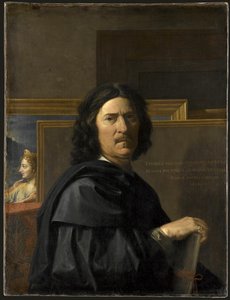
Nicolas Poussin
1594 - 1665 , France
Quick Facts
- Artistic Movement Or Style: Baroque, Classicism
- Artists Or Movements Influenced By This Artist:
- Jacques-Louis David
- Paul Cézanne
- Artists Who Influenced This Artist:
- Raphael
- Titian
- Date Of Birth: 1594
- Date Of Death: 1665
- Full Name: Nicolas Poussin
- Nationality: French
- Notable Artworks:
- The Death of Germanicus
- Seven Sacraments Series
- A Roman Road
- Orion Blinded
- The Seasons
- Place Of Birth: Le Havre, France
Related Articles

Oil on Canvas: The Professional Guide to Durable, High-Quality Art Reproductions for Hospitality and Large-Scale Interior Projects
A professional guide for hotel designers and procurement managers on selecting durable, high-quality oil on canvas reproductions. Learn about material longevity, custom multi-panel layouts, and efficient bulk ordering solutions for large-scale hospitality projects.


