- Home

- Oil Painting Reproduction
- Purvis Young
- Carrying the Angel to the People

 Buy print
 Send
Send Share
Share
 Details

 Download
 Similars
 X-Ray
X-Ray Diaporama
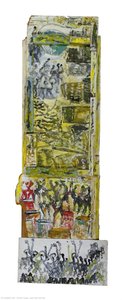
Carrying the Angel to the People
 Acrylic On Canvas
- WallArt
- Contemporary Realism
 1994
1994 203.0 x 124.0 cm
 Souls Grown Deep
 Read More
Hand Made Oil Reproduction
Hand-painted oil on canvas in your size and frame, made to order by our artists.




P118B $10

P118H $10

P118W $10

P438Z $10

P508JH $12

P508YH $12

P805H $10

P805Z $10

P919BZ $10

P919G $10

P919XJ $10

P959ZH $10

P968JZ $12

W106C $8

W218G $10

W218JH $8

W218Y $10

W307PJ $10

W316G $10

W316PJ $8

W316Y $10

W398PJ $8

W4111J $10

W500HY $15

W500JH $15

W692G $12

W849H $8

W940BG $15

W953PJ $8




Pick from our preset sizes that match the artwork's original proportions.

You may enter your own dimensions to fit a specific frame or space. If your selected size does not match the original image's proportions, we will either crop the artwork or extend the painting with additional hand-painted elements. A digital mockup will be sent for your approval before production begins.
Please note that the on-screen preview does not reflect the actual cropping or extension. Only the mockup will accurately show the final composition.
While custom sizes are available, we recommend selecting a dimension from the predefined list to preserve the original proportions.
After order, AllPaintingsStore.com team will email client for instructions and provide a mockup preview
Worldwide Delivery () in 3/4 weeks instead of standard 5 weeks. (16 July). No compromise on quality.

Free Worldwide Express Shipping

High-Quality Linen Canvas

Full Shipping Insurance

Customs Tax Refund Guarantee

True Color Matching Guarantee

60-Day Return Policy (Defects Only)

100% Money-Back Guarantee

Bulk Discount Offer
 Glass option is only available in size under 110 CM

Carrying the Angel to the People
Reproduction Medium
Reproduction Size
-


Total Price
-
Artwork Description
A Symphony of Urban Decay and Spiritual Resonance: Exploring Purvis Young’s “Carrying the Angel to the People”
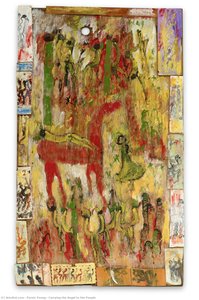
Purvis Young's "Carrying the Angel to the People" isn’t merely a painting; it’s a visceral embodiment of Miami’s Overtown neighborhood—a testament to resilience forged in hardship and illuminated by an unwavering artistic vision. Created in 1994, this monumental mixed-media collage transcends conventional representation, immersing viewers in a chaotic yet profoundly meaningful tableau that captures the spirit of Black American experience during its time. Young's approach was revolutionary – he eschewed formal training, prioritizing observation and immersion within his surroundings, mirroring the very essence of Overtown’s vibrant culture.The Assemblage Technique: Transforming Waste into Wonder
Young’s artistic process defied convention. Rather than meticulously crafting canvases in a studio, he actively sought discarded materials—plywood scraps, broken furniture fragments, mirrored shards, and even wallpaper samples—from local factories and offices. These weren't simply decorative elements; they were imbued with significance by Young himself, chosen for their textural qualities and philosophical compatibility. As Souls Grown Deep eloquently describes, “The materials are chosen for more than texture, color, and form; Young considers each object’s original use, and in his final creation—gathered, selected, arranged, nailed or glued together, painted, and framed—each component carries its own subtle and highly esoteric definition.” This painstaking layering process resulted in a textured surface that pulsates with energy – an intentional disruption of traditional artistic norms.Style and Emotion: Expressionism Rooted in Observation
The painting’s style leans heavily into expressionism, prioritizing emotional impact over precise realism. Loose brushstrokes convey movement and dynamism, mirroring the frenetic pace of Overtown life. Shapes are organic and irregular, rejecting geometric precision to reflect the fragmented nature of urban experience. The color palette—dominated by warm reds, yellows, and browns—is punctuated by splashes of green and blue, creating a visually arresting contrast that underscores the painting’s emotional intensity. Young's work isn't about depicting what *looks* like Overtown; it’s about conveying how it *feels*. The unsettling density of figures contributes to this sense of unease, prompting contemplation on themes of community, faith, and perseverance.Symbolism Within Chaos: An Angel Among the Ruins
Despite its apparent disorder, “Carrying the Angel to the People” is rich in symbolic resonance. At its center stands a horse-like creature—a potent emblem of strength and nobility—surrounded by numerous figures engaged in what appears to be a procession or gathering. This central figure carries an angel – representing hope and divine grace – amidst the debris of urban decay, suggesting a narrative of spiritual aspiration overcoming adversity. The inclusion of seemingly random objects—bank statements, memos, record albums—further amplifies this symbolic dimension, inviting viewers to consider the everyday realities of Black American life within Overtown.A Legacy of Authenticity: Young’s Enduring Influence
Purvis Young's legacy extends far beyond his artistic output; he represents a profound commitment to artistic integrity and a refusal to compromise vision for commercial success. His work, now housed in prominent museums worldwide, continues to inspire artists and collectors alike—a reminder that true beauty resides not in polished perfection but in the raw honesty of observation and the transformative power of repurposing discarded materials into expressions of profound emotion and spiritual contemplation.Related Artworks




Artist Biography
A Life Forged in Overtown: The Story of Purvis Young
Purvis Young’s art wasn't born in a studio, but on the streets of Miami’s Overtown neighborhood—a place he didn’t just depict, but *lived* and breathed. Born in Liberty City in 1943, Young’s journey was one of self-discovery fueled by hardship, observation, and an unwavering dedication to translating the soul of his community onto any surface he could find. He wasn't formally trained; his education came from immersing himself in art books during a period of incarceration, and then through relentless study at Miami’s public libraries. This autodidacticism became central to his artistic identity—a refusal to conform to established norms, mirroring the resilience of Overtown itself. His early life was marked by challenges, including time spent in prison for breaking and entering, an experience that profoundly shaped his worldview and ultimately ignited a creative fire within him. Upon release, he didn’t seek out galleries or mentors; instead, he turned inward, finding inspiration in the decaying beauty and vibrant humanity surrounding him.The Alchemy of Found Objects
Young's artistic process was as unique as his vision. He wasn’t interested in pristine canvases or expensive materials. Instead, he scavenged Overtown—a neighborhood undergoing dramatic change and decline—for discarded wood, scrap metal, old books, fragments of wallpaper, and anything else that caught his eye. These weren’t simply *materials*; they were the very essence of the community he sought to represent. He transformed these castoffs into powerful assemblages, layering drawings, paintings, and text in a chaotic yet strangely harmonious manner. This technique wasn't merely about resourcefulness; it was a deliberate act of reclamation—giving voice to the forgotten and overlooked. His work often features recurring motifs: horses symbolizing freedom, angels representing spirituality, and fragmented figures engaged in ritualistic acts, all rendered with an expressive rawness that conveys both despair and hope. The surfaces are textured, layered, and often distressed, mirroring the physical and emotional landscape of Overtown. He didn’t just paint *about* the neighborhood; he painted *with* it, incorporating its very fabric into his art.Echoes of Influence and a Singular Voice
While largely self-taught, Young wasn't entirely isolated from artistic currents. The mural movement of the 1960s resonated with him, inspiring him to create large-scale works directly within Overtown—transforming dilapidated walls into vibrant canvases that documented the lives and struggles of its residents. He absorbed influences from a wide range of sources, evident in his eclectic style, yet he never imitated. His work possesses a distinct aesthetic—a raw energy, a chaotic beauty, and a poignant social commentary that sets him apart. Some critics have noted echoes of Expressionism and Surrealism in his imagery, but these are filtered through the unique lens of his personal experience and cultural context. He wasn’t interested in replicating existing styles; he was intent on forging his own visual language—one that could capture the complexities of urban life and the resilience of the human spirit. Purvis of Overtown, a 2006 documentary, offered a compelling glimpse into this process, revealing an artist deeply connected to his community and driven by an inner compulsion to create.Recognition and Lasting Legacy
For years, Young’s work circulated primarily within a devoted local following. Collectors like Jane Fonda, Damon Wayans, Jim Belushi, and Dan Aykroyd recognized the power and originality of his vision early on, providing crucial support during a time when mainstream art institutions largely overlooked him. The documentary Purvis of Overtown brought wider attention to his life and work, but it was ultimately the increasing recognition from museums and galleries that solidified his place in art history. Today, his paintings are held in prestigious collections worldwide, including the American Folk Art Museum, the Pérez Art Museum Miami, and the Smithsonian American Art Museum. In 2018, he was posthumously inducted into the Florida Artists Hall of Fame—a testament to his enduring impact on the state’s artistic heritage.A Chronicle of a Community
Purvis Young's significance extends far beyond aesthetics. His work serves as an invaluable historical document, preserving the memory of Overtown during a period of profound transformation and social upheaval. He captured the essence of a community facing displacement, poverty, and systemic injustice—giving voice to those who were often marginalized and ignored. His art is a powerful commentary on the African American experience in the South, exploring themes of resilience, spirituality, and the enduring search for dignity. Moreover, his success as a self-taught artist challenges conventional notions of artistic training, demonstrating that true creativity can flourish outside the confines of academia. He reminds us that art isn’t just about technical skill; it's about vision, passion, and the courage to tell your story—even when that story is difficult or uncomfortable. His legacy continues to inspire artists and viewers alike, urging us to look beyond the surface and engage with the complexities of the world around us.
Purvis Young
1943 - 2010 , United States of America
Quick Facts
- Artistic Movement Or Style: Social Expressionism
- Date Of Birth: February 4, 1943
- Date Of Death: April 20, 2010
- Full Name: Purvis Young
- Nationality: American
- Notable Artworks:
- Untitled (1980)
- Untitled (1978)
- Place Of Birth: Liberty City, USA
Related Articles

The Evocation of Tranquility: Exploring Serenity in Visual Art Across Movements & Media
Explore the history of serenity in art with AllPaintingsStore. Discover calming landscapes by Cole, Corot & Van Gogh. Find paintings that evoke peace and create a tranquil atmosphere in your home. Expert guidance & handmade reproductions.

John Sloan: Capturing the Soul of American Urban Life – A Realist Master
Explore the life & art of John Sloan, a key figure of American Realism and the Ashcan School. Discover his evocative NYC scenes, socialist influences, and lasting impact on modern art. Learn more at AllPaintingsStore.
Harmonizing Heritage: A Cross-Cultural Approach to Interior Design with Asian, European, and African Art Reproductions
Discover the art of cross-cultural interior design with AllPaintingsStore.com. Explore museum-quality reproductions & expert guidance to create a globally inspired, sophisticated home. Shop now!

The Ashcan School: Realism, Urban Life & the Democratization of American Art
Explore the revolutionary Ashcan School! Discover how artists like Henri & Sloan challenged tradition with gritty realism, capturing urban life in early 20th-century America. Learn about their impact on American art history.

Concrete Visions: Exploring the Urban Landscape in Painting – From Realism to Contemporary Art
Explore the evolution of cityscape painting from Realism to contemporary art with AllPaintingsStore. Discover key artists & invest in timeless urban visions. Expert guidance, museum-quality reproductions.