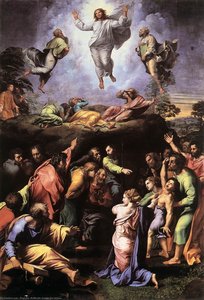
Oil On Canvas.

§ 1Catalogue data


§ 2Abstract
Collectible Description
Explore Raphael's masterpiece 'Prime Mover (Astronomy)' from the Vatican Stanze! Admire its intricate composition and masterful use of oil on canvas, reflecting Renaissance ideals of beauty and harmony.
 Read More
Artist Biography
High Renaissance master of the School of Athens. Discover his legendary Madonnas and breathtaking Vatican frescoes today.
§ 3Commentary
Introduction
This article provides an in-depth analysis of the painting Prime Mover (Astronomy) by the renowned Italian artist, Raphael (Raffaello Sanzio Da Urbino). The work is a prime example of Renaissance art and demonstrates Raphael's mastery of oil on canvas as an art medium.Artist: Raphael (Raffaello Sanzio Da Urbino)
Born in 1483, Raphael was a prominent painter and architect of the High Renaissance. His works are admired for their clarity of form, ease of composition, and visual achievement of the Neoplatonic ideal of human grandeur. Raphael's style had a significant influence on his contemporaries and continues to inspire artists today.Title: Prime Mover (Astronomy)
Prime Mover (Astronomy) is one of the four frescoes that Raphael painted for the Stanze di Raffaello, also known as the Stanze Vaticane or Raphael Rooms, in the Apostolic Palace in the Vatican. The painting depicts the mythological Mount Parnassus where Apollo resides, surrounded by the nine muses, nine poets from antiquity, and nine contemporary poets.Media: Oil on Canvas
Oil on canvas is a popular and versatile medium for artistic expression, with a rich history that spans centuries. The use of oil as a binder for pigments has allowed artists to create vibrant and textured works of art that have stood the test of time. Raphael's mastery of this medium is evident in Prime Mover (Astronomy).Style: Renaissance
Renaissance art emerged in Italy in the late 14th and early 15th centuries. It was characterized by a revival of interest in classical learning and values, which led to the development of new techniques and approaches in painting, sculpture, and architecture. Raphael's Prime Mover (Astronomy) is an excellent example of Renaissance art, showcasing the artist's mastery of perspective, anatomy, and composition.Composition Analysis
The painting features a complex composition with multiple figures arranged in a dynamic and harmonious manner. Apollo, the central figure, is depicted as the embodiment of reason and order, surrounded by the muses who represent various aspects of human creativity. The poets from antiquity and contemporary times are depicted on either side of the painting, creating a visual dialogue between past and present.Conclusion
Raphael's Prime Mover (Astronomy) is a masterpiece of Renaissance art that showcases the artist's mastery of oil on canvas as an art medium. The painting's complex composition and dynamic figures demonstrate Raphael's deep understanding of classical learning and values, making it a valuable addition to any art collection. To learn more about Prime Mover (Astronomy) or other works by Raphael, visit our website at Prime Mover (Astronomy).Questions & Answers
What color saturation does "Prime Mover (Astronomy)" by Raphael have?
The palette of "Prime Mover (Astronomy)" is clear color presence in saturation.
Does "Prime Mover (Astronomy)" by Raphael use strong contrasts or soft harmonies?
The color composition of "Prime Mover (Astronomy)" by Raphael combines a gentle contrast with a strong color unity harmony.
Are the colors of "Prime Mover (Astronomy)" by Raphael vivid or muted?
"Prime Mover (Astronomy)" by Raphael is recorded with a clear color presence saturation and a vivid intensity.

![Stanze Vaticane - The Fire In The Borgo (detail) [01] — Raphael, High Renaissance](/media/artworks/images-thumb/76/f6/76f6220ba33c4e1d9790e47ace4c7148.jpg)
![Stanze Vaticane - The Liberation Of St Peter (detail) [02] — Raphael, Renaissance](/media/artworks/images-thumb/37/67/376727508005fdf6aba941d2691713fd.jpg)
![Stanze Vaticane - The School Of Athens (detail) [05] — Raphael, Renaissance](/media/artworks/images-thumb/ca/a9/caa9f9be8f76fbc617e906bfcb543fad.jpg)

![Stanze Vaticane - La Disputa (detail) [08] — Raphael, Renaissance](/media/artworks/images-thumb/3d/82/3d824970f573582a9a29e0e167a781f5.jpg)
![Stanze Vaticane - The Liberation Of St Peter (detail) [01] — Raphael, High Renaissance](/media/artworks/images-thumb/56/b1/56b164228e527303d62222f1b9e9aa13.jpg)
![Stanze Vaticane - The Parnassus (detail) [07] — Raphael, High Renaissance](/media/artworks/images-thumb/3c/a1/3ca1620e84d3f2fe4e94d9bb954e0eca.jpg)
![Stanze Vaticane - La Disputa (detail) [05] — Raphael, High Renaissance](/media/artworks/images-thumb/48/6a/486abd6d783ca809a3f7d22192ea7fc0.jpg)

![Stanze Vaticane - The Mass At Bolsena (detail) [01] — Raphael, Renaissance](/media/artworks/images-thumb/8d/99/8d998e18ce3c0281eaf2360a52026685.jpg)

 Switch to Print


 For artworks or reproductions larger than 105 cm (approximately 41 inches) on any side, the frame will be shipped as a kit, disassembled. This method ensures safe delivery and prevents damage during transport.