- Home

- Oil Painting Reproduction
- Richard Lindner
- The Meeting

 Buy print
 Send
Send Share
Share
 Details

 Download
 Similars
 X-Ray
X-Ray Diaporama
The Meeting


 Read More
Hand Made Oil Reproduction
Hand-painted oil on canvas in your size and frame, made to order by our artists.




P118B $10

P118H $10

P118W $10

P438Z $10

P508JH $12

P508YH $12

P805H $10

P805Z $10

P919BZ $10

P919G $10

P919XJ $10

P959ZH $10

P968JZ $12

W106C $8

W218G $10

W218JH $8

W218Y $10

W307PJ $10

W316G $10

W316PJ $8

W316Y $10

W398PJ $8

W4111J $10

W500HY $15

W500JH $15

W692G $12

W849H $8

W940BG $15

W953PJ $8




Pick from our preset sizes that match the artwork's original proportions.

You may enter your own dimensions to fit a specific frame or space. If your selected size does not match the original image's proportions, we will either crop the artwork or extend the painting with additional hand-painted elements. A digital mockup will be sent for your approval before production begins.
Please note that the on-screen preview does not reflect the actual cropping or extension. Only the mockup will accurately show the final composition.
While custom sizes are available, we recommend selecting a dimension from the predefined list to preserve the original proportions.
After order, AllPaintingsStore.com team will email client for instructions and provide a mockup preview
Worldwide Delivery () in 3/4 weeks instead of standard 5 weeks. (16 July). No compromise on quality.

Free Worldwide Express Shipping

High-Quality Linen Canvas

Full Shipping Insurance

Customs Tax Refund Guarantee

True Color Matching Guarantee

60-Day Return Policy (Defects Only)

100% Money-Back Guarantee

Bulk Discount Offer
 Glass option is only available in size under 110 CM

The Meeting
Reproduction Medium
Reproduction Size
-


Total Price
-
Artwork Description
A Gathering Steeped in Modernity: Unveiling Richard Lindner’s “The Meeting”
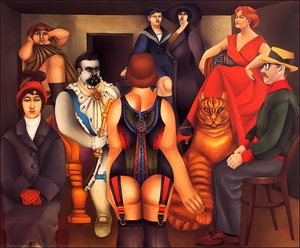
Richard Lindner's "The Meeting" is not merely a depiction of social interaction; it’s an immersion into a world poised between reality and dream, a vibrant tableau that captures the anxieties and fascinations of mid-20th century modernity. The canvas teems with nine figures arranged in a deliberate semi-circle, their individual styles and expressions hinting at complex narratives woven within this intimate yet strangely detached gathering. Lindner doesn’t offer a straightforward scene; instead, he presents a carefully constructed stage where identity, social roles, and perhaps even a touch of the surreal collide. The inclusion of a regal cat in the foreground is particularly striking – an enigmatic presence that adds layers of symbolism, suggesting themes of authority, independence, or a subtle undercurrent of mysticism. It’s a scene that invites prolonged contemplation, prompting viewers to decipher the relationships and unspoken stories held within this dynamic composition.
Bold Strokes and Expressive Forms: A Masterclass in Style
Lindner's artistic voice is immediately recognizable in “The Meeting” through his bold, expressive style. He eschews traditional realism for a more emotionally charged approach, employing exaggerated forms, vibrant colors, and stylized features that echo the influences of both modernism and expressionism. Strong outlines define each figure, lending them a graphic quality while simultaneously emphasizing their individuality. The color palette—a rich interplay of reds, blues, blacks, and earthy tones—is far from arbitrary; it’s carefully orchestrated to enhance visual dynamism and underscore the unique personality of each participant in this gathering. The technique suggests a masterful handling of oil or acrylic paints on canvas, resulting in a smooth yet textured finish that accentuates both the stylized aesthetic and the depth within the scene. It's a style that feels simultaneously familiar and unsettling, drawing the viewer into its captivating world.
Echoes of an Era: Historical Context and Artistic Significance
Created during a period of significant social and cultural upheaval, “The Meeting” reflects the anxieties and energies of the mid-20th century. Lindner, having experienced displacement as a German artist fleeing Europe before World War II, brought a unique perspective to his work. His art blends European modernist traditions with American pop sensibilities, creating a visual language that is both contemporary and timeless. The painting’s stylistic choices—the bold colors, simplified shapes, and expressive forms—align it with movements like expressionism and early pop art, yet Lindner's distinct voice prevents easy categorization. His work often explored themes of alienation and the complexities of modern life, and “The Meeting” serves as a powerful example of his ability to capture these sentiments on canvas. The painting’s presence in prominent collections, including that of the Museum of Modern Art in New York, underscores its enduring artistic significance.
Decoding the Symbols: Emotional Resonance and Interpretation
Beyond its aesthetic qualities, “The Meeting” resonates with a profound emotional depth. The stylized figures and vibrant palette evoke a spectrum of responses – from quiet contemplation to a sense of underlying tension. The exaggerated forms and contrasting colors amplify the expressive impact, inviting viewers to interpret the relationships and narratives at play. Is this a scene of camaraderie or veiled conflict? Are these individuals connected by shared purpose or simply existing in proximity? The regal cat, with its air of aloof authority, adds another layer of intrigue – perhaps representing an unseen power dynamic or a symbol of independence within the group. Ultimately, “The Meeting” is not about providing answers; it’s about prompting questions and inviting viewers to engage with the artwork on a personal level. It's a piece that promises to elevate any interior space, sparking conversation and inspiring contemplation for years to come.


Artist Biography
Richard Lindner: A Visionary of Urban Eroticism
Richard Lindner, born in Hamburg, Germany, in 1901, was a truly singular figure in 20th-century art – a German-American painter whose work pulsed with an arresting blend of urban energy, unsettling eroticism, and a distinctly mechanical sensibility. His journey, spanning decades and continents, shaped a body of work that continues to fascinate and provoke, offering a unique visual commentary on gender roles, mass media, and the evolving landscape of modern life. Lindner’s artistic universe is one of striking originality, rooted in European influences yet profoundly informed by his experiences as an immigrant navigating the vibrant, often contradictory, world of New York City.Early Years and Artistic Training
Lindner's early life was marked by a fascinating duality. His mother, Mina Lindner, was American, born in New York to German parents, while his father, Wilhelm Lindner, remained firmly rooted in Hamburg. In 1905, the family relocated to Nuremberg, where his mother established a successful corset business – a detail that would later subtly inform some of Lindner’s recurring motifs of constraint and form. He received a foundational artistic education at the Kunstgewerbeschule (Arts and Crafts School) in Nuremberg, honing his skills in design and craftsmanship before pursuing further studies at the Kunstakademie in Munich from 1925 to 1927. This period exposed him to the burgeoning Neue Sachlichkeit movement, characterized by its stark realism and critical engagement with contemporary society – an influence that would remain a quiet undercurrent throughout his career.Parisian Engagement and Artistic Awakening
In 1927, Lindner moved to Berlin, immersing himself in the city’s dynamic artistic scene. However, the rise of Nazism forced him to flee to Paris in 1933, where he found work as a commercial artist, supporting himself while quietly observing and absorbing the diverse influences swirling around him. It was during this time that he became politically engaged, seeking connections with French artists and developing a keen awareness of the changing social and cultural landscape. The internment during World War II further shaped his perspective, culminating in his emigration to the United States in 1941.New York City: A Crucible of Innovation
America proved to be a transformative environment for Lindner. He quickly established himself as a sought-after illustrator for prominent magazines like *Fortune*, *Vogue*, and *Harper’s Bazaar*, mastering the techniques of commercial art while simultaneously nurturing his own artistic vision. It was in New York City, however, that he truly blossomed as a painter. The city's frenetic energy, its diverse population, and its pervasive influence on popular culture provided an endless source of inspiration. He began to experiment with bold colors, fragmented figures, and a distinctly mechanistic aesthetic – a style often described as “Robot Art” or “Mechanistic Cubism.” This approach wasn’t simply stylistic; it reflected Lindner's fascination with the dehumanizing effects of mass media and advertising, where individuals were increasingly reduced to stylized representations.Themes and Symbolism: Gender, Media, and the Grotesque
Lindner’s work is deeply layered with symbolism, often exploring complex themes related to gender roles, sexuality, and the manipulation of perception through advertising. His figures – frequently androgynous or deliberately distorted – are presented in a manner that challenges conventional notions of beauty and identity. The recurring presence of robots, mannequins, and other mechanical forms underscores his critique of consumer culture and its tendency to reduce human beings to mere commodities. His paintings from the 1960s, particularly, engaged with the ideas of Deleuze and Guattari’s *Anti-Oedipus*, investigating how desire is shaped by social structures and media representations. The use of vibrant colors, often juxtaposed in unsettling ways, further amplifies this sense of unease and ambiguity.Legacy and Recognition
Despite initially facing resistance from the art establishment, Richard Lindner gained increasing recognition throughout the 1960s and 70s. He received the William and Norma Copley Foundation Award in 1957, a testament to his growing influence. In 1965, he was invited to become a guest professor at the Hochschule für Bildende Künste in Hamburg, returning to his birthplace to share his unique perspective with a new generation of artists. Lindner’s work continues to be exhibited and studied today, recognized for its originality, its provocative themes, and its enduring relevance to contemporary culture. He died in 1978, leaving behind a body of art that remains both unsettling and profoundly captivating – a visual exploration of the complexities of modern life through the lens of urban eroticism and mechanical symbolism.
Richard Lindner
1901 - 1978 , Germany
Quick Facts
- Artistic Movement Or Style: Urban eroticism, Pop Art, Cyberpunk
- Artists Or Movements Influenced By This Artist: ['American Pop Art']
- Artists Who Influenced This Artist:
- Hansen Prinzhorn
- Neue Sachlichkeit
- Date Of Birth: November 11, 1901
- Date Of Death: April 16, 1978
- Full Name: Richard Lindner
- Nationality: German-American
- Notable Artworks:
- Marilyn Was Here
- The Meeting
- Louis ii
- Place Of Birth: Hamburg, Germany
Related Articles
Figurative Expressionism: Emotional Intensity & Subjective Reality in 20th-Century Art
Explore the powerful world of Figurative Expressionism with AllPaintingsStore. Discover key artists like Kirchner & Beckmann, understand its emotional depth, and learn how to collect this influential 20th-century art movement.
The Visceral Language of Emotion: Exploring Expressionism's Impact on 20th-Century Art
Explore the powerful world of Expressionism! Discover key artists like Kirchner & Nolde, understand its emotional impact, and learn about this revolutionary art movement's lasting legacy. Expert insights for collectors & enthusiasts.

Beyond Reality's Grasp: Surrealism & Expressionism in 20th-Century Art
Explore the captivating interplay of Surrealism & Expressionism in 20th-century art. Discover key artists like Masson and Pollock, automatism techniques, and their lasting influence. Expert insights for art enthusiasts.

The Raw Emotion of Expressionism: A Revolution in 20th-Century Art
Explore the revolutionary world of Expressionism with . Discover key artists like Kirchner & Nolde, understand its emotional impact, and learn how to collect this influential art movement.

Richard Lindner: Pop Art's Intimate Narratives of Modern Alienation & Desire
Explore the captivating world of Richard Lindner, a pivotal Pop Art figure. Discover his unique style, symbolic depth, collecting insights & lasting influence on contemporary art. Expert analysis for collectors.