


 Preview
 Send
Send Share
Share
 Details
 Guide
Guide

 Download
 Similars
 X-Ray
X-Ray Diaporama
 Stats
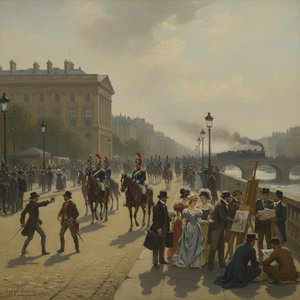
StatsMADAME ADOLPHE SALLES, NEE CLAIRE EIFFEL, FILLE DE GUSTAVE EIFFEL

 Read More
Hand Made Oil Reproduction
Hand-painted oil on canvas in your size and frame, made to order by our artists. ( Switch to Print Switch to Digital Image)




































Pick from our preset sizes that match the artwork's original proportions.

You may enter your own dimensions to fit a specific frame or space. If your selected size does not match the original image's proportions, we will either crop the artwork or extend the painting with additional hand-painted elements. A digital mockup will be sent for your approval before production begins.
Please note that the on-screen preview does not reflect the actual cropping or extension. Only the mockup will accurately show the final composition.
While custom sizes are available, we recommend selecting a dimension from the predefined list to preserve the original proportions.
After order, AllPaintingsStore.com team will email client for instructions and provide a mockup preview
Worldwide Delivery () in 3/4 weeks instead of standard 5 weeks. (22 September). No compromise on quality.

Free Worldwide Express Shipping

High-Quality Linen Canvas

Full Shipping Insurance

Customs Tax Refund Guarantee

True Color Matching Guarantee

100-Day Return Policy (Defects Only)

100% Money-Back Guarantee

Bulk Discount Offer
 Glass option is only available in size under 110 CM

MADAME ADOLPHE SALLES, NEE CLAIRE EIFFEL, FILLE DE GUSTAVE EIFFEL
Reproduction Medium
Reproduction Size
-


Total Price
$ 258
Related Artworks


Artist Biography
Jacques-Ferdinand Humbert: A Parisian Master of Light and Emotion
Jacques-Ferdinand Humbert (1842-1934) stands as a significant, yet often overlooked, figure in late 19th and early 20th-century French art. Born into a family deeply rooted in the artistic world – his uncle, Jean Charles Ferdinand Humbert, was a celebrated landscape painter mentored by Ingres – Jacques inherited not only a legacy of artistic training but also an appreciation for meticulous technique and a profound understanding of light’s transformative power. His career, spanning over seven decades, witnessed shifts in artistic styles, from the academic traditions of his early years to the burgeoning Symbolism that would ultimately define his most compelling work.
Humbert's formal education began at the École nationale supérieure des Beaux-Arts in Paris, where he studied under esteemed instructors like François-Édouard Picot, Alexandre Cabanel, and Eugène Fromentin. These formative years instilled in him a rigorous approach to drawing and painting, emphasizing anatomical accuracy and realistic representation – qualities evident in his early works depicting historical scenes and portraits. His initial Salon entries showcased a burgeoning talent, with pieces such as “The Flight of Nero” demonstrating an ability to capture dramatic narratives and theatrical lighting. However, Humbert’s artistic journey wasn't solely defined by adherence to established conventions; he possessed a keen eye for capturing the subtle nuances of human emotion and the ethereal quality of light, foreshadowing his later embrace of Symbolism.
The Panthéon Murals: A Defining Achievement
Humbert’s most ambitious and arguably most significant undertaking was the creation of a series of monumental wall paintings – known collectively as “Pro Patria” (For the Homeland) – for the Panthéon in Paris. This project, initiated in 1874 and completed in 1900, represented a culmination of his artistic skills and a profound engagement with French history and national identity. The murals depicted a sweeping cycle of events from Roman times to the Third Republic, interwoven with allegorical figures representing virtue, courage, and sacrifice. Humbert’s masterful handling of color, composition, and narrative depth transformed the Panthéon into a powerful visual chronicle of France's past.
The “Pro Patria” cycle is particularly noteworthy for its dramatic use of light and shadow, creating an atmosphere of both grandeur and intimacy. Humbert skillfully employed chiaroscuro – the contrast between light and dark – to heighten emotional impact and draw the viewer’s eye to key moments within the historical narrative. These murals cemented his reputation as a leading artist of his time and established him as a significant contributor to French public art.
A Portraitist of Distinction
While the Panthéon murals represent the apex of Humbert's career, he was equally renowned for his exquisite portraiture. He possessed an uncanny ability to capture not only the physical likeness of his subjects but also their inner character and emotional state. His portraits – ranging from aristocratic figures to everyday Parisians – are characterized by a remarkable sensitivity to detail, a subtle use of color, and a profound understanding of human psychology. Many of these works, including “Ritratto di giovane donna” (Portrait of a Young Girl) and “Portrait d'élégante au chapeau” (Portrait of an Elegant Lady), demonstrate his mastery of capturing fleeting expressions and conveying a sense of quiet dignity.
Humbert’s portraiture reflects the influence of academic traditions, yet it transcends mere imitation. He infused his portraits with a distinctly personal style, employing loose brushwork and vibrant color palettes to create works that are both realistic and emotionally resonant. His ability to capture the essence of his subjects – their personalities, aspirations, and vulnerabilities – is what distinguishes his portraiture from more conventional representations.
Influence and Legacy
Jacques-Ferdinand Humbert’s artistic legacy extends beyond his individual masterpieces. He played a crucial role in shaping the development of French art during a period of profound social and cultural change. His embrace of Symbolism, particularly in his later works, foreshadowed the aesthetic trends that would dominate the 20th century. Furthermore, he served as an influential teacher at his own academy, nurturing the talents of numerous aspiring artists, including Georges Braque, Raoul Dufy, and Pierre Waidmann.
Despite often being overshadowed by more celebrated contemporaries, Humbert’s contributions to French art are undeniable. His masterful command of technique, his profound understanding of light and emotion, and his unwavering commitment to artistic excellence ensure that he remains a significant figure in the history of 19th-century painting.

jacques-ferdinand humbert
1842 - 1934
Quick Facts
- Artistic Movement Or Style: Symbolist, Portraiture
- Artists Or Movements Influenced By This Artist: ['Eugène Fromentin']
- Artists Who Influenced This Artist: ['Jean Charles Ferdinand Humbert']
- Date Of Birth: 1842-10-08
- Date Of Death: 1934-10-06
- Full Name: Jacques-Ferdinand Humbert
- Nationality: French
- Notable Artworks:
- Flight of Nero
- Pro Patria
- The Virgin and Child
- Place Of Birth: Paris, France
Related Articles

19th Century Masterpieces: 10 Paintings That Defined an Era | AllPaintingsStore
Journey through 19th century art with AllPaintingsStore! Explore 10 iconic paintings – from Monet & Renoir to Courbet – and discover the stories behind Romanticism, Realism & Impressionism. Find museum-quality reproductions for your home decor. Explore the full collection online!

Émile Munier: Capturing 19th-Century French Life with Tender Realism
Discover Émile Munier's tender depictions of 19th-century French life. Explore his Realist style, charming paintings of children & pets, and lasting artistic legacy. Expert insights at AllPaintingsStore.
Émile Jean Horace Vernet: Romantic Realism & Depicting 19th-Century Life
Explore the life & art of Émile Jean Horace Vernet, a master of Romantic Realism. Discover his captivating battle scenes, portraits, and Orientalist works – a window into 19th-century France. Learn about his techniques & enduring legacy.

Amédée Masclef: Navigating Symbolism & Sentiment in Late 19th-Century French Landscape Painting
Explore the evocative landscapes of Amédée Masclef, a key figure bridging Barbizon realism & Symbolist sentiment. Discover his exquisite botanical watercolors and artistic legacy with AllPaintingsStore.

Beyond Reality: A Definitive Guide to the Dreamlike World of Symbolist Painting
Explore the evocative world of Symbolist painting. Discover how masters like Gustave Moreau rejected realism to capture dreams, myths, and the subconscious through fine art history and expert analysis.


