- Home

- Oil Painting Reproduction
- Thomas Cole
- The Ages of Life: Youth

 Buy print
 Send
Send Share
Share
 Details

 Download
 Similars
 X-Ray
X-Ray Diaporama
The Ages of Life: Youth
 Oil On Canvas
- WallArt
- Hudson River School
 1842
1842 134.0 x 195.0 cm
 National Gallery of Art
 Read More
Hand Made Oil Reproduction
Hand-painted oil on canvas in your size and frame, made to order by our artists.




P118B $10

P118H $10

P118W $10

P438Z $10

P508JH $12

P508YH $12

P805H $10

P805Z $10

P919BZ $10

P919G $10

P919XJ $10

P959ZH $10

P968JZ $12

W106C $8

W218G $10

W218JH $8

W218Y $10

W307PJ $10

W316G $10

W316PJ $8

W316Y $10

W398PJ $8

W4111J $10

W500HY $15

W500JH $15

W692G $12

W849H $8

W940BG $15

W953PJ $8




Pick from our preset sizes that match the artwork's original proportions.

You may enter your own dimensions to fit a specific frame or space. If your selected size does not match the original image's proportions, we will either crop the artwork or extend the painting with additional hand-painted elements. A digital mockup will be sent for your approval before production begins.
Please note that the on-screen preview does not reflect the actual cropping or extension. Only the mockup will accurately show the final composition.
While custom sizes are available, we recommend selecting a dimension from the predefined list to preserve the original proportions.
After order, AllPaintingsStore.com team will email client for instructions and provide a mockup preview
Worldwide Delivery () in 3/4 weeks instead of standard 5 weeks. (16 July). No compromise on quality.

Free Worldwide Express Shipping

High-Quality Linen Canvas

Full Shipping Insurance

Customs Tax Refund Guarantee

True Color Matching Guarantee

60-Day Return Policy (Defects Only)

100% Money-Back Guarantee

Bulk Discount Offer
 Glass option is only available in size under 110 CM

The Ages of Life: Youth
Reproduction Medium
Reproduction Size
-


Total Price
-
Artwork Description
The Ages of Life: Youth – A Vision of American Romanticism
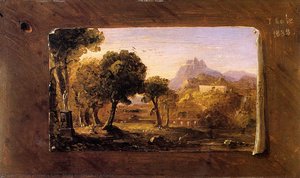
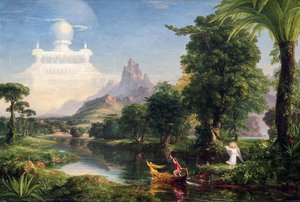
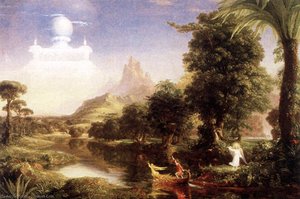
Thomas Cole’s “The Ages of Life: Youth,” painted in 1842, isn't merely a landscape; it’s a profound allegory of human experience, a cornerstone of the Hudson River School movement and a testament to the burgeoning American identity. This monumental canvas, measuring an impressive 134 x 195 cm, transports us to a serene, idealized wilderness – a carefully constructed vision of the untamed American frontier imbued with both spiritual resonance and a subtle critique of societal progress. Cole, deeply influenced by European Romanticism yet firmly rooted in his native landscape, masterfully blends meticulous observation with symbolic depth, creating an image that continues to captivate viewers centuries later.
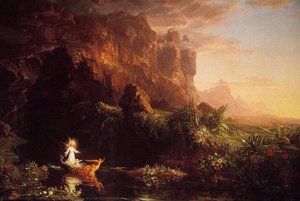
The scene unfolds within a lush, verdant forest, bathed in the golden light of early morning. A crystalline river snakes its way through the trees, leading towards a distant, shimmering castle – not a literal fortress, but rather a symbol of youthful aspiration and potential. Dominating the foreground are two figures, rendered with remarkable detail and imbued with an almost ethereal quality. These aren’t portraits in the traditional sense; they represent humanity at its most vibrant and hopeful stage. The central figure, a young man, confidently steers a small boat along the river's course, his hand firmly gripping the tiller – a gesture of agency and control over one’s own destiny. Notice the delicate rendering of his clothing, suggesting both practicality and an awareness of beauty.
A Symphony of Color and Light
Cole’s technical skill is immediately apparent in the masterful use of color and light. He employs a technique known as “lost-edge blending,” where colors are subtly layered to create soft transitions and atmospheric depth. The greens of the forest are not uniform; they range from deep, shadowed hues to vibrant, sunlit patches, conveying a sense of movement and vitality. The sky is rendered with an almost luminous quality, utilizing layers of blue and white to suggest both clarity and mystery. Light plays a crucial role in shaping the scene, illuminating the figures and highlighting the beauty of the natural world. The artist’s attention to detail extends to the reflections on the water's surface, adding another layer of realism and visual interest.
Symbolism Woven into the Landscape
Beyond its aesthetic appeal, “The Ages of Life: Youth” is rich in symbolism. The river itself represents the flow of time, carrying humanity through the stages of existence. The castle symbolizes youthful ambition, dreams, and the pursuit of knowledge – a beacon guiding the voyager towards his future. The angel, positioned on the riverbank, isn’t a divine intervention but rather a guide, representing wisdom and spiritual direction. Crucially, the angel doesn't actively control the boat; instead, it offers assistance and encouragement, reflecting the importance of inner strength and self-reliance. The distant castle is not a destination to be reached, but a symbol of aspiration – a goal to strive for with grace and determination.
A Reflection of American Identity
Painted during a period of significant social and political change in America, “The Ages of Life: Youth” can be interpreted as a reflection on the nation’s burgeoning identity. Cole, deeply concerned with the relationship between humanity and nature, sought to capture the spirit of the American wilderness – its vastness, its beauty, and its potential for spiritual renewal. This painting stands in contrast to the industrialization sweeping across Europe, offering an idealized vision of a simpler, more harmonious existence rooted in connection with the natural world. It’s a powerful statement about the values that should guide America's future—a celebration of individualism, self-reliance, and reverence for the land.
Bringing “Youth” Home: Reproductions and Beyond
Today, “The Ages of Life: Youth” remains one of Thomas Cole’s most celebrated works. High-quality reproductions capture much of the original's atmosphere and detail, making it a stunning addition to any home or office. Consider how this evocative image can contribute to a space—a reminder of the beauty of nature, the importance of aspiration, and the enduring spirit of American Romanticism. When selecting a reproduction, prioritize archival quality materials to ensure that the colors remain vibrant for generations to come.
Related Artworks



Artist Biography
A Pioneer of American Landscape Painting
Thomas Cole, a name synonymous with the birth of distinctly American art, stands as a pivotal figure in 19th-century painting. Born in Bolton le Moors, Lancashire, England, in 1801, his early life offered little indication of the profound impact he would have on the artistic landscape. Emigrating to the United States with his family in 1818 and settling in Ohio, Cole’s journey was one of self-discovery and artistic awakening. Initially working as an itinerant portrait painter—a common trade at the time—he soon found himself drawn to the untamed beauty of the American wilderness. This shift wasn't merely a change in subject matter; it represented a fundamental divergence from European artistic traditions, which often focused on historical or mythological narratives. Cole’s landscapes weren’t simply depictions of scenery; they were imbued with a spiritual and allegorical depth that resonated deeply with a nation forging its own identity. His move to Catskill, New York, in 1825 proved transformative, providing him with both inspiration and a permanent base from which to explore the surrounding Hudson River Valley—a region that would become inextricably linked with his artistic legacy.The Hudson River School and Romantic Ideals
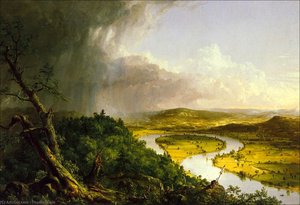
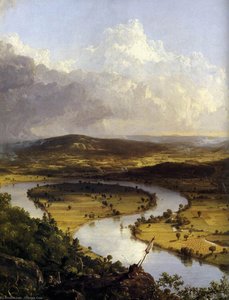
Cole is rightfully regarded as the founder of the Hudson River School, an art movement characterized by its romantic portrayal of the American landscape. However, to label him simply a “landscape painter” feels inadequate. His work transcended mere representation; it was deeply philosophical, often exploring themes of humanity’s relationship with nature, the passage of time, and the rise and fall of civilizations. Influenced by European Romanticism—particularly the works of Claude Lorrain and J.M.W. Turner—Cole adapted these sensibilities to an American context. Where European Romantics often depicted dramatic, sublime landscapes as a reflection of inner turmoil, Cole’s paintings frequently conveyed a sense of optimism and divine presence within the natural world. He saw in the vastness of the American wilderness a symbol of national potential and spiritual renewal. The Oxbow (1836), perhaps his most iconic work, exemplifies this perfectly—a sweeping vista that contrasts the wild, untamed river valley with the cultivated farmlands, representing both the promise and the challenges of westward expansion.Allegory and The Course of Empire
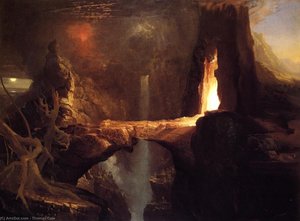
While celebrated for his realistic depictions of nature, Cole’s artistic ambition extended beyond pure landscape painting. He frequently employed allegory to convey complex moral and philosophical ideas. This is most powerfully demonstrated in his monumental series The Course of Empire, created between 1833 and 1836. Comprising five canvases—"Savage State," "Pastoral State," "Arcadian State," "Consummation," and "Destruction"—the series traces the cyclical history of a civilization, from its pristine origins to its inevitable decline. The paintings are not merely historical narratives; they serve as cautionary tales about the dangers of unchecked ambition and the fragility of human achievement. The Course of Empire resonated deeply with contemporary audiences, reflecting anxieties about the rapid industrialization and westward expansion that were transforming the American landscape. It cemented Cole’s reputation as a visionary artist capable of addressing profound societal concerns through his art.Legacy and Enduring Influence
Thomas Cole's untimely death in 1848 at the age of 47 marked a significant loss for the American art world. However, his influence continued to reverberate through generations of artists. He directly mentored Frederic Edwin Church, who would become one of the leading figures of the second generation of Hudson River School painters. His emphasis on observation from nature, combined with a deeply personal and symbolic approach to landscape painting, laid the foundation for a distinctly American artistic tradition.- Cole’s work continues to be exhibited in major museums across the United States, including the New-York Historical Society, the National Gallery of Art in Washington D.C., and the Smithsonian American Art Museum.
- His paintings are not merely historical artifacts; they remain powerfully evocative and relevant today, prompting viewers to contemplate their own relationship with nature and the enduring questions about humanity’s place in the world.
- The Thomas Cole National Historic Site in Catskill, New York, preserves his home and studio, offering visitors a glimpse into the life and work of this remarkable artist.

Thomas Cole
1801 - 1848 , United Kingdom
Quick Facts
- Artistic Movement Or Style: Hudson River School
- Artists Or Movements Influenced By This Artist:
- Asher B. Durand
- Frederic Edwin Church
- Date Of Birth: February 1, 1801
- Date Of Death: February 11, 1848
- Full Name: Thomas Cole
- Nationality: American
- Notable Artworks:
- The Course of Empire
- The Oxbow
- A View from Mount Etna
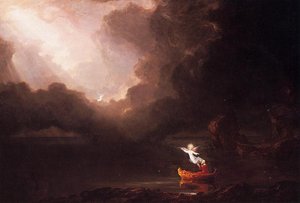
- The Voyage of Life
- Place Of Birth: Bolton, UK
Related Articles

William Bradford: Navigating Faith, Landscape & Artistic Innovation in Early American Painting
Explore the captivating world of William Bradford, American Romanticist painter renowned for his dramatic Arctic seascapes & ship portraits. Discover his artistic evolution, influences, and lasting legacy with AllPaintingsStore.

Luminism: Capturing Ephemeral Light & Transcendence in 19th-Century American Landscape Painting
Explore the captivating world of Luminism! Discover the key artists, techniques & legacy of this influential 19th-century American art movement. Expert insights & high-quality reproductions at AllPaintingsStore.
Edward Mitchell Bannister: A Pioneer of American Landscape Painting & Artistic Recognition
Discover the remarkable life & art of Edward Mitchell Bannister, a pioneering African American landscape painter. Explore his journey overcoming barriers to achieve recognition and lasting impact on 19th-century American art.
Evoking Nature's Sublime: A Comprehensive Exploration of 19th-Century Landscape Painting
Explore the captivating world of 19th-century landscape painting! Discover renowned artists like Friedrich & Monet, key movements, and find the perfect artwork to bring nature's serenity into your home. Expert insights at AllPaintingsStore.
Thomas George Webster: Navigating Genre Boundaries & American Identity in 19th-Century Landscape Painting
Explore the captivating genre scenes of Thomas George Webster, a Victorian painter bridging British traditions with American themes. Discover his style, influences & legacy in 19th-century art history.