Money-Back Guarantee · 100 days Free Worldwide Delivery
449,587artworks 30,613artists 4,660museums 32languages
Catalogue entry

Danae

1546. Oil On Canvas, 120.0 x 172.0 cm. Museo di Capodimonte.

Fig. 1. Titian Ramsay Peale II, Danae, 1546. Shown as the reproduction you are specifying: , .

§ 1Catalogue data

Dimensions
120.0 x 172.0 cm

§ 2Abstract

Collectible Description

A divine scene of mythological vulnerability unfolds in Titian Ramsay Peale II's Danae, where celestial angels descend upon a princess in a masterful display of Venetian-inspired Mannerism waiting to grace your collection.

Artist Biography

High Renaissance style defines Venus Anadyomene. Discover the stunning beauty of his classical works today.

§ 3Commentary

A Venetian Echo in American Vision

The story of Danae is one of profound vulnerability met by divine intervention, a mythological tapestry woven with threads of longing and celestial grace. In this evocative masterpiece by Titian Ramsay Peale II, we find ourselves transported to a moment of quiet intensity. The painting captures the princess of Argolis, confined within a tower by her father, King Acrisius, to shield her from the whims of fate. As she reclines upon her bed, the atmosphere is thick with a sense of sacred anticipation. An angel hovers above her, a silent sentinel of the heavens, while another descends through the air, signaling the arrival of Zeus in his golden form. This narrative of celestial intrusion into human isolation creates a tension that is both breathtaking and deeply intimate, inviting the viewer to witness a miracle unfolding in the stillness of a private chamber.

Peale II’s technique serves as a bridge between the rugged landscapes of 19th-century America and the opulent traditions of the Italian Renaissance. While his lineage was firmly rooted in the burgeoning American art scene of Philadelphia, his heart beat to the rhythm of Venice. One can observe this devotion in the masterful manipulation of color and light; the canvas possesses an arresting vibrancy and a textural richness that directly echoes the works of Titian and Giorgione. His approach leans into the elegance of Mannerism, utilizing stylized poses and elongated figures to heighten the dramatic expression of the scene. Yet, he avoids mere abstraction by grounding the work in a palpable sense of naturalism. Every detail, from the soft folds of the linens to the delicate presence of birds—symbols of love and freedom—is rendered with a precision that breathes life into the myth.

Symbolism and Emotional Resonance

Beyond the literal retelling of myth, the painting is a profound study in symbolism and emotional depth. The presence of the angels does more than just advance the plot; they represent a divine protection that transcends the physical walls of the tower. The birds fluttering within the scene act as poignant metaphors for the soul's desire to escape confinement, mirroring Danae’s own plight. For the collector or the interior designer, this piece offers much more than visual beauty; it provides an emotional anchor. The interplay between the heavy atmosphere of imprisonment and the light-filled promise of divine visitation creates a dynamic energy that can transform a room.

Whether displayed in a grand gallery or as a focal point in a sophisticated living space, Danae commands attention through its ability to evoke contemplation. It is a work that speaks to the universal human experience of seeking light within darkness and finding grace amidst struggle. For those seeking to curate an environment of intellectual depth and classical elegance, this reproduction offers a window into a singular moment in art history—where the meticulous observation of an American naturalist meets the eternal, luminous spirit of the Venetian masters.

Questions & Answers

Which artistic current is "Danae" by Titian Ramsay Peale II part of?

"Danae" is a work of Renaissance Echo. The movement indicates the artistic tradition the work is part of.

When was "Danae" made?

"Danae" dates from 1546. The date places the work within Titian Ramsay Peale II's career and its era.

What technique and style characterize "Danae" by Titian Ramsay Peale II?

In "Danae", the oil on canvas technique meets the Renaissance Echo movement.
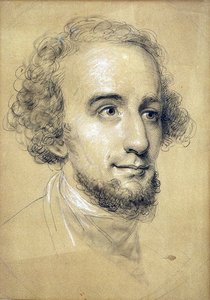
§ 4The artist

Artist Biography

The intersection of science and classical form

To look at the work of Titian Ramsay Peale II is to see a deliberate attempt to reconcile the rigorous demands of 19th-century natural history with the aesthetic weight of the High Renaissance. Born in Philadelphia in 1799, he did not merely inherit a famous name as the son of Charles Willson Peale; he inherited a specific way of seeing. His early years were defined by this dual focus. He was an explorer and a scientific illustrator long before he was purely a painter. During the Stephen Harriman Long expedition to the Rocky Mountains between 1819 and 1820, his task was documentation. He recorded flora and fauna with a precision that required anatomical accuracy. This period of fieldwork provided the technical foundation for his later canvases. He understood how light hit a wing or how texture defined a specimen.

This scientific training prevented his later religious and mythological works from becoming mere abstractions. When he turned to subjects like St. Augustine, he applied the same scrutiny to the folds of a garment as he would to a botanical specimen. He utilized techniques such as sfumato to soften edges, yet the underlying structure remained grounded in physical reality. His work exists in the tension between the observational eye of a naturalist and the stylistic ambitions of Venetian colorism.

A technical bridge between eras

Peale’s development was marked by an refusal to adhere to the purely utilitarian trends of American art in his era. While many contemporaries focused on straightforward portraiture or landscape, he looked backward to the principles of artists like Rubens and the Venetian masters. This is most evident in his handling of color and light. He sought a luminous quality that mirrored the Old World traditions. His religious paintings, such as The Holy Family with a Shepherd, demonstrate a controlled use of oil paint to build depth through layers. He did not rely on superficial beauty; he relied on the structural application of pigment.

His technical repertoire was broad and functional. He worked across several media to achieve his goals:

  • Watercolor and graphite for scientific documentation
  • Oil on canvas for religious and mythological subjects
  • Lithography and ink for illustration
  • Photography, which he adopted as an amateur later in life

This versatility allowed him to move between the microscopic detail of a Cicada watercolor and the atmospheric scale of a landscape. He was not interested in style for its own sake, but in how specific techniques could communicate the weight of his subject matter.

The legacy of an overlooked naturalist

For much of the 20th century, Peale’s significance was obscured by the sheer scale of the Peale family's broader impact on American culture. He did not fit the mold of the purely commercial portraitist. His career included roles as a chief naturalist for the United States Exploring Expedition from 1838 to 1842 and work within the United States Patent Office. These were not distractions from his art; they were the source of it. The precision found in his wildlife drawings informed the dignity he brought to his classical subjects.

Today, the value of his work lies in this specific synthesis. He represents a moment when American identity was being formed through the simultaneous exploration of new territories and the reinterpretation of ancient artistic values. His paintings, now held in institutions such as the Uffizi Gallery and the Scottish National Gallery of Modern Art, remain relevant because they refuse to separate the intellect from the aesthetic. He proved that scientific observation and classical reverence could occupy the same canvas.

§ 5Comparanda

§ 6Questions

Quick Facts

  • Subject or theme: Mythology
  • Movement: Renaissance
  • Medium: Oil on canvas
  • Artistic style: Classical
  • Influences: Venetian Renaissance
  • Location: Private Collection

Art Quiz

There is only one correct answer for each question.

Question 1:
What mythological story does Titian Ramsay Peale II’s painting ‘Danae’ depict?
Question 2:
According to the description, what is symbolized by the three birds in the scene?
Question 3:
What artistic movement heavily influenced Titian Ramsay Peale II’s style, evident in his meticulous detail and vibrant color palette?
Question 4:
The painting portrays Danae being protected by angels. What does this imagery represent?
Question 5:
Charles Willson Peale, Titian Ramsay Peale II’s father, is renowned for his contribution to American art history. What was his primary artistic focus?

§ 7Cite this entry

AllPaintingsStore.com, “Titian Ramsay Peale II, Danae (1546)”, https://allpaintingsstore.com/en/art/titian-ramsay-peale-ii-danae-D2SEMG-en/ (accessed 4 October 2026).

§ 8The reproduction

Hand Made Oil Reproduction

Hand-painted oil on canvas in your size and frame, made to order by our artists. ( Switch to Print Switch to Digital Image)

It is specified on the order sheet in the margin; the present state of that sheet reads as follows.

Danae

Reproduction Medium

Reproduction Size

-

Elite Senior Artist

More detail, finesse, and extra production time

-

Reproduction Frame

-

-

For artworks or reproductions larger than 105 cm (approximately 41 inches) on any side, the frame will be shipped as a kit, disassembled. This method ensures safe delivery and prevents damage during transport.

Professional assembly required - this is not a DIY product.
The kit must be assembled and the canvas stretched by an experienced professional framer, using wood glue (not supplied), a canvas stretching plier and clamps to hold the bars square while the glue dries. Incorrect assembly or uneven canvas tension can permanently damage the artwork and is not covered by our warranty.

  • All solid wood bars are included, precisely cut to size.

  • Assembled with the screws provided, plus wood glue for the corner joints, which is not supplied and must be sourced by your framer.

  • Professional tools are required and not included: a canvas stretching plier (tensioner) and clamps to hold the bars square while the glue dries.

Important:
The corner joints require wood glue, the bars must be held with clamps until the glue is fully dry, and tightening the canvas on the assembled frame requires a canvas stretching plier. None of these are included in the kit. Please arrange an experienced professional framer before ordering this size.

Nameplate

-

-

Protective Varnish

Glossy Varnish (enhances colors, protects against light/moisture)

-

Customize My Artwork

Examples of what can be changed: Replace face with customer photo; Add pet (e.g., replace cat with dog); Include hidden message in background; Change background landscape or elements.

-

Urgent

Worldwide Delivery () in 3/4 weeks instead of standard 5 weeks. (1 November). No compromise on quality.

-

Express Shipping

Worldwide Delivery () in 5 weeks. (8 November).

Included

Total Price

$ 258

Included with every order

  • Free Worldwide Express Shipping
  • High-Quality Linen Canvas
  • Full Shipping Insurance
  • Customs Tax Refund Guarantee
  • True Color Matching Guarantee
  • 100-Day Return Policy (Defects Only)
  • 100% Money-Back Guarantee
  • Bulk Discount Offer
Order sheet