Money-Back Guarantee · 100 days Free Worldwide Delivery
449,561artworks 30,612artists 4,658museums 32languages
Catalogue entry

St Augustine

Acrylic On Canvas. Santa Maria della Salute.

Fig. 1. Titian Peale, St Augustine. Shown as the reproduction you are specifying: , .

§ 1Catalogue data

§ 2Abstract

Collectible Description

Discover 'St Augustine' by Titian Ramsay Peale II – a captivating High Renaissance portrait showcasing the revered bishop with striking detail and masterful composition.

Artist Biography

High Renaissance style defines Venus Anadyomene. Discover the stunning beauty of his classical works today.

§ 3Commentary

A Renaissance Echo: Titian Ramsay Peale II’s “St Augustine”

Titian Ramsay Peale II's "St Augustine" is more than just a portrait; it’s a quiet contemplation rendered in oil, a testament to the enduring power of faith and intellectual pursuit. The painting centers on the figure of St Augustine of Hippo, one of the most influential theologians and philosophers in Christian history. Peale presents him not as a distant icon, but as a man deeply immersed in thought, his gaze directed inward, suggesting a profound inner life. The artist’s meticulous attention to detail – evident in the rendering of Augustine's beard and the folds of his garments – speaks to a dedication to both technical skill and respectful representation. The composition is deliberately focused on the face and upper body, drawing the viewer into an intimate encounter with this pivotal figure.

The Legacy of a Family & A Style

Born in 1799, Titian Ramsay Peale II inherited a rich artistic lineage as the son of Charles Willson Peale, a celebrated American portraitist. This familial influence undoubtedly shaped his early training and instilled within him an appreciation for capturing the likeness and character of his subjects. However, Peale II distinguished himself through a clear affinity for the High Renaissance aesthetic – a style characterized by its emphasis on balance, harmony, and idealized forms. This is particularly evident in “St Augustine,” where the figure’s features are rendered with a classical grace reminiscent of Italian masters. The inclusion of a clock in the background adds an intriguing layer to the composition; it could symbolize the passage of time, the weight of history, or perhaps even Augustine's own reflections on temporality and eternity.

Symbolism & Spiritual Depth

St Augustine himself is laden with symbolic meaning. As Bishop of Hippo, he was a pivotal figure in shaping Christian doctrine, particularly his writings on grace, sin, and redemption. Peale’s depiction subtly alludes to these intellectual contributions; the contemplative pose suggests Augustine's tireless pursuit of truth and understanding. The staff held in his hand is a traditional symbol of pastoral authority, representing his role as a shepherd guiding his flock. Beyond the religious symbolism, the painting also evokes a sense of humanism – a celebration of individual intellect and spiritual yearning that was central to Renaissance thought. The overall effect is one of quiet dignity and profound introspection.

A Rediscovered Voice in American Art

For many years, Titian Ramsay Peale II remained somewhat overshadowed by his more famous father. However, recent scholarship has begun to recognize the unique contributions of this talented artist. His work represents a fascinating intersection of American artistic traditions and European Renaissance ideals. “St Augustine” stands as a compelling example of his skill and vision – a painting that invites viewers to engage with both the historical figure it portrays and the enduring questions of faith, knowledge, and the human condition. A reproduction of this piece would bring not only aesthetic beauty but also a sense of intellectual depth and spiritual resonance to any space.

Questions & Answers

Does "St Augustine" by Titian Peale use strong contrasts or soft harmonies?

In "St Augustine", a gentle contrast is paired with a strong color unity harmony.

How do I discover artworks close to "St Augustine" by Titian Peale?

Works similar to "St Augustine" are listed on the artwork's Similars page.

What use is suggested for "St Augustine" by Titian Peale?

The recommended use of a print of "St Augustine" is accent.
§ 4The artist

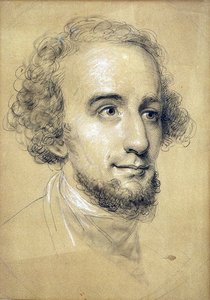
Titian Peale

Titian Peale

1799 - 1885, United States

Quick facts about Titian Peale

  • Artistic Movement Or Style: High Renaissance Revival
  • Artists Who Influenced This Artist:
    • Rubens
    • Venetian masters
  • Full Name: Titian Ramsay Peale II
  • Nationality: American
  • Notable Artworks:
    • Entertaining the Favorites
    • Five Bobwhites at the Delaware Water Gap
    • St Ambrose
    • St Augustine
    • St Mark
    • St Matthew
    • St Gregory the Great
    • Venus with an Organist and a Dog
    • Doge Andrea Gritti
    • Portrait of Emperor Charles V
    • St Luke
    • St John the Evangelist
    • St Jerome
    • Alfonso d'Este
  • Place Of Birth: Philadelphia, USA
  • Date Of Birth: 1799
  • Date Of Death: 1885

Artist Biography

The Life of Titian Ramsay Peale II

Titian Ramsay Peale II occupied a specific, functional space in the American landscape, operating at the intersection of scientific documentation and formal art. Born on November 17, 1799, in Philosophical Hall, Philadelphia, Pennsylvania, he was the youngest son of Charles Willson Peale and Elizabeth DePeyser. His life was defined by a refusal to settle into a single discipline. He was an American artist, naturalist, explorer, and scientific illustrator, moving between the meticulous requirements of field research and the structured demands of studio painting.

His career was not a pursuit of mere aestheticism but a practical application of observation. He spent much of his life documenting the physical world, a task that required him to be as much a technician as a painter. This dual identity allowed him to navigate diverse environments, from the controlled settings of a museum to the unpredictable terrain of an expedition. He died in Philadelphia, Pennsylvania, on March 13, 1885, leaving behind a body of work that prioritized the structural reality of his subjects over stylistic abstraction.

Early Life, Family and Training

To understand Titian Ramsay Peale II, one must look at the weight of the Peale name. He was born into a dynasty that functioned as the primary engine of American artistic and scientific life. As the son of Charles Willson Peale, a central figure in early American portraiture, his upbringing was dictated by the intersection of fine art and natural history. This was no quiet childhood. He grew up alongside a large, interconnected family of artists and intellectuals, including his brothers Raphaelle, Rembrandt, Rubens, and Franklin Peale. His lineage was complex, involving half-siblings such as Sophonisba Angusciola Peale and Titian Ramsay Peale I, the latter of whom the subject was named after.

The training he received was practical and rigorous. He was not merely a student of aesthetics but a participant in a family-run enterprise of observation. His siblings, including James, Anna Claypoole, and Margaretta Peale, were all part of this intense environment of production. This familial structure meant that his education was inseparable from the work of his father and his brothers. He learned to see through the lens of both the portraitist and the naturalist. This dual education provided the technical foundation for a career that would eventually bridge the gap between scientific documentation and classical painting.

Scientific Expeditions and Naturalist Career

Peale’s career was defined by a commitment to empirical observation that many of his contemporaries lacked. He did not merely observe nature from a distance; he actively participated in the primary scientific explorations of the early nineteenth century. His fieldwork began early, including the 1817–1818 expedition to Florida and Georgia alongside George Ord, William Maclure, and Thomas Say. This early immersion in the field established a pattern of rigorous documentation. Between 1819 and 1820, he accompanied the Stephen Harriman Long expedition to the Rocky Mountains and the Great Plains. These years in the field provided the anatomical and botanical precision that would later ground his more formal artistic endeavors.

His professional standing in the scientific community was solidified by his election to the American Philosophical Society in 1833. This recognition coincided with his most significant institutional contribution: his role in the United States Exploring Expedition from 1838 to 1842. Serving as the chief naturalist for this expedition, Peale moved beyond simple illustration into the realm of active scientific leadership. His ability to bridge the gap between the meticulous requirements of a naturalist and the technical skill of a draftsman made him an essential asset to these large-scale maritime and terrestrial surveys.

Even as his focus shifted toward other professional duties, his connection to the systematic recording of information remained constant. He maintained a steady presence within the federal bureaucracy, working at the United States Patent Office until 1873. This long tenure reflects a career built on the disciplined application of observation, whether applied to a specimen in the field or a technical detail in a government office.

Technique and Artistic Style

Peale’s work operates within a specific tension between the observational eye of a naturalist and the stylistic ambitions of Venetian colorism. He did not settle for the flat, utilitarian documentation common in 19th-century scientific illustration. Instead, he sought a luminous quality that mirrored Old World traditions. This was achieved through a controlled use of oil paint, which he applied in layers to build physical and visual depth. He frequently employed sfumato to soften edges, a technique that allowed him to bridge the gap between anatomical precision and atmospheric grace.

His technical repertoire was notably broad, reflecting a versatility that allowed him to move between the microscopic and the monumental. He was proficient in several media: watercolor and graphite for his scientific observations, oil on canvas for religious and mythological subjects, and lithography and ink for his illustrations. Even in his later years, he engaged with the emerging medium of photography as an amateur. This technical breadth ensured that his subjects—whether a botanical specimen or a classical figure—retained a sense of structural reality beneath their aesthetic finish.

Key Works and Subjects

Peale’s output reveals a tension between the biological and the divine. His religious subjects, such as St. Augustine, St. Gregory the Great, and The Holy Family with a Shepherd, all produced around 1510, demonstrate a commitment to classical form. These works rely on structural clarity rather than mere sentiment. He applied similar scrutiny to his mythological subjects, notably Venus Anadyomene, which he also produced around 1520. The precision of his observation is evident in how he handled the drapery and anatomical presence in these figures. He also produced undated works of St. Mark and St. Matthew, maintaining this focus on religious iconography throughout his career.

The naturalist in Peale was never a secondary interest; it was a primary lens. His ability to transition from the theological to the ornithological is seen in Five Bobwhites at the Delaware Water Gap, painted about 1868. This work demands the same technical rigor as his larger canvases but applies it to the specific textures of wildlife. Even his more social or observational scenes, like Entertaining the Favorites from about 1830, reflect a controlled application of pigment that avoids superficiality. He did not paint for decoration; he painted to document the weight of his subject matter.

  • St. Mark, undated
  • St. Matthew, undated

Where to See the Works Today

Peale’s presence in major international collections confirms that his work moved far beyond the American frontier. His religious and mythological subjects are distributed across Europe’s most significant institutions. In London, the National Gallery holds his output, while the Museo del Prado in Madrid and the Museo di Capodimonte in Naples maintain substantial holdings. These collections demonstrate that his technical approach to light and form resonated with European standards of the time.

The reach of his oeuvre extends into Central and Southern Europe. The Kunsthistorisches Museum in Vienna and Santa Maria della Salute in Venice both house his paintings. In the Netherlands, the Mauritshuis in The Hague preserves his work, alongside the Scottish National Gallery of Modern Art in Edinburgh, which holds his Venus Anadyomene. These locations provide the necessary context to see how he applied Venetian colorism to classical themes.

  • Entertaining the Favorites (1830)
  • Five Bobwhites at the Delaware Water Gap (1868)
  • The Holy Family with a Shepherd (about 1510)

§ 5Comparanda

§ 6Questions

Quick Facts

  • Influences: High Renaissance
  • Subject or theme: Religious portrait
  • Artist: Titian Ramsay Peale II
  • Movement: High Renaissance

Art Quiz

There is only one correct answer for each question.

Question 1:
Based on the provided information, to which artistic period does Titian Ramsay Peale II’s ‘St Augustine’ most likely belong?
Question 2:
What is notable about the background of the painting 'St Augustine' as described in the image description?
Question 3:
Who was St. Augustine, the subject of this painting?
Question 4:
Titian Ramsay Peale II was the son of a prominent artist. Who was his father?

§ 7Cite this entry

AllPaintingsStore.com, “Titian Peale, St Augustine”, https://allpaintingsstore.com/en/art/titian-ramsay-peale-ii-st-augustine-D2GHWE-en/ArtistReproduction/ (accessed 14 October 2026).

§ 8The reproduction

Hand Made Oil Reproduction

Hand-painted oil on canvas in your size and frame, made to order by our artists. ( Switch to Print Switch to Digital Image)

It is specified on the order sheet in the margin; the present state of that sheet reads as follows.

St Augustine

Reproduction Medium

Reproduction Size

-

Elite Senior Artist

More detail, finesse, and extra production time

-

Reproduction Frame

-

-

For artworks or reproductions larger than 105 cm (approximately 41 inches) on any side, the frame will be shipped as a kit, disassembled. This method ensures safe delivery and prevents damage during transport.

Professional assembly required - this is not a DIY product.
The kit must be assembled and the canvas stretched by an experienced professional framer, using wood glue (not supplied), a canvas stretching plier and clamps to hold the bars square while the glue dries. Incorrect assembly or uneven canvas tension can permanently damage the artwork and is not covered by our warranty.

  • All solid wood bars are included, precisely cut to size.

  • Assembled with the screws provided, plus wood glue for the corner joints, which is not supplied and must be sourced by your framer.

  • Professional tools are required and not included: a canvas stretching plier (tensioner) and clamps to hold the bars square while the glue dries.

Important:
The corner joints require wood glue, the bars must be held with clamps until the glue is fully dry, and tightening the canvas on the assembled frame requires a canvas stretching plier. None of these are included in the kit. Please arrange an experienced professional framer before ordering this size.

Nameplate

-

-

Protective Varnish

Glossy Varnish (enhances colors, protects against light/moisture)

-

Customize My Artwork

Examples of what can be changed: Replace face with customer photo; Add pet (e.g., replace cat with dog); Include hidden message in background; Change background landscape or elements.

-

Urgent

Worldwide Delivery () in 3/4 weeks instead of standard 5 weeks. (11 November). No compromise on quality.

-

Express Shipping

Worldwide Delivery () in 5 weeks. (18 November).

Included

Total Price

$ 258

Included with every order

  • Free Worldwide Express Shipping
  • High-Quality Linen Canvas
  • Full Shipping Insurance
  • Customs Tax Refund Guarantee
  • True Color Matching Guarantee
  • 100-Day Return Policy (Defects Only)
  • 100% Money-Back Guarantee
  • Bulk Discount Offer
Order sheet