- Home

- Oil Painting Reproduction
- Walker Evans
- Roadside Stand, vicinity Birmingham, Alabama

 Buy print
 Send
Send Share
Share
 Details

 Download
 Similars
 X-Ray
X-Ray Diaporama
Roadside Stand, vicinity Birmingham, Alabama
 Acrylic On Canvas
- WallArt
- Documentary Photography
 1971
1971 24.0 x 19.0 cm
 George Eastman Museum
 Read More
Hand Made Oil Reproduction
Hand-painted oil on canvas in your size and frame, made to order by our artists.




P118B $10

P118H $10

P118W $10

P438Z $10

P508JH $12

P508YH $12

P805H $10

P805Z $10

P919BZ $10

P919G $10

P919XJ $10

P959ZH $10

P968JZ $12

W106C $8

W218G $10

W218JH $8

W218Y $10

W307PJ $10

W316G $10

W316PJ $8

W316Y $10

W398PJ $8

W4111J $10

W500HY $15

W500JH $15

W692G $12

W849H $8

W940BG $15

W953PJ $8




Pick from our preset sizes that match the artwork's original proportions.

You may enter your own dimensions to fit a specific frame or space. If your selected size does not match the original image's proportions, we will either crop the artwork or extend the painting with additional hand-painted elements. A digital mockup will be sent for your approval before production begins.
Please note that the on-screen preview does not reflect the actual cropping or extension. Only the mockup will accurately show the final composition.
While custom sizes are available, we recommend selecting a dimension from the predefined list to preserve the original proportions.
After order, AllPaintingsStore.com team will email client for instructions and provide a mockup preview
Worldwide Delivery () in 3/4 weeks instead of standard 5 weeks. (16 July). No compromise on quality.

Free Worldwide Express Shipping

High-Quality Linen Canvas

Full Shipping Insurance

Customs Tax Refund Guarantee

True Color Matching Guarantee

60-Day Return Policy (Defects Only)

100% Money-Back Guarantee

Bulk Discount Offer
 Glass option is only available in size under 110 CM

Roadside Stand, vicinity Birmingham, Alabama
Reproduction Medium
Reproduction Size
-


Total Price
-
Artwork Description
A Snapshot of Resilience: Examining Walker Evans’s “Roadside Stand”
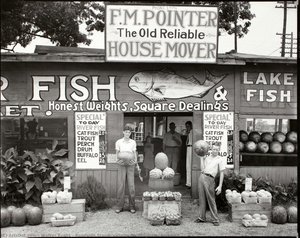
Walker Evans's "Roadside Stand, vicinity Birmingham, Alabama," produced in 1971, transcends mere documentation; it embodies a profound meditation on American identity during the twilight years of the Depression era. Captured with masterful precision using a large format camera – a deliberate choice reflecting Evans’s commitment to capturing nuanced detail – the photograph presents a deceptively simple tableau: a weathered storefront displaying fish alongside two men diligently tending their trade in rural Alabama. Yet, within this unassuming scene lies an astonishing wealth of observation and symbolic resonance. The image's stylistic hallmark is undeniably documentary photography, prioritizing authenticity over idealized representation. Evans eschewed artistic embellishment, favoring instead a direct engagement with the subject matter—a conscious rejection of prevailing trends toward painterly abstraction that dominated the art world of his time. This approach aligns perfectly with Evans’s broader philosophical stance: he sought to portray America as it *was*, confronting its hardships and vulnerabilities without resorting to sentimental glossing over. The muted palette – predominantly shades of gray punctuated by subtle highlights – contributes significantly to this atmosphere of understated solemnity, mirroring the pervasive sense of economic hardship that gripped the nation during the period. Technically speaking, Evans utilized a large format camera, allowing for exceptional sharpness and tonal range—crucial elements in conveying the textures and subtleties of the Alabama landscape and its inhabitants. The meticulous printing process ensured that every nuance of light and shadow was faithfully reproduced, preserving the photograph's inherent realism. Lines dominate the composition, delineating the building’s structure and guiding the viewer’s gaze across the frame. Geometric shapes—rectangular signage and rounded fish illustrations—create a visual rhythm that reinforces the image’s stability and quiet dignity. Beyond its aesthetic qualities, “Roadside Stand” speaks powerfully to the historical context of its creation. Produced in 1935-1937 during Evans's involvement with the Farm Security Administration (FSA), the photograph served as part of a larger effort to document the plight of American farmers struggling amidst the Great Depression. The FSA’s mission was not merely to record hardship but to foster empathy and understanding—a goal Evans admirably achieved through his unflinching portrayal of rural Alabama life. The inclusion of two men diligently displaying their wares symbolizes perseverance and industriousness, embodying the spirit of resilience that characterized the era. Furthermore, the fish itself functions as a potent symbol – representing sustenance, livelihood, and ultimately, hope amidst despair. Ultimately, “Roadside Stand” remains an enduring testament to Evans’s artistic vision and his unwavering dedication to capturing the essence of American experience. Its quiet beauty resides not in grand gestures but in meticulous observation—a reminder that profound insight can be found within the most unassuming corners of our world. It continues to inspire artists and designers alike, prompting contemplation on themes of authenticity, resilience, and the enduring power of visual storytelling.Related Artworks





Artist Biography
A Witness to America: The Life and Legacy of Walker Evans
Walker Evans, born in St. Louis in 1903, emerged as a pivotal figure in American photography, his name inextricably linked with the visual record of the Great Depression. Yet to define him solely by this period would be to diminish the breadth of his artistic vision and enduring influence. His journey was one of constant exploration, evolving from literary aspirations to a uniquely observant photographic style that captured not just *what* America was, but *how* it felt – its quiet dignity, its stark realities, and its often-overlooked beauty. Evans’s upbringing, marked by frequent moves between cities like Toledo, Chicago, and New York, instilled in him an early awareness of the diverse facets of American life. Though educated at prestigious institutions like Phillips Academy Andover and briefly at Williams College, his true education unfolded through self-directed study and immersion in the cultural currents of the time. A year spent in Paris in 1926 exposed him to European artistic trends, but it was upon his return to New York that he discovered his calling, initially as a writer before turning decisively towards photography around 1928.Forging a Documentary Vision
The early influences on Evans’s photographic approach were profound. He admired the meticulous documentation of Eugène Atget, whose images of Parisian streets felt both timeless and immediate, and August Sander, whose portraits aimed for an objective cataloging of German society. Equally important were literary figures like T.S. Eliot, D.H. Lawrence, James Joyce, and e.e. cummings – writers who valued precision of language and a keen observation of the human condition. These influences coalesced in Evans’s developing aesthetic: a commitment to clarity, directness, and an avoidance of sentimentality. This approach found its most powerful expression during his tenure with the Farm Security Administration (FSA) beginning in 1935. Tasked with documenting the effects of the Depression on rural communities in the Southern United States, Evans traveled extensively, capturing images that became iconic representations of hardship and resilience. His collaboration with writer James Agee on *Let Us Now Praise Famous Men* (1941), a groundbreaking work combining stark photographs with lyrical prose depicting three tenant farming families in Alabama, remains a cornerstone of documentary literature and photography. Though initially rejected by *Fortune* magazine for its length and unconventional style, the project stands as a testament to their shared commitment to portraying the lives of ordinary people with honesty and empathy. Evans’s use of an 8x10 view camera contributed significantly to his distinctive style; the large format yielded images of exceptional detail and formal clarity, lending a sense of timelessness to his subjects.Beyond the FSA: Portraits and Shifting Perspectives
Following his work with the FSA, Evans’s artistic trajectory continued to evolve. The landmark exhibition “Walker Evans: American Photographs” at the Museum of Modern Art in 1938 solidified his reputation as a major force in photography, marking the first solo show dedicated to a photographer at the museum. However, he resisted being pigeonholed as simply a documentary photographer. He increasingly turned his attention towards portraits and street photography, capturing candid moments of urban life in New York City with an understated elegance. These later works reveal a subtle shift in focus – less concerned with social commentary and more interested in exploring the aesthetic qualities of everyday scenes. In the 1960s, Evans embraced color photography, producing vibrant images of interiors, architecture, and commonplace objects. This experimentation demonstrated a willingness to challenge conventional notions of photographic representation and explore new avenues for artistic expression. The playful and decorative quality of these later works often surprises those familiar only with his black-and-white FSA photographs, revealing a previously unseen facet of his creative personality.A Lasting Impact on Photographic History
Walker Evans’s legacy extends far beyond the iconic images he created during the Great Depression. He is widely considered one of the most important figures in the history of documentary photography, having established a new standard for realism and objectivity in photographic representation. His work profoundly influenced generations of photographers, inspiring them to look at the world with fresh eyes and to find beauty and meaning in the ordinary. His impact on social realism is undeniable, as his FSA photographs became powerful symbols of hardship and resilience during a pivotal moment in American history. But perhaps his greatest contribution lies in demonstrating how photography could serve not only as a tool for social commentary but also as a medium for aesthetic exploration. He proved that even the most seemingly mundane subjects could be transformed into works of art through careful observation, precise composition, and a commitment to visual truth. Evans’s work continues to resonate today, reminding us of the power of photography to document our world, challenge our perceptions, and connect us to the shared human experience.
Walker Evans
1903 - 1975 , United States of America
Quick Facts
- Artistic Movement Or Style: Documentary photography
- Artists Or Movements Influenced By This Artist:
- Sherrie Levine
- Social realism
- Artists Who Influenced This Artist:
- Eugène Atget
- August Sander
- Date Of Birth: 1903
- Date Of Death: 1975
- Full Name: Walker Evans
- Nationality: American
- Notable Artworks:
- Let Us Now Praise Famous Men
- Silverware
- Barn with Porch Addition
- Place Of Birth: St. Louis, USA
Related Articles
Documentary Photography's Defining Moments: 10 Masterpieces for Your Home |
Explore 10 defining documentary photography masterpieces – from Dorothea Lange to Robert Capa. Discover powerful stories, iconic images & timeless art for your home. Museum-quality prints at .
Monochrome Visions: Exploring the Aesthetic & Historical Significance of Black & White Photography
Explore the rich history & artistic power of black and white photography. From early techniques to iconic masters like Ansel Adams, discover why monochrome continues to captivate art lovers today. Expert insights for collectors.

Witnessing History: Documentary Photography as an Art Movement
Explore the powerful history of documentary photography – from its origins to contemporary masters like Gordon Parks. Discover how this art form shapes our understanding of society and witness pivotal moments in time.

The Subtleties of Shade: Exploring Black, White & Gray Abstraction in Modern Interior Design
Explore the power of black, white & gray abstraction in modern interior design. Discover how minimalist art impacts spatial perception & creates sophisticated hotel spaces. Expert insights for designers.

Pictorialism: A Search for Artistic Photography's Soul – Aesthetics, Techniques & Legacy
Explore the captivating world of Pictorialism – a pivotal movement that transformed photography into fine art. Discover key artists like Stieglitz & Käsebier, techniques, and collecting tips from experts.