

The Rise of Regionalism: Contextualizing an American Aesthetic
In the history of the 20th century, the interwar period, also known as the interbellum (from Latin inter bellum 'between the war[s]'), lasted from 11 November 1918 to 1 September 1939 (20 years, 9 months, 21 days) – from the end of World War I (WWI)...
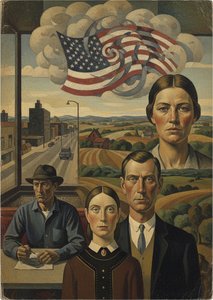
The decade following the Armory Show of 1913 witnessed a seismic shift in the art world, yet its reverberations weren’t immediately felt across the vast expanse of America. While European modernism – Cubism, Futurism, Expressionism – captivated avant-garde circles, a countercurrent began to brew, particularly within the heartland. This wasn't a rejection of artistic innovation *per se*, but rather a questioning of its relevance to the American experience. The interwar period, bracketed by the devastation of World War I and the looming shadow of another global conflict, fostered a deep introspection about national identity. The Great Depression, beginning in 1929, further intensified this search for meaning, prompting artists to turn inward, seeking solace and subject matter within their own communities and landscapes. This burgeoning movement, soon to be known as American Regionalism, wasn’t simply a stylistic choice; it was a cultural response – a yearning for authenticity in the face of economic hardship and societal upheaval.
The prevailing sentiment was that European art addressed European concerns. American artists felt compelled to depict *their* America—the rolling fields of Iowa, the bustling towns along the Mississippi River, the resilient spirit of its people. This wasn’t a naive embrace of pastoral simplicity; it was a deliberate attempt to forge an artistic language uniquely American, one rooted in realism and narrative storytelling. The earlier Hudson River School painters had laid some groundwork with their romantic depictions of the landscape, but Regionalism sought something more direct, more grounded in the everyday realities of modern life.
Defining Characteristics: Realism, Nationalism & Rejection of European Modernism
At its core, American Regionalism was defined by a commitment to representational art. Unlike the abstraction and fragmentation favored by many European movements, Regionalist painters prioritized clarity and detail. They sought to depict scenes with meticulous accuracy, often employing techniques reminiscent of 19th-century academic realism. However, this wasn’t merely an exercise in technical skill; it was a conscious rejection of what they perceived as the intellectualism and detachment of modern art. The emphasis on recognizable forms and familiar subjects made Regionalist paintings accessible to a wider audience—a crucial factor during a time when public support for the arts was vital.
Nationalism, though often implicit rather than explicitly stated, permeated much of the movement’s work. Artists weren't necessarily advocating for jingoistic fervor, but they were deeply invested in celebrating American values and traditions. This manifested in depictions of rural life, small-town communities, and the dignity of labor. The focus on the “American heartland” wasn’t simply a geographical preference; it was an ideological one—a belief that the true essence of America resided in its agrarian roots and close-knit communities. The rejection of European influences extended beyond style to encompass subject matter. Regionalist artists deliberately avoided themes associated with urban life or high society, instead focusing on the lives of ordinary Americans.
The 'Regionalist Triumvirate': Wood, Benton & Curry – Masters of the Heartland
While numerous artists contributed to the Regionalist movement, three figures stand out as its most prominent representatives: Grant Wood, Thomas Hart Benton, and John Steuart Curry. Each possessed a distinct style and perspective, yet they shared a common commitment to depicting American life with honesty and authenticity. Grant Wood, perhaps best known for his iconic 1930 painting American Gothic, cultivated a highly refined and meticulously detailed aesthetic. His work often carried an undercurrent of satire, subtly questioning the values of rural society while simultaneously celebrating its resilience. Wood’s paintings weren't simply portraits of farmers; they were complex meditations on American identity and the changing social landscape.
Thomas Hart Benton, a native of Missouri, brought a dynamic energy to his depictions of working-class America. His murals, often large in scale and imbued with a sense of narrative drama, celebrated the dignity of labor and the struggles of ordinary people. Benton’s style was characterized by bold brushstrokes, vibrant colors, and a distinctly American sensibility. He also played a crucial role as an educator, mentoring a generation of artists, including Jackson Pollock, though their artistic paths would eventually diverge significantly. John Steuart Curry, hailing from Kansas, focused on scenes of rural life with a dramatic flair. His paintings often depicted the harsh realities of farm life—droughts, storms, and the relentless cycle of labor—but also celebrated the enduring spirit of the American farmer.
Social Commentary and the WPA: Art as a Reflection of the Great Depression
 George Biddle
George Biddle (1885-1973) was an American painter & muralist known for his Social Realism, combat art, and role in the Federal Art Project. Explore his WPA murals, lithographs, and diverse artistic influences – from Impressionism to Mexican Muralism.
The Great Depression profoundly shaped the trajectory of American Regionalism. The economic hardship and widespread unemployment created a fertile ground for art that addressed social issues and reflected the realities of everyday life. This is where the Works Progress Administration (WPA) entered the picture. Established in 1935 as part of President Franklin D. Roosevelt’s New Deal, the WPA provided employment for artists through various programs, including the Federal Art Project. Regionalist painters were among the most prominent beneficiaries of this initiative, receiving commissions to create murals and paintings for public buildings across the country.
The WPA murals weren't simply decorative embellishments; they served as powerful statements about American values and social concerns. Artists depicted scenes of industrial labor, rural life, and historical events, often with a clear political message. Thomas Hart Benton’s murals, for example, celebrated the dignity of working-class Americans while subtly critiquing the excesses of capitalism. Grant Wood's work also reflected the anxieties and uncertainties of the Depression era. The WPA provided Regionalist artists with an unprecedented opportunity to reach a wide audience and engage in a national dialogue about art and society.
Beyond Nostalgia: Exploring Diverse Perspectives within Regionalism
It’s easy to fall into the trap of viewing American Regionalism as simply a nostalgic celebration of rural life. However, a closer examination reveals a more nuanced and complex picture. While many paintings did depict idyllic scenes of farms and small towns, others offered a more critical perspective on American society. Grant Wood's work, for instance, often contained subtle satirical elements, questioning the values and conventions of rural communities. Furthermore, not all Regionalist artists focused exclusively on positive depictions of American life; some addressed issues of poverty, inequality, and social injustice.
The movement also encompassed a diverse range of styles and techniques. While realism was the dominant aesthetic, artists experimented with different approaches to composition, color, and brushwork. Carl Folke Sahlin’s vibrant watercolors, for example, captured Surinam culture with an impressionistic flair, demonstrating that Regionalism wasn't limited to a single stylistic approach. Exploring these diverse perspectives reveals a more complex and multifaceted movement than often portrayed.
Legacy and Influence: Regionalism’s Enduring Impact on American Art
The rise of Abstract Expressionism in the 1940s marked a turning point for American art, effectively eclipsing Regionalism as the dominant aesthetic force. The abstract style, with its emphasis on individual expression and non-representational forms, resonated with a postwar audience eager to embrace new ideas and break from tradition. However, Regionalism’s influence shouldn't be underestimated. It played a crucial role in establishing a uniquely American artistic identity, paving the way for subsequent generations of artists to explore themes of national culture and social commentary.
The movement’s emphasis on realism and narrative storytelling continues to resonate with contemporary audiences. Artists like Andrew Wyeth, though often working outside the confines of established movements, carried forward Regionalism's commitment to depicting American life with honesty and authenticity. Today, paintings by Grant Wood, Thomas Hart Benton, and John Steuart Curry remain iconic representations of the American experience, offering a powerful glimpse into a pivotal moment in our nation’s history. At AllPaintingsStore, we are proud to offer high-quality reproductions of these masterpieces, allowing you to bring the spirit of American Regionalism into your home. Explore our collection and discover the enduring power of this remarkable movement.