

The Rise of Regionalism: A Response to Modernity & Crisis
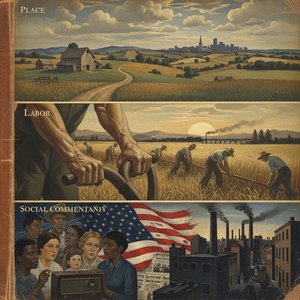
American Regionalism is an American realist modern art movement that included paintings, murals, lithographs, and illustrations depicting realistic scenes of rural and small-town America, primarily in the Midwest. It arose in the 1930s as a response ...
The early decades of the 20th century witnessed a seismic shift in the art world, as European avant-garde movements – Cubism, Surrealism, Futurism – relentlessly challenged traditional notions of representation. Yet, across the Atlantic, a different current was brewing, one that looked not towards the future but inward, to the heartland of America. This was the genesis of Regionalism, an artistic response born from a complex interplay of economic hardship, national identity, and a yearning for authenticity in a rapidly changing world. The Great Depression cast a long shadow over the United States, shattering illusions of prosperity and prompting artists to re-evaluate their relationship with both their subject matter and their audience. The abstract explorations felt increasingly distant from the realities faced by everyday Americans; a desire arose for art that spoke directly to their experiences, their landscapes, and their values.
This wasn’t simply a rejection of modernism, however. Many Regionalist artists had initially studied in Europe, absorbing its lessons before consciously turning away from them. The Armory Show of 1913, with its shocking display of radical new styles, served as a pivotal moment for many American artists, prompting both fascination and unease. The subsequent disillusionment with European artistic dominance fueled a search for uniquely American forms of expression. Artists began to look towards their own communities – the rural landscapes of Iowa, the bustling cities of Missouri, the small towns of Kansas – for inspiration, seeking to capture the essence of a nation grappling with profound social and economic upheaval.
Defining the American Scene: Beyond European Influences
The term “American Scene” often serves as an umbrella encompassing Regionalism, but it’s crucial to understand its broader scope. While Regionalism focused specifically on depictions of rural life and small-town America, the American Scene movement also included artists who documented urban realities with a similar commitment to realism. Both strands shared a common thread: a rejection of abstraction in favor of narrative clarity and accessible subject matter. This wasn’t merely about stylistic preference; it was deeply intertwined with a desire to connect with a wider audience, to create art that resonated with the lives of ordinary people.
The influence of European Realism is undeniable, particularly the work of artists like Gustave Courbet and Jean-François Millet. However, American Scene painters infused their realism with a distinctly national character. They weren’t simply replicating what they saw; they were interpreting it through the lens of American experience, imbuing their works with a sense of nostalgia, social commentary, or even satire. The Federal Art Project, established as part of the New Deal, played a significant role in fostering this movement, providing artists with employment and opportunities to create public art that reflected the diversity and complexity of American life. Murals became a particularly important medium, adorning post offices, schools, and other public buildings across the country.
The 'Regionalist Triumvirate': Wood, Benton, and Curry – Styles & Visions
Three artists stand out as central figures in the Regionalist movement: Grant Wood, Thomas Hart Benton, and John Steuart Curry. Often referred to as the “Regionalist Triumvirate,” each possessed a unique style and vision, yet they were united by their commitment to depicting American life with unflinching realism. Grant Wood is perhaps best known for his iconic painting American Gothic, which has become synonymous with the movement itself. His meticulous attention to detail, precise rendering of form, and subtly unsettling atmosphere evoke a sense of both reverence and critique. Wood’s work often explored themes of rural life, morality, and the changing social landscape of the Midwest.
Thomas Hart Benton, a dynamic painter and muralist from Missouri, brought a distinctly energetic style to his depictions of working-class America. His bold compositions, vibrant colors, and dramatic narratives captured the spirit of a nation grappling with economic hardship and social change. Benton’s murals, often depicting scenes of agricultural labor or industrial activity, were imbued with a sense of social commentary and political urgency. John Steuart Curry, hailing from Kansas, focused on capturing the raw power and beauty of the American landscape. His paintings, often featuring dramatic depictions of storms, harvests, and rural life, conveyed a sense of both awe and vulnerability.
Social Realism's Intertwined Narrative: Politics & Everyday Life
Social realism is work produced by painters, printmakers, photographers, writers, filmmakers and some musicians that aims to draw attention to the real socio-political conditions of the working class as a means to critique the power structures behind...
While Regionalism emphasized the depiction of rural America, it’s important to recognize its close relationship with Social Realism. Both movements shared a commitment to portraying the realities of everyday life, but Social Realism explicitly aimed to draw attention to the socio-political conditions of the working class and critique the power structures behind them. Artists associated with Social Realism sought to expose the inequalities and injustices of American society, using their art as a tool for social change.
American Gothic, while often interpreted as a celebration of rural values, can also be seen as a subtle commentary on the hardships faced by farmers during the Depression. Similarly, Benton’s murals frequently depicted scenes of labor unrest and economic exploitation. The lines between Regionalism and Social Realism were often blurred, with many artists incorporating elements of both into their work. This intersection reflects the complex social and political climate of the 1930s, a period marked by widespread economic hardship, political polarization, and a growing awareness of social injustice.
Women Artists of Regionalism: Challenging Conventions & Capturing Local Culture
 Women in Regional Costume, Natives, Paramaribo, Surinam
Explore 'Women in Regional Costume' by Carl Folke Sahlin! Vibrant watercolor captures Surinam culture. Impressionistic realism & ethnographic art – a unique piece.
The narrative of Regionalism often centers on its male figures – Wood, Benton, and Curry. However, numerous women artists played a vital role in shaping the movement, challenging conventional artistic norms and capturing the nuances of American life with their own unique perspectives. Artists like Carl Folke Sahlin, through her vibrant watercolors depicting Surinam culture, brought an ethnographic sensibility to Regionalist aesthetics, documenting the traditions and customs of diverse communities. These women often faced significant obstacles in a male-dominated art world, yet they persevered, creating powerful works that reflected their own experiences and perspectives.
Their contributions were not merely stylistic; they expanded the scope of Regionalism to include broader themes of cultural identity, social justice, and gender equality. By documenting the lives of ordinary people – farmers, workers, families – these artists challenged traditional notions of artistic subject matter and paved the way for future generations of women artists.
Legacy and Reinterpretation: Regionalism’s Enduring Influence on American Art
The rise of Abstract Expressionism in the 1940s marked a turning point in American art, effectively eclipsing Regionalism as the dominant artistic movement. The abstract explorations of Pollock, Rothko, and de Kooning came to represent a new vision of American freedom and individuality, one that rejected the figurative realism of Regionalism in favor of subjective expression. However, the legacy of Regionalism continues to resonate today.
Its emphasis on narrative clarity, accessible subject matter, and authentic representation has influenced generations of artists. The movement’s exploration of American identity remains relevant in a nation grappling with questions of cultural diversity, social justice, and national belonging. At AllPaintingsStore.com, we celebrate the enduring power of Regionalist art, offering high-quality reproductions that allow you to experience the beauty and complexity of this pivotal moment in American history. Explore our collection today and discover the artists who captured the heartland of America with such skill and passion.