
differences between impressionism and expressionism
Impressionism is a 19th-century movement focused on capturing the external, fleeting effects of light and atmosphere through observation. Expressionism is a 20th-century modernist movement from Northern Europe that prioritizes the internal, subjective experience, often using radical distortion to convey intense psychological states rather than physical reality.
In the workshop, we see these differences in how the paint is handled. Impressionism, which emerged in France and saw artists exhibiting together eight times between 1874 and 1886, relies on loose, spontaneous brushstrokes. These artists were often inspired by photography to capture momentary action and the changing qualities of light, often working en plein air to document the spontaneous beauty of the natural world.
Expressionism developed as a reaction to Impressionism, Naturalism, and positivism. Instead of documenting the sensory experience of the eye, Expressionists seek the "sensation in the soul." This approach often involves:
- Distorted forms to evoke specific moods or ideas
- Jagged lines and fragmented compositions
- A focus on themes such as anxiety, joy, or existential dread
How do color and light differ in these movements?
Impressionism uses color to reflect the optical truth of light and atmosphere on a subject, often using unblended colors to capture momentary light. Expressionism uses powerful, non-naturalistic, and often jarring colors to represent vivid emotional reactions and internal psychological states rather than objective reality.
When we prepare a canvas, the intent of the movement dictates the palette. Impressionists focused on the ephemeral effects of natural light and the visual appearance of objects. Their goal was to capture how light changes over time, resulting in compositions that resemble a snapshot, relaxing the boundary between the subject and the background.
Expressionists, however, use color as a tool for emotional eruption. They do not seek to reproduce an aesthetically pleasing scene but to project the artist's inner world onto the external environment. This can result in highly dynamic compositions and colors that are arbitrary or non-naturalistic, used specifically to manifest the turbulent depths of the human soul.
How do these styles affect the mood of a room?
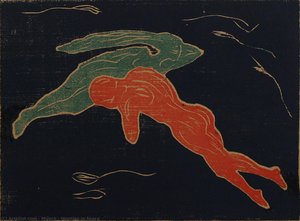
 In the human brain
, Edvard Munch
Impressionism is typically chosen to create a sense of calm, light, and spontaneous beauty within a space. Expressionism is selected to make a bold, provocative statement regarding the intensity of the human experience, often introducing themes of tension, anxiety, or deep emotion into the environment.
For space planning, the direction of the artist's gaze determines the atmosphere. An Impressionist work acts as an art of observation, documenting landscapes and modern life. This makes it suitable for environments where a sense of openness and the fleeting beauty of nature are desired. In contrast, Expressionism is an art of eruption.
Because Expressionism focuses on subjective interpretation, it can introduce significant psychological weight to a room. For example, Edvard Munch’s In the human brain (1897) uses visceral depiction to convey fear and despair. Such works are designed to evoke specific moods through:
- Intense emotional resonance
- Bold, non-naturalistic color palettes
- Dynamic and often unsettling compositions
Frequently asked questions
Where did Impressionism originate?
Impressionism originated with a group of Paris-based artists.
When did Expressionism emerge?
Expressionism emerged in Northern Europe around the beginning of the 20th century.
How many times did Impressionist artists exhibit together?
Impressionist artists exhibited together eight times between 1874 and 1886.
What did Michel Ragon say about Expressionism?
Expressionism can be likened to the Baroque style by Michel Ragon.
Learn more
- 1863 – 1944Edvard Munch catalogExplore a complete collection of works by this master of Expressionism.