



The Hudson River School Roots: Inness's Early Influences
Transcendentalism is a philosophical, spiritual, and literary movement that developed in the late 1820s and 1830s in the New England region of the United States. A core belief is in the inherent goodness of people and nature, and while society and it...
George Inness, a name synonymous with the evocative power of American landscape painting, didn’t emerge fully formed as the artist-philosopher he would become. His journey began within the established framework of the Hudson River School, a movement captivated by the sublime beauty and untamed grandeur of the American wilderness. Artists like Thomas Cole and Asher B. Durand sought to faithfully represent nature, viewing it as a direct manifestation of the divine. However, even in his early works, Inness demonstrated a subtle divergence from this purely descriptive approach. While he absorbed their technical mastery – particularly their meticulous attention to detail and compositional structure – he possessed an innate desire to move beyond mere replication, seeking instead to capture something deeper: the emotional resonance and spiritual undercurrents within the landscape itself.
His initial training was modest, consisting of lessons with itinerant painter John Jesse Barker and a brief apprenticeship as a map engraver. These experiences, though seemingly disparate, proved formative. The engraving work honed his precision and eye for detail, while exposure to reproductions of Old Master landscapes – Claude Lorrain and Salvator Rosa in particular – ignited a passion for classical composition and the power of atmospheric effects. Inness wasn’t simply copying nature; he was studying how artists throughout history had interpreted and imbued it with meaning. He admired “a power of motive, a bigness of grasp” in these earlier works, recognizing that they weren't just depictions of scenery but expressions of a grander vision.
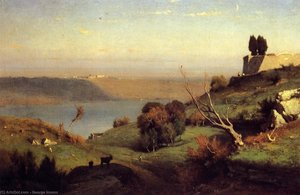
The early years were marked by a restless search for artistic identity. His formal entry into the New York art world in 1845 was followed by a pivotal trip to Europe in 1851, funded by patron Ogden Haggerty. Rome and Florence offered him direct access to the landscapes that had captivated him through reproductions, allowing him to study firsthand the techniques of Claude Lorrain and Nicolas Poussin. This period solidified his understanding of compositional balance and the use of light to create a sense of depth and serenity.
Beyond Realism: The Philosophical Turn in Inness’s Art
 Wikipedia: George Inness
George Inness (May 1, 1825 – August 3, 1894) was an American landscape painter. Now recognized as one of the most influential American artists of the nineteenth century, Inness was influenced by the Hudson River School at the start of his career. He ...
The mid-19th century was a time of intellectual ferment, and Inness found himself increasingly drawn to philosophical inquiry. While his contemporaries focused on accurately portraying the *visible* world, Inness began to explore the *invisible* forces that shaped it. This shift wasn't abrupt; it evolved gradually through encounters with new ideas and a growing dissatisfaction with purely representational art. He sought not just to paint what he saw, but to convey what he felt – the underlying unity and spiritual harmony of nature.
A crucial catalyst in this transformation was his introduction to the writings of Emanuel Swedenborg, a Swedish scientist and mystic whose theological ideas profoundly influenced Inness’s worldview. Swedenborg posited that all things are interconnected and imbued with divine energy, and that the material world is merely a reflection of a spiritual reality. This concept resonated deeply with Inness, who began to see his paintings as vehicles for expressing this underlying unity. He believed that art should not simply depict nature but reveal its inherent spirituality.
This philosophical turn led him away from the meticulous detail favored by some members of the Hudson River School and towards a more subjective and expressive style. He started prioritizing mood, atmosphere, and emotional impact over precise topographical accuracy. His paintings became less about specific locations and more about evoking a sense of transcendence – a feeling of connection to something larger than oneself.
Swedenborgian Spirituality & the Language of Landscape
The influence of Swedenborgianism on Inness’s art is not always overt, but it permeates his work at a fundamental level. He didn't paint allegorical scenes explicitly illustrating Swedishborgian doctrines; instead, he used landscape as a metaphor for spiritual realities. The serene beauty of his paintings, the harmonious compositions, and the subtle interplay of light and shadow all served to convey a sense of divine presence.
Consider his use of atmospheric perspective. Rather than creating sharp, defined forms, Inness often employed hazy or blurred edges, suggesting that the landscape extends beyond what is immediately visible – hinting at an unseen realm. This technique wasn’t merely aesthetic; it was a deliberate attempt to evoke a sense of mystery and suggest the interconnectedness of all things. The soft light filtering through trees, the gentle undulation of hills, and the tranquil stillness of water all contributed to this overall effect.
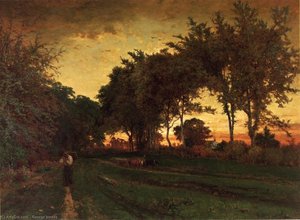
Landscape with Farmhouse (1869) exemplifies this approach. While depicting a seemingly ordinary rural scene, the painting exudes a sense of peace and harmony that transcends its subject matter. The moody skies and serene landscape aren’t simply observed; they are *felt*. Similarly, in works like Summer, Montclair (also known as New Jersey Landscape), the rich colors and tranquil atmosphere create an idyllic vision that invites contemplation.
Atmospheric Perspective and Tonalism: Defining Inness’s Mature Style
As Inness matured, his style became increasingly refined and distinctive. He embraced atmospheric perspective with a newfound subtlety, using it not just to create depth but to evoke mood and emotion. His palette softened, favoring muted tones and harmonious color combinations. This evolution led him towards Tonalism, an American art movement characterized by its emphasis on atmosphere, subtle gradations of tone, and evocative subject matter.
Tonalism, while not a rigid school with strict tenets, shared Inness’s belief in the importance of conveying emotional resonance through landscape. Artists associated with Tonalism often used dark, subdued colors to create a sense of mystery and introspection. They sought to capture the fleeting effects of light and atmosphere, emphasizing mood over precise detail.
Inness's late works are particularly notable for their masterful use of color and light. He wasn’t interested in replicating the bright, vibrant hues of reality; instead, he used color as a means of expressing his inner vision. His paintings often feature subtle gradations of tone, creating a sense of depth and atmosphere that draws the viewer into the scene. The result is a body of work that is both visually stunning and deeply contemplative.
Key Works: Exploring ‘Landscape with Farmhouse,’ ‘Summer, Montclair,’ and Beyond
 Summer, Montclair (also known as New Jersey Landscape)
Discover George Inness’s ‘Summer, Montclair.’ This iconic Impressionist landscape captures serene beauty & atmospheric detail. Explore its rich colors & tranquil scene – a timeless masterpiece.
Examining specific works reveals the nuances of Inness’s artistic development. Landscape with Farmhouse, painted in 1869, showcases his growing mastery of American realism blended with tonalist sensibilities. The composition is carefully balanced, with the farmhouse serving as a focal point amidst a serene landscape. However, it's the atmospheric effects – the moody skies and soft light – that truly captivate the viewer.
Summer, Montclair, created in 1877, exemplifies his Impressionist leanings while retaining his signature spiritual depth. The painting captures a fleeting moment of tranquility, with rich colors and atmospheric detail creating an idyllic scene. It’s not simply a depiction of a specific place; it's an evocation of a feeling – a sense of peace and harmony.
Beyond these iconic works, Inness produced a vast body of paintings that explore similar themes. His landscapes often feature trees as symbolic representations of growth, resilience, and spiritual connection. Water serves as a metaphor for the flow of life and the interconnectedness of all things. And his use of light consistently evokes a sense of divine presence.
Inness's Legacy: A Lasting Impact on American Art
George Inness’s influence on American art is profound and enduring. He wasn’t simply a painter; he was an artist-philosopher who sought to express the underlying unity and spiritual harmony of nature. His work bridged the gap between realism and abstraction, paving the way for future generations of artists.
He became known as “the father of American landscape painting,” not because he was the first to paint landscapes in America, but because he elevated the genre to a new level of artistic expression. He inspired countless artists to look beyond mere representation and explore the emotional and spiritual dimensions of their subjects. His emphasis on atmosphere, tone, and mood continues to resonate with contemporary painters today.
At AllPaintingsStore.com, we are proud to offer high-quality reproductions of George Inness’s masterpieces, allowing you to experience the beauty and tranquility of his work firsthand. Whether you're a seasoned art collector or simply appreciate stunning landscapes, Inness’s paintings are sure to inspire and uplift.





