Early Life and Influences: The Foundations of a Norwegian Vision
Johan Christian Claussen Dahl, born in Bergen, Norway, in 1788, emerged from humble beginnings – his father a fisherman and ferryman – to become the pivotal figurehead of Norwegian Romantic painting. While often lauded as “the father of Norwegian landscape painting,” this title belies a complex artistic journey shaped by both inherent talent and a persistent yearning for formal training he initially lacked. His early years, though marked by a lack of structured education, were not devoid of artistic stimulation; a sympathetic mentor recognized his precocious ability and secured him an apprenticeship with Johan Georg Müller, Bergen’s leading painter at the time. However, Dahl later reflected on this period with a degree of bitterness, feeling exploited rather than nurtured. It was through Lyder Sagen, another influential figure, that he gained access to art historical texts and developed a burgeoning interest in patriotic subjects – seeds that would blossom into his uniquely Norwegian aesthetic.
Dahl’s initial studies at the Royal Danish Academy of Fine Arts in Copenhagen proved formative, yet it was his immersion in the surrounding countryside and the city's collections that truly ignited his artistic vision. He gravitated towards the Dutch landscape masters – Ruisdael and Everdingen – but crucially, he didn’t merely imitate their style. He embarked on a path of direct observation, believing that a painting should not simply *depict* a view, but embody the very spirit of the land itself—its history, its character, and the lives interwoven with it. This commitment to capturing the essence of Norway would become the defining characteristic of his work.
Dahl's Breakthrough: Defining a National Romantic Style
The mid-1810s marked Dahl’s ascent within the Copenhagen art scene. Exhibiting thirteen paintings in 1815 alone signaled a turning point, attracting the attention of Prince Christian Frederik, who became a lifelong patron and champion of his work. This support allowed Dahl to pursue an independent career, free from the constraints of academic expectations that favored historical narratives over landscape painting. He began to forge a style distinctly his own – one characterized by dramatic compositions, meticulous detail, and a palpable emotional resonance.
Dahl’s paintings weren't simply scenic views; they were imbued with a sense of national pride, awakening a cultural consciousness in Norway as it navigated its newfound independence. He skillfully blended realism with Romantic ideals, creating landscapes that felt both authentic and deeply evocative. This period saw the emergence of works like “Den Store Kro i Fredensborg” (1817), which established his mastery of oil painting and cemented his reputation as a rising star.
The Power of Place: Key Landscapes and Artistic Techniques
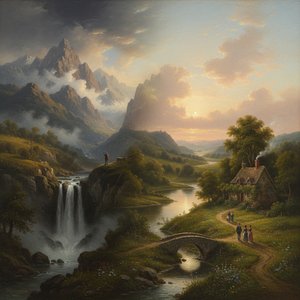
 View of the Feigumfoss in Lysterfjord
Experience the serene beauty of Norway's fjords with Johan Christian Dahl’s 'View of the Feigumfoss in Lysterfjord.' A stunning Romantic landscape from 1848.
Though Dahl spent much of his adult life in Dresden, where he held a professorship at the Academy of Fine Arts, Norway remained the wellspring of his inspiration. Frequent returns to his homeland were not merely personal pilgrimages but dedicated sketching expeditions, providing him with the raw material for monumental canvases. His technique was meticulous and layered; he built up compositions through careful observation, employing subtle gradations of light and shadow to create a sense of depth and atmosphere.
View from Stalheim (1842) stands as perhaps his most iconic work, capturing the grandeur of the Nærøydalen valley with sweeping perspective and dramatic skies. The painting is not simply a faithful representation of the landscape; Dahl deliberately altered elements – narrowing the valley, emphasizing peaks, reducing river visibility – to heighten its symbolic power. The inclusion of a rainbow adds another layer of meaning, suggesting hope and renewal. Similarly, View of the Feigumfoss in Lysterfjord (1848) exemplifies his ability to convey serenity and beauty through precise detail and masterful use of color.
Even works depicting more turbulent scenes, such as Shipwreck, reveal Dahl’s profound connection to the Norwegian landscape. The dramatic seascape isn't merely a depiction of disaster; it’s a testament to human resilience in the face of nature’s power. His brushwork is particularly evocative here, conveying the chaos and energy of the sea with remarkable skill.
Beyond the Canvas: Dahl’s Role in Shaping Norwegian Culture
 Shipwrech
Discover "Shipwreck" by Johan Christian Dahl – a dramatic Romantic seascape showcasing turbulent seas & resilient survivors. Oil on canvas, evocative brushwork, & powerful symbolism.
Dahl's influence extended far beyond his paintings. He was a tireless advocate for Norwegian culture, actively involved in establishing institutions that would preserve and promote its artistic heritage. He played a key role in founding the Norwegian National Gallery, recognizing the importance of providing a platform for both established and emerging artists. His efforts weren’t limited to painting; he also championed the preservation of historic stave churches and the restoration of significant landmarks like Nidaros Cathedral and Bergenhus Fortress.
His commitment to national identity resonated deeply with his contemporaries, fostering a sense of pride in Norway's unique landscapes and cultural traditions. He wasn’t simply *depicting* Norway; he was actively constructing its visual identity, shaping how Norwegians saw themselves and their place in the world.
Legacy and Influence: Dahl's Enduring Impact on Landscape Painting
Johan Christian Dahl’s legacy is profound. He not only established himself as the first great Romantic painter in Norway but also laid the foundation for a “golden age” of Norwegian art. His influence can be seen in the work of subsequent generations of landscape painters, including Hans Dahl, who further popularized idyllic portrayals of Norwegian life and scenery. Artists like Johan Martin Nielssen also built upon his techniques and themes, capturing the beauty of Norway with realistic detail and atmospheric light.
More than 150 years after his death, Dahl’s paintings continue to captivate audiences worldwide. His work serves as a powerful reminder of the enduring power of landscape painting – its ability to evoke emotion, celebrate national identity, and connect us to the natural world. At AllPaintingsStore.com, we are proud to offer high-quality reproductions of Dahl’s masterpieces, allowing you to experience the beauty and grandeur of his vision firsthand. Explore our collection today and discover the timeless appeal of Norway's first great Romantic painter.