From Maritime Exploration to Modern Tranquility: The Evolution of Seascape Symbolism
The ocean has long served as a mirror for the human condition, shifting from a site of perilous adventure to a sanctuary for the modern psyche. In the early eras of maritime history, painters focused on the tension of the voyage, capturing heavy ships battling roaring waves to symbolize the reach of trade and the unpredictability of discovery. These works were about the struggle against the elements, a visual record of human ambition meeting the vastness of the unknown. Today, the focus has pivoted toward the internal landscape. The contemporary collector often seeks the ocean not as a battlefield, but as a source of balance and reflection. Where the old masters depicted the chaos of the storm to evoke awe, today’s preference leans toward the restorative power of the horizon, using the sea to provide a sense of peace and spatial equilibrium in increasingly crowded urban environments.
The Physics of Light: From Impressionist Broken Color to Contemporary Glazing
Capturing the movement of water requires a sophisticated understanding of how light interacts with a shifting surface. The Impressionists revolutionized this through the technique of broken color, where distinct, unblended strokes of pigment are placed side-by-side. Up close, the canvas appears as a chaotic arrangement of hues, but at a distance, the eye blends them into the shimmering effect of sunlight hitting a cresting wave. This method relies on the viewer's perception to complete the image, creating a sense of constant motion. Modern artists continue this investigation through advanced glazing methods and even digital tools that simulate light reflection. While the Impressionists used the physical properties of oil to achieve luminosity, contemporary creators often employ mixed media or augmented reality to explore how light dances across a surface, ensuring that the transition between the sky and the sea remains as fluid as the water itself.
Materiality and Texture: The Tactile Evolution of Oil and Acrylic Surfaces
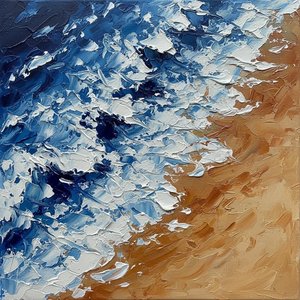
The physical presence of a painting is often determined by the weight of its medium. In traditional oil painting, the artist utilizes subtle tonal blending to create seamless, soft edges, allowing the sky to melt into the sea with a naturalistic grace. This is frequently contrasted with the use of impasto, where thick, heavy applications of paint create a three-dimensional texture that mimics the physical heave of a swell. Acrylics have introduced a different dimension to the genre, offering a flexibility that allows for rapid layering and a crispness that suits more abstract compositions. This evolution in materiality mirrors the shift from the highly detailed, realistic seascapes of the past to the bold, textured abstractions favored in modern interiors. Whether through the smooth, lost edges of a calm tide or the hard edges of a crashing wave, the choice of medium dictates the emotional temperature of the work.
Market Dynamics: Historical Provenance and the Rise of Large-Format Demand
The market for seascape art has undergone a significant transformation, moving from niche maritime collections to a staple of global art investment. According to Art Basel’s Global Art Market Report, ocean-themed works have seen a steady rise in popularity since 2022, driven by a renewed interest in nature-inspired aesthetics. There is a growing demand for large-format ocean wall art, as collectors look for pieces that can anchor a room and provide a sense of expansive scale. This trend is particularly evident in the hospitality sector, where large-scale, high-quality reproductions are used to enhance the atmosphere of luxury resorts and corporate spaces. As the market matures, the distinction between the rare, museum-level realism of a single original and the high-quality, repeatable demand for large-scale prints has become a key consideration for procurement managers and private collectors alike.
Spatial Utility: The Aesthetic and Functional Value of Coastal Imagery
Beyond their visual appeal, ocean paintings serve a distinct functional purpose in contemporary architecture and interior design. The color palettes inherent to the sea—azure, aquamarine, and sandy neutrals—are leading choices for creating calming environments. In professional settings, such as corporate offices or high-end hotels, large-scale seascapes are utilized to promote creativity and reduce stress through their association with natural tranquility. This utility extends to the technical realm with innovations like acoustic ocean art, which merges aesthetic beauty with sound-absorbing functionality to manage ambient noise in urban spaces. Whether through a minimalist, single-panel print or a complex multi-panel group set that flows across a wide wall, the seascape has become a versatile tool for shaping the psychological impact of a space.
For those seeking to integrate these themes into a professional or private collection, AllPaintingsStore.com provides a comprehensive range of options, from custom-commissioned oil reproductions to high-quality Giclée prints, ensuring that the movement and light of the ocean can be tailored to any architectural requirement.
Transform your space with breathtaking coastal art. Discover hand-painted oil reproductions of impressionist seascapes and custom maritime portraits. From multi-panel sets to personalized photo-to-oil commissions, bring the serene beauty of the ocean home with AllPaintingsStore.com expertise.
Discover the profound beauty of Contemporary Impressionism. Explore how masters capture light and emotion through textured brushwork and vibrant color, perfect for discerning collectors seeking timeless elegance and museum-quality artistry for luxury interiors.
Elevate hospitality interiors with premium maritime art. Our procurement guide for hotel designers covers high-quality ship painting reproductions, custom large-scale murals, and efficient bulk ordering with global shipping and VAT support for professional large-scale projects.