--- title: Cubism - The Metropolitan Museum of Art author: Sabine Rewald url: https://www.metmuseum.org/essays/cubism hostname: metmuseum.org description: The Cubist painters rejected the inherited concept that art should copy nature, or that they sh...
To understand the seismic shift that occurred in Paris at the dawn of the twentieth century, one must look past the polished surfaces of traditional representation. Before the radical deconstruction of the subject, there was a growing dissatisfaction with the static, single-point perspective that had governed European art since the Renaissance. The movement began not as a sudden rupture, but as an evolution of ideas rooted in the late works of Paul Cézanne, whose tendency to distill landscapes into flat planes of color provided the essential blueprint for what was to come.
Between 1907 and 1914, Pablo Picasso and Georges Braque began a collaboration that would fundamentally alter the visual vocabulary of the modern age. This period, often referred to as Proto-Cubism, saw the rejection of traditional modeling and foreshortening in favor of something far more complex. Picasso’s Les Demoiselles d'Avignon introduced a jarring, non-naturalistic energy, drawing influence from African tribal masks to rearrange facial features with a new, liberated logic. The goal was no longer to mirror the visible world but to present it through multiple, contrasting vantage points simultaneously.
As these artists moved away from the imitation of nature, they began to emphasize the two-dimensionality of the canvas itself. They sought to represent objects not merely as they appear to the eye in a single moment, but as they exist in the mind—a collection of disparate elements and overlapping memories. This was the birth of a new way of seeing, where the boundaries between the subject and the space surrounding it began to dissolve into a singular, structured vision.
Analytical Deconstruction: The Interweaving of Planes and Monochromatic Form
Deconstructing Perception: An Exploration of Braque’s *Still Life II* Georges Braque's Still Life II is not merely a depiction of objects; it’s an intellectual and visual dismantling of how we perceive reality. Created during the fervent years of Cub...
As the movement entered its most rigorous phase, known as Analytical Cubism between 1908 and 1912, the subject matter underwent an intense process of dissection. Artists began to "analyze" objects, breaking them down into a multitude of small, interlocking facets and crystalline layers. This was not an act of destruction, but one of profound investigation. In works such as Braque’s Still Life II, the familiar elements of a scene—perhaps a bottle, a glass, or a musical instrument—are fragmented and reassembled within a shallow, relief-like space.
To maintain focus on this structural inquiry, the palette was intentionally restricted. The vibrant colors of earlier movements like Fauvism were abandoned in favor of a near-monochromatic scheme dominated by muted browns, grays, blacks, and ochres. This reduction of color allowed the viewer to concentrate entirely on the interplay of lines and planes. In The Man of the Guitar, Braque uses these neutral tones to create a sense of stillness, where the figure and his instrument are woven into a complex geometric web. The use of sharp, angular lines and varying line weights suggests a sense of depth without relying on the illusions of traditional perspective.
This "hermetic" stage of Cubism often pushed abstraction to its limits. The interweaving of planes became so dense that the subject could become nearly unrecognizable to the untrained eye. Yet, even in this state of extreme fragmentation, subtle anchors remained. A single nail, a coil of rope, or the distinct curve of a sound hole served as tactile reminders of the physical world, tethering the intellectual exercise of the painting to a tangible reality.
Synthetic Reconstruction: Texture, Collage, and the Reassembly of Reality
A Fragmented Vision The artwork titled La cocina 1 by Pablo Picasso presents a fragmented and abstract depiction of a kitchen scene. The composition is characterized by geometric shapes, overlapping planes, and a lack of traditional perspective, exem...
By 1912, the Cubist project underwent another significant transformation, moving from the analytical dissection of forms toward the constructive logic of Synthetic Cubism. If the previous phase was about taking things apart, this era was about putting them back together using entirely new materials. This period saw the introduction of papiers collés—the use of collage and pasted elements like newspaper clippings, wallpaper, or even cloth directly onto the canvas.
This technique effectively swept away the last vestiges of three-dimensional illusionism. Instead of creating the appearance of an object through shading and light, artists used large, flat pieces of colored or neutral paper to allude to a particular form. The inclusion of real-world fragments introduced a new dimension of texture and pattern, making the artwork a physical construction rather than just a window into another space. In works like Picasso’s Still Life with Chair Caning, the boundary between the painted image and the physical object becomes blurred, challenging the very definition of what constitutes a painting.
The Synthetic phase brought a renewed sense of brightness and simplicity to the movement. The shapes became larger and more legible, often utilizing bold color blocking and sharp outlines. This era demonstrated that art could be constructed from the ground up, using graphic elements to clarify associations and create a new, flattened reality that was both modern and structurally sound.
Geometric Abstraction: From Cubist Foundations to Pure Mathematical Form
Geometric abstraction is a form of abstract art based on the use of geometric forms sometimes, though not always, placed in non-illusionistic space and combined into non-objective (non-representational) compositions. Although the genre was popularize...
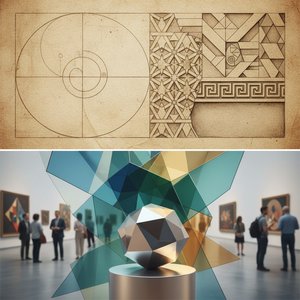
The formal experiments of Cubism provided the essential groundwork for the broader movement of Geometric Abstraction. While Cubism often maintained a connection to a recognizable subject, the artists who followed sought to move toward pure, non-objective composition. This evolution led to a visual language based entirely on geometric forms—circles, squares, and triangles—placed within non-illusionistic spaces.
This pursuit of mathematical purity was shared by various avant-garde groups across Europe and America. Artists like Wassily Kandinsky explored the spiritual resonance of geometric shapes, while others, such as Piet Mondrian, sought a universal harmony through the strict use of horizontal and vertical lines. The influence of this movement can be traced back to ancient decorative motifs in Islamic art, which used geometry to connect science with spirituality, but it found its modern expression in the industrial and technological optimism of the early twentieth century.
The transition toward total abstraction was characterized by a reduction of visual elements to their most essential states. For artists like Auguste Herbin, this meant moving away from any representational accuracy to focus on the plasticity and two-dimensionality of the medium. The goal was to create an "organization of forms" that did not refer to anything outside of itself, but rather existed as a self-contained reality of color, line, and structure.
The Legacy of Structure: Influence on Modernism and Contemporary Design
Introduction Imagine a world stripped bare to its essential forms – lines, colors, and shapes resonating with an almost mathematical purity. This is the realm of Geometric Abstraction, a movement that dared to abandon representational art in favor of...
The ripples of the Cubist revolution extended far beyond the studios of Paris, influencing nearly every major movement that followed, from Constructivism and Suprematism to Art Deco and De Stijl. The liberating formal concepts initiated by Picasso and Braque provided a toolkit for artists like Fernand Léger to celebrate the machine age through tubular, mechanical forms, and for Sonia Delaunay to explore the rhythmic energy of color through Orphism.
Today, the impact of this geometric logic is visible in the very fabric of our modern environment. The principles of structural clarity, balance, and the reduction of form are foundational to contemporarygraphic design, architecture, and even urban planning. The way we perceive space and hierarchy in a digital interface or a minimalist interior owes a great debt to the Cubist deconstruction of the picture plane.
For the modern collector, these works offer more than historical significance; they provide a sense of intellectual rigor and aesthetic stability. Whether through the heavy impasto of a hand-painted reproduction or the clean lines of a contemporaryprint, the power of geometric form remains a potent tool for creating atmosphere and commanding presence in any curated space. At AllPaintingsStore.com, we continue to celebrate this enduring dialogue between structure and emotion, offering pieces that honor the radical legacy of those who first dared to break reality apart.
Explore the revolutionary world of Cubist Still Life with AllPaintingsStore. Discover Picasso & Braque's groundbreaking techniques, its philosophical roots, and lasting impact on modern art. Expert insights for collectors.
Explore the revolutionary world of Cubism with AllPaintingsStore. Discover Picasso & Braque's groundbreaking techniques, its philosophical roots, and lasting impact on modern art. Expert insights for collectors.
Explore the enduring legacy of geometric abstraction! Discover key artists, historical movements & investment insights for discerning art collectors. Expert guidance from AllPaintingsStore.
Explore the revolutionary world of Cubism. Discover how Pablo Picasso and Georges Braque dismantled perspective to redefine modern art through geometric innovation and analytical mastery. An essential guide for art students, collectors, and history enthusiasts.
Explore the revolutionary world of Cubism with AllPaintingsStore. Discover Picasso & Braque's groundbreaking techniques, its philosophical roots, and lasting impact on modern art. Expert insights for collectors.


 Still Life II
 La cocina 1
 Geometric abstraction
 Geometric Abstraction's 10 Defining Masterpieces | Art for Your Home - AllPaintingsStore