--- title: Dada | Tate author: Christine Battersby url: https://www.tate.org.uk/art/art-terms/d/dada hostname: tate.org.uk description: Tate glossary definition for dada: Art movement formed during the First World War in Zurich in negative reaction t...
The year 1916 brought a profound sense of disillusionment to Europe. As the mechanized slaughter of World War I unfolded, a group of artists, poets, and intellectuals found themselves seeking refuge in the neutral territory of Zurich, Switzerland. They gathered at the Cabaret Voltaire, a satirical nightclub founded by Hugo Ball, to express their disgust with the rationalism and nationalist fervor that they believed had fueled the global conflict. This was not merely a gathering for entertainment; it was the birth of a movement that would use nonsense as a weapon against a world that no and longer made sense.
The name Dada itself reflects this spirit of playful irreverence. While scholars debate its exact origin—some suggest a random selection made by stabbing a paper knife into a dictionary, others point to the French word for hobbyhorse—the sound is intentionally infantile and meaningless. This lack of a fixed definition was a deliberate choice. By embracing the absurd, these creators sought to dismantle the very cultural values that had allowed such widespread destruction to occur.
This historical moment of rebellion finds an echo in the way we view modern protest. Just as the Dadaists used performance and noise to shock a complacent society, contemporarystreet art often utilizes public spaces to force a confrontation with uncomfortable political truths. The impulse remains the same: to use the tools of culture to question the morality of the status quo.
Defining Anti-Art: The Rejection of Logic and Tradition
Anti-art is a loosely used term applied to an array of concepts and attitudes that reject prior definitions of art and question art in general. Somewhat paradoxically, anti-art tends to conduct this questioning and rejection from the vantage point of...
To understand Dada, one must grasp the concept of anti-art. This was not an attempt to create a new style of painting or sculpture, but rather a direct attack on the definition of art itself. The Dadaists viewed traditional aesthetics—the polished, academic perfection of the past—as partory of the same bourgeois logic that had led to war. They rejected beauty, order, and even the idea of the artist as a solitary genius. Instead, they favored strategies of chance, spontaneity, and deliberate irritation.
This rejection was often expressed through works that appeared intentionally crude or nonsensical. By presenting objects or performances that lacked traditional skill or "preciousness," they challenged the art market and the institutions that curated it. They wanted to erase the boundary between high culture and everyday life, proving that anything could be a subject for contemplation if viewed through a lens of critical subversion.
We see this same tension in the contemporary debate over what constitutes "fine art." When modern digital creators use glitches or low-fidelity aesthetics to critique consumerism, they are operating within the lineage of anti-art. They are using the "broken" parts of technology to remind us that the polished surfaces of our digital lives often hide a much more complex and fragmented reality.
Assembling Reality: The Innovation of Collage and Photomontage
Introduction Imagine walking through a quiet gallery, where the air feels thick with history, and suddenly, your eyes land on a canvas that defies logic. Instead of smooth, continuous brushstrokes, you see fragments of reality—a scrap of newspaper, a...
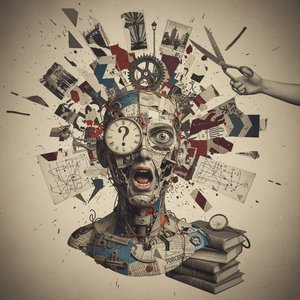
One of the most enduring technical legacies of Dada is the development of collage and photomontage. Rather than using a brush to mimic reality, artists like Max Ernst and Hannah Höch began to physically reconstruct it. They took fragments of the world—newspaper clippings, photographs, advertisements, and scraps of fabric—and layered them into new, jarring compositions. This technique did not aim for seamless integration; instead, it relied on juxtaposition, forcing unrelated images into a dialogue that could provoke thought or laughter.
In these works, the flattened perspective emphasizes that the image is a construction. A piece by Max Ernst might place a human limb next to a mechanical gear, creating a sense of unepping tension. Hannah Höch used photomontage to offer sharp political and feminist commentary, slicing through the media imagery of her time to reveal the underlying social structures. These artists were not just observers; they were curators of the debris of modern life, rearranging the world to expose its contradictions.
This method of assembly continues to shape how we perceive visual information today. In our era of digital layering, where we construct our identities through a mosaic of social media feeds and curated imagery, the logic of the collage is omnipresent. We are all, in a sense, performing a continuous photomontage, pulling disparate fragments of global culture together to create a personal narrative.
The Readymade Revolution: Redefining the Artist's Role
Perhaps no single contribution to modern art is as disruptive as Marcel Duchamp’s introduction of the "readymade." By selecting mass-produced, everyday objects—most famously a porcelain urinal signed with the pseudonym R.M. Mutt in his work Fountain (1917)—Duchamp stripped the artist of the need for manual craftsmanship and replaced it with the power of choice. The art was no longer in the making of the object, but in the intellectual act of designating it as art.
This shift moved the focus from the eye to the mind. It challenged the idea that art must be a unique, hand-crafted item of value. When Duchamp presented a bicycle wheel or a bottle rack as art, he was questioning the very sanctity of the museum and the authority of the critic. He proved that the context in which an object is placed can entirely transform its meaning, a concept that would later become a cornerstone of Conceptual Art.
This revolution finds its modern parallel in the way we interact with found objects in design and fashion. When a designer repurposes industrial materials or vintage components into high-end products, they are utilizing the Duchampian logic of recontextualization. They are asserting that value is not inherent in the material itself, but in the creative vision that selects and presents it to the world.
The Dadaist Legacy: From Subversion to Contemporary Aesthetics
--- title: Dada - Wikipedia url: https://en.wikipedia.org/wiki/Dada hostname: wikipedia.org sitename: Wikimedia Foundation, Inc. date: 2001-11-04 license: CC BY-SA 4.0 --- | This article has multiple issues.Please helpor discuss these issues on the[i...
Though the formal Dada movement lasted less than a decade, its impact on the trajectory of the twentieth century was profound. It provided the foundational DNA for Surrealism, which took the Dadaist interest in the irrational and applied it to the exploration of dreams and the subconscious. Later movements, from Pop Art’s embrace of mass media to the anarchic energy of Punk Rock, all owe a debt to the Dadaist spirit of defiance and subversion.
The movement's influence is visible in everything from the way we use irony in advertising to the way contemporary artists use "glitch" aesthetics to critique technology. The Dadaists taught us that art does not have to be a window into a beautiful world; it can be a mirror held up to a chaotic one. They expanded the boundaries of what materials could be used, how an artist could work, and how a viewer could perceive meaning.
Today, as we navigate an increasingly complex and fragmented global landscape, the lessons of Dada remain relevant. Whether through digitalcollage or the subversion of social media, the impulse to take the pieces of our experience and rearrange them into something provocative continues to drive the evolution of human expression. At AllPaintingsStore.com, we celebrate this enduring spirit of creativity by offering a vast catalog of works that reflect these transformative moments in art history.
Explore the radical origins of Dadaism. From the chaos of WWI to Marcel Duchamp's revolutionary readymades, discover how this anti-art movement dismantled tradition and birthed modern conceptual art. An essential guide for students and collectors of fine art history.
Explore the revolutionary Dada art movement! Discover its origins, key artists like Duchamp & Arp, and lasting impact on modern art. A deep dive into anti-art & challenging conventions.
Dive into the raw chaos of Dadaism. Explore how rebels like Marcel Duchamp used anti-art, readymades, and pure provocation to crash the system and redefine modern visual culture forever.
Journey through Impressionism's golden age! Explore 10 masterpieces by Monet, Renoir & Degas that redefined art. Discover the stories behind these iconic paintings and find museum-quality reproductions to elevate your home decor on AllPaintingsStore.com.
Explore the radical world of Dadaism with our expert-led deep dive. From Duchamp's readymades to the aesthetics of chaos, uncover how this anti-art movement redefined modern creativity and paved the way for Surrealism. A must-read for art students and history enthusiasts alike.


 Anti-art
 10 Iconic Collage Masterpieces That Redefined Modern Art