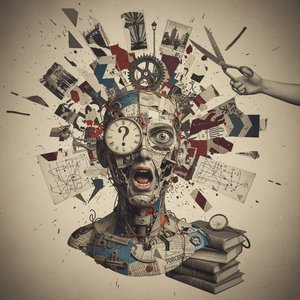
The Crucible of Chaos: World War I and the Genesis of Dadaist Discontent
 Dadaism Unfiltered: The Chaos, Rebellion, and Anti-Art Movement That Changed Everything
The Great System Crash: World War I and the Birth of Pure Chaos Dadaism Unfiltered: The Chaos, Rebellion, and Bold Spirit of Anti-Art The Great Glitch: World War I and the Birth of Pure Chaos Dadaism Explained: The Anti-Art Movement That Redefined Mo...
To understand the seismic shift that was Dadaism, one must first look toward the smoke-filled horizons of the early twentieth century. It was an era defined by a profound sense of disillusionment, where the traditional structures of society—logic, nationalism, and even the concept of progress—seemed to collapse under the weight of industrial warfare. As the senseless carnage of World War I ravaged Europe, the very foundations of civilization appeared to dissolve into the trenches. This was not merely a geopolitical crisis; it was a profound psychological fracture that left an entire generation staring into the abyss.
The movement did not emerge from a desire for aesthetic refinement but as a visceral, guttural scream against the civilization that had permitted such devastation. In the neutral sanctuary of Zurich, Switzerland, a group of displaced intellectuals and artists found refuge amidst the shadows. They witnessed a world where the concept of progress had hit a fatal error, a total system crash of human reason. In this atmosphere of intense trauma, the only honest response was to mirror the absurdity of a world that had lost its moral compass. The seeds of rebellion were sown in this crucible of chaos, creating a space where the old certainties died, leaving behind a landscape of pure, unadulterated disillusionment.
The Philosophy of Anti-Art: Rejecting Logic, Reason, and Tradition
 Dadaism Explained: The Anti-Art Movement That Redefined Modernity
The Crucible of Chaos: World War I and the Genesis of Discontent Dadaism Unveleid: The Radical Art Movement That Defied All Rules and Redefined Modernity The Genesis of Chaos: Post-War Trauma and the Birth of Dada To understand the seismic shift that...
Dadaism was fundamentally an anti-art movement. If the logic and reason of the modern age had led only to the slaughter of millions in the trenches, then the Dadaists reasoned that logic and reason were enemies to be dismantled. They sought to reject the polished aesthetics of the past, viewing traditional beauty as a deceptive mask for a decaying society. Their principles, first collected in Hugo Ball's Dada Manifesto in 1916, were designed to provoke rather than to please. They embraced the nonsensical, the irrational, and the chaotic as tools of resistance.
This philosophical rebellion was a deliberate act of iconoclasm. By denouncing bourgeois values and artistic dogma, Dadaists sought to expose the arbitrariness of aesthetic judgment. They did not wish to create objects for quiet contemplation in gilded frames; they wanted to disrupt the viewer's perception and confront the fundamental questions regarding artistic intention. This rejection of established norms was not merely a stylistic choice but a moral imperative—a way to strip away the pretenses of a culture that had failed its own humanity.
Marcel Duchamp and the Readymade: Redefining the Artistic Object
 Fountain (Duchamp)
Fountain was a readymade sculpture attributed to Marcel Duchamp in 1917, consisting of a porcelain urinal signed "R. Mutt". The work is regarded by art historians and theorists of the avant-garde as a major landmark in 20th-century art. In April 1917...
At the heart of this revolution stood Marcel Duchamp, a philosophical provocateur who fundamentally altered the course of modern art. While his early training involved mastering traditional techniques and experimenting with Post-Impressionist and Cubist styles—evident in works like Portrait of Chess Players—he eventually abandoned these established practices for a path of intellectual experimentation. Duchamp was not interested in what he called "retinal art"—art that was only intended to please the eye—but rather in art that engaged the mind.
His most radical contribution was the invention of the readymade. By selecting ordinary, mass-produced objects and elevating them to the status of art through the simple act of choice and repositioning, Duchamp challenged the very definition of creativity. The most infamous example remains Fountain (1917), a porcelain urinal signed with the pseudonym "R. Mutt." Through this gesture, Duchamp asserted that the artist's idea, rather than their manual skill or the beauty of the medium, was the true essence of art. This shift from the physical act of painting to the conceptual act of selection laid the groundwork for the entire movement of Conceptual Art.
Beyond the Canvas: Found Objects, Collage, and the Aesthetics of Chance
 Bicycle Wheel - Marcel Duchamp
A Pioneering Gesture of Conceptual Art Marcel Duchamp’s Bicycle Wheel stands as an emblem of Dadaism and a pivotal moment in the history of modern art. Created in 1913, this deceptively simple assemblage – a bicycle wheel affixed to a wooden stool – ...
The Dadaist toolkit extended far beyond the traditional oil on canvas. To further dismantle the sanctity of the "masterpiece," artists embraced techniques that celebrated randomness and the mundane. The use of collage and photomontage allowed creators to fragment reality, pulling images from newspapers, advertisements, and magazines to create jarring, disorienting compositions. This method reflected the fractured nature of post-war life, where truth was often a mosaic of propaganda and industrial debris.
Furthermore, the movement embraced chance as a primary creative force. Whether it was dropping scraps of paper onto a surface and gluing them where they fell or composing poetry by pulling random words from a hat, Dadaists sought to remove the artist's ego from the process. This reliance on spontaneity served to undermine the notion of the "genius" creator and instead highlighted the beautiful, terrifying randomness of existence. In works like Duchamp’s Bicycle Wheel, we see the early stages of this assemblage-based approach, where a simple wheel affixed to a stool transcends its utility to become a profound provocation.
The Global Spread: From Zurich to New York and Berlin
--- title: Dada - Wikipedia author: Authority control databases url: https://en.wikipedia.org/wiki/Dada hostname: wikipedia.org sitename: Wikimedia Foundation, Inc. date: 2001-11-04 --- # Dada | This article has multiple issues.Please helpor discuss ...
While Dada was born in the shadows of Zurich, it quickly mutated as it traveled across the globe, taking on different characters depending on its local political climate. In Berlin, Dada became intensely political, utilizing biting satire and photomontage to critique the Weimar Republic and the rise of nationalism. The movement here was a sharp, aggressive response to the socio-political instability of post-war Germany.
In Paris, the movement intersected with the burgeoning Surrealist movement, blending Dada's nihilism with an exploration of the subconscious. Meanwhile, in New York, the spirit of Duchamp and his contemporaries brought a sense of intellectual playfulness and iconoclasm to the American avant-garde. This international network of displaced artists ensured that Dada was not a localized phenomenon but a global contagion of creativity, spreading through exhibitions, manifestos, and the shared language of rebellion.
Dada’s Enduring Legacy: The Foundation of Conceptual and Modern Art
Marcel Duchamp was a pioneer of Dada, a movement that questioned long-held assumptions about what art should be, and how it should be made.
Though the original Dada movement eventually dissolved, its impact on the trajectory of 20th-century visual culture is immeasurable. It shattered the boundaries of what could be considered art, paving the way for Surrealism, Pop Art, and the radical experiments of Fluxus. The movement's insistence that the concept outweighs the execution remains a cornerstone of contemporary practice.
Today, whenever we encounter an installation that uses everyday objects, or digital art that challenges our perception of reality, we are seeing the echoes of Dada. It taught us that art is not merely a window into beauty, but a mirror held up to the chaos, the absurdity, and the profound complexities of the human condition. The radical spirit of Dada continues to resonate, reminding us that even in a world of total system crashes, there is immense power in the act of reimagining everything.