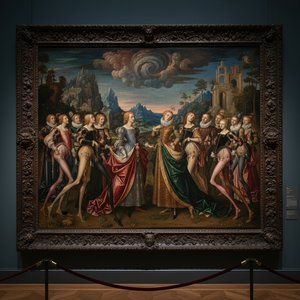
The Fracture of Harmony: Transitioning from High Renaissance Stability to Mannerist Tension Drama & Distortion: A Journey Through the Captivating World of Baroque Mannerism The Renaissance Departure: From Serene Harmony to Mannerist Tension Drama and...
To understand the sudden, restless energy of the sixteenth century, one must first sit quietly with the serene equilibrium that preceded it. For decades, the European artistic landscape was anchored by a pursuit of mathematical perfection—a world where perspective, anatomical accuracy, and light converged to create a window into a divine, harmonious reality. The masters of this era, such as Leonardo da Vinci and Raphael, sought to mirror the order of the cosmos through stable pyramidal compositions and a sense of tranquil permanence. There was a predictable beauty in this classical stability, a belief that art could capture the very essence of a rational and balanced universe.
However, as the sixteenth century dawned, this classical stability began to fracture under the weight of profound social, religious, and political upheaval. The certainty of the Renaissance—rooted in faith, reason, and order—was shaken by seismic events such as the sack of Rome in 1527, which fostered a pervasive sense of instability across the continent. This was not a sudden rupture but a gradual, deliberate departure from the predictable. Where once there was balance, there emerged tension; where once there was naturalism, there arose a fascination with the artificial and the elongated.
The transition is visible in the very architecture of the era. Consider the Cathedral in Toledo, a monumental achievement that rises from the heart of Spain. While its foundations hold Roman and Visigothic echoes, its soaring Gothic heights suggest an aspiration toward the ethereal. Just as the cathedral moves from heavy, earth-bound textures to luminous heights, Mannerist painting moved away from the grounded weight of the High Renaissance toward a more spiritualized, unsettled space.
The Aesthetic of Distortion: Elongated Forms and the Pursuit of Virtuosity
Girolamo Francesco Maria Mazzola – The Enigmatic Parmigianino Girolamo Francesco Maria Mazzola, more commonly known as Parmigianino, was a figure of captivating complexity and profound influence within the artistic landscape of 16th-century Italy. Bo...
Mannerism, derived from the Italian maniera meaning “style” or “manner,” was not an attempt to reject beauty altogether, but rather a profound endeavor to redefine it. It emerged as a reaction against the perceived perfection of its predecessors, seeking to excel through artifice rather than imitation. The artists of this period began to manipulate the human form with a sophisticated disregard for strict anatomical accuracy. This aesthetic is characterized by what we might call a sensuous distortion—the deliberate elongation of limbs and the creation of complex, often unstable, poses.
This pursuit of virtuosity is perhaps most evident in the works of Parmigianino. In his depictions, such as the portrait of Lucrezia, the figure's proportions are subtly altered to achieve an ethereal grace. Every line, from the sweep of drapery to the delicate curve of a neck, speaks to an artifice elevated to the level of sublime beauty. This was not a failure to capture nature, but a mastery of it, where the artist’s individual skill in manipulating form became more significant than the objective depiction of the physical world.
This fascination with the elongated and the complex finds its echo in the later Elizabethan court paintings of Britain. Much like the Mannerist masters, these works utilized an elegant artificiality to convey status and refinement, proving that the desire to transcend naturalism through stylized grace was a sentiment that traveled far beyond the borders of Italy.
Chromatic Intensity: The Shift from Naturalism to Spiritual Luminosity
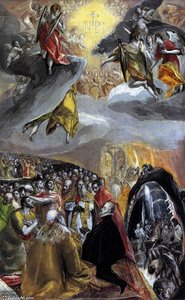
Adoration of the Shepherds: A Visionary Synthesis El Greco’s *Adoration of the Shepherds*, completed around 1605-10, stands as a monumental testament to Mannerist artistic innovation and spiritual fervor. More than just a depiction of biblical narrat...
The color palette of the Mannerist era underwent a transformation as dramatic as the figures themselves. The clear, balanced light of the High Renaissance gave way to an era of ambiguity and psychological complexity. Artists began to experiment with intense, often unnatural colors and a flattened pictorial space that obscured depth. This use of color was not merely decorative; it was intended to heighten the emotional pitch of the scene, guiding the viewer through a landscape of spiritual intensity.
El Greco’s Adoration of the Shepherds serves as a profound example of this shift. Completed in the late sixteenth century, the painting employs dramatic chiaroscuro—stark contrasts between light and dark—to emphasize the spiritual significance of the narrative. The use of vibrant reds and golds creates an atmosphere of solemn grandeur, while the luminous figures seem to pulsate with a divine energy that defies the laws of physics. Here, color is used to convey both physicality and an ethereal luminosity, anticipating the expressive power of much later movements.
This movement toward spiritualized light can be seen in the architectural transitions of the period as well. In the Oratorio del Gonfalone in Rome, the fresco cycles depict scenes of the Passion with a heightened sense of theatricality. The interplay of light and shadow within these sacred spaces mirrors the way Mannerist painters used color to move the soul, transforming a physical space into a site of intense religious contemplation.
Intellectual Artifice: Navating the Sophistication of the Maniera
To engage with Mannerism is to enter a realm of beautiful uncertainty, where the rules of nature are secondary to the rules of style. The movement valued the sophisticated solution of intricate artistic challenges, favoring a cultivated intellectual sophistication over simple naturalism. This was an art for the discerning, often involving complex allegories and mythological references that required a deep knowledge of classical literature to fully decode.
This level of complexity is evident in the works of Agnolo Bronzino, whose official portraits of the Medici court demonstrate an extraordinary technical skill used to convey aristocratic dignity. His execution is extremely refined, utilizing graceful silhouettes and meticulous detail to highlight the social status and learning of his subjects. The art was self-consciously "mannered," a display of virtù that celebrated the artist's ability to navigate difficult compositions and intricate textures with apparent ease.
This intellectual tension finds a parallel in the very concept of the "modern style" described by Giorgio Vasari. He viewed the maniera moderna as an evolution where artists were no longer merely copying their predecessors but were synthesizing various influences into something entirely new. It was a period of profound intellectual ambition, where the goal was to surpass the achievements of the past through the sheer force of inventive thought and technical facility.
Expanding the Horizon: Mannerist Echoes in Northern and Spanish Traditions
Giulio Cesare Amidano: A Parma Painter Lost in the Shadows of Mannerism Giulio Cesare Amidano, a name largely absent from the grand narratives of 16th-century Italian art, was nonetheless a painter who quietly contributed to the evolving landscape of...
While Mannerism found its most concentrated expression in Florence and Rome, its influence spread across Europe, adapting to local traditions and creating distinct regional variations. In the North, this evolution took on a different character, often blending the sophisticated distortions of Italy with the detailed, atmospheric qualities of Flemish masters. Artists like Giulio Cesare Amidano, working in Parma, produced landscapes that, while retaining a sense of classical grace, incorporated a subtle melancholy and psychological depth that foreshadowed the emerging Mannerist aesthetic.
In Spain, the movement merged with existing architectural and artistic traditions to create something uniquely Iberian. The Spanish Renaissance was characterized by an eclectic fusion, where Gothic forms met Italianate motifs. This is seen in the Plateresque style, which utilized highly ornamental designs reminiscent of silversmith work. The integration of these diverse elements—from the heavy textures of the Romanesque to the light-filled expansions of the Gothic—created a cultural landscape that was as complex and layered as a Mannerist canvas.
Ultimately, whether through the elongated figures of an Italian altarpiece or the intricate ornamentation of a Spanish facade, the spirit of Mannerism remains one of profound transition. It represents that fleeting, brilliant moment when the certainties of the past were abandoned in favor of a more expressive, uncertain, and ultimately more human way of seeing the world. For those seeking to bring this sense of drama and history into a modern space, AllPaintingsStore.com offers an extensive collection of hand-painted reproductions and custom commissions that capture the enduring power of these historical masters.
Explore the dramatic evolution of Northern Mannerism. Discover how 16th-century artists moved from Renaissance harmony to elegant distortion, tension, and complex symbolism in European art history.
Explore the captivating world of Renaissance Mannerism. Discover how artists moved beyond High Renaissance harmony into an era of dramatic elegance, elongated forms, and profound tension. A sophisticated guide for art enthusiasts and collectors seeking historical depth.
Explore the dramatic evolution of Northern Mannerism. Discover how masters like Bosch and Grünewald transitioned from Renaissance harmony to profound, elegant distortion through an expert analysis of symbolism, emotional intensity, and artistic innovation.
Explore the dramatic evolution of Mannerism from High Renaissance perfection to El Greco's spiritual intensity. Discover the history, techniques, and enduring legacy of this transformative era through an expert art-history lens.




 Beyond Perfection: The Dramatic Elegance and Intellectual Tension of Renaissance Mannerism
 Girolamo Francesco Maria Mazzola
 Adoration of the Shepherds
 Giulio Cesare Amidano