The Physics of Light: Specular Reflection and Surface Detail
To understand how a painter creates the illusion of weight and substance, one must first understand how light interacts with a surface. In the study of optics, we distinguish between two primary behaviors: diffuse and specular reflection. When light hits a matte object, such as a dry stone or a piece of unpolished wood, it scatently scatters in many directions, a process known as diffuse reflection. This provides the base layer of form-modeling that allows us to perceive shape and volume. However, when a surface becomes smooth or wet, a second layer is added.
This secondary layer is specular reflection, where light rays bounce off an object at the same relative angle they approached. Consider the difference between a dry slate rooftop and the same roof immediately following a rainstorm. The thin film of water creates a temporary mirror, allowing the dark chimneys to be reflected clearly against the grey stone. This transition from matte to reflective is what gives a painting its sense of physical reality. By adding this specular pattern on top of traditional form-modeling, an artist can communicate texture, moisture, and even the cleanliness of a surface, such as the high shine found on a well-polished apple or a leather shoe.
Expanding the Frame: Mirrors as Tools for Multi-Angle Composition
A mirror does more than reflect light; it functions as a compositional device that expands the boundaries of the canvas. For an artist working in an interior setting, a mirror offers the opportunity to present a subject from more than one perspective simultaneously. This technique allows the viewer to see both the front and the profile of a figure within a single, unified frame.
The works of Francis Campbell Boileau Cadell demonstrate this mastery of spatial expansion. In pieces such as The Black Hat, At The Mirror and Nude Seated on a Sofa, Cadell utilizes mirrors to depict his models from multiple angles, effectively increasing the amount of visual information available to the observer. He also used mirrors within interior scenes to play with light and to suggest a larger, more complex room than the canvas width might otherwise allow. Even in still life compositions, such as Still Life With A White Buddha And A Porcelain Buffalo, a mirror can be positioned to enhance the balance of the arrangement. It is worth noting that when a mirror faces outward toward the viewer, it reflects only the objects contained within the frame, intentionally omitting the observer to maintain the integrity of the painted world.
Atmospheric Stillness: Using Water to Establish Emotional Depth
Beyond the controlled environment of an interior, natural bodies of water provide a much larger, more fluid canvas for reflection. In landscape painting, the state of a water's surface is a primary indicator of the atmosphere. A disturbed, rushing river creates broken, distorted reflections that suggest movement and energy, whereas still water acts as a steadying force in the composition.
In the work of Henri Jacques Delpy, specifically Evening on the river, the use of reflections in calm water is essential to evoking a sense of tranquility. The mirror-like surface holds the light of the sky, creating a symmetry that settles the eye. A similar principle is found in Andrew Wood’s Axmouth, where the reflections of moored boats highlight the absolute stillness of the water. These reflections emphasize that all activity has been brought to rest. Without these specular elements, the water would appear flat and lifeless; with them, the painting gains a profound sense of peace and environmental depth.
The Hidden Observer: The Artist’s Presence in the Reflected Image
The use of reflection often introduces a subtle tension between what is seen and what is hidden. While many artists use mirrors to expand space, others use them to insert themselves into the narrative of the work. This creates a complex relationship between the subject, the artist, and the viewer, turning a simple portrait into a layered exploration of presence.
The surrealist Salvador Dali famously utilized this concept in Dali from the Back Painting Gala from the Back Eternalized by Six Virtual Corneas Provisionally Reflected by Six Real Mirrors, where the artist himself is visible within the reflections. This contrasts with the more subtle approach found in Jan Van Eyck’s Arnolfini wedding portrait. In the convex mirror at the rear of the room, two small figures appear; while some scholars suggest these are witnesses to the marriage, others believe they represent the artist himself. Whether the artist chooses to remain invisible or to leave a trace of their presence, the reflection serves as a bridge between the painted reality and the act of creation.
Texture and Light: The Interplay of Polished and Matte Surfaces
The true skill in rendering reflections lies in managing the relationship between different surface qualities. A painting that relies solely on matte textures can feel heavy or dull, while one that overuses highlights can feel disconnected from the underlying forms. The most successful works find a balance, treating the specular pattern as a distinct layer of light that sits atop the physical structure of the object.
This is evident when observing how an artist handles polished surfaces versus organic ones. In Cadell’s The Red Chair, reflections are used specifically to portray the high sheen of a well-polished floor, providing a sense of material hardness and cleanliness. This same principle applies to the way light hits more organic subjects; by increasing the proportion of specular reflection on an object, the artist communicates a change in state—from dry to wet, or from rough to smooth. It is this careful calibration of light that allows a hand-painted oil reproduction to achieve a depth and tonal range that far exceeds the flat appearance of a digitalprint. At AllPaintingsStore.com, our artists apply these classical principles of light and reflection to every commission, ensuring that each brushstroke contributes to a cohesive and realistic whole.
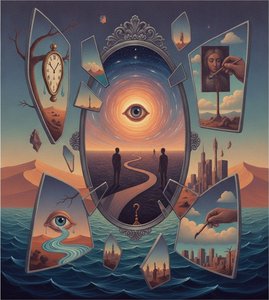
Explore the profound symbolism of mirror art through a journey of Surrealist mastery. From Dalí's fractured realities to technical brilliance, discover how reflections redefine art history and inspire sophisticated modern collections.
Step into the dreamscape of Salvador Dalí. Explore 25 iconic surrealist masterpieces, from melting clocks to bizarre visions. Discover the stories behind these timeless works and find museum-quality art reproductions for your decor. Explore the full collection online at AllPaintingsStore.com.