Paul Cézanne’s “Potted Plants”: A Window into Post-Impressionist Vision In the realm of art, few still lifes possess the quiet power and revolutionary spirit of Paul Cézanne's Potted Plants , created in 1890 and currently residing within the esteemed...
To look upon a collection of indoor greenery is often to see mere decoration, yet for Paul Cézanne, the arrangement of vessels and leaves offered a rigorous study in structural permanence. In his 1890 work, Potted Plants, the artist moved away from the fleeting light of Impressionism toward something far more substantial. He did not merely record the presence of flora; he deconstructed it into volumes and planes. Each vase, each stem, and each cluster of leaves was treated as a geometric component, contributing to a larger, analytical whole that would later inform the very foundations of Cubism.
This approach finds a profound parallel in the way we perceive the weight of objects today. When selecting botanical art for a professional or residential space, one is not simply choosing a subject, but a method of organizing visual space. Just as Céz andanne used overlapping planes of color to create an illusion of solidity, a well-placed large-format print can anchor a room. The strength of the composition lies in its ability to command the wall through form rather than mere ornament.
Symbolism in the Shadows: Dutch Vanitas and the Narrative of Still Life
A Master of the Dutch Golden Age: The Life and Legacy of Hendrik Gerritsz Pot In the vibrant, bustling atmosphere of the seventeenth-century Netherlands, few artists captured the intricate dance between everyday reality and profound moral reflection ...
The seventeenth-century Netherlands produced a particular breed of painter, one who understood that a domestic scene could carry the weight of a sermon. Hendrick Gerritsz Pot, working within the vibrant atmosphere of the Dutch Golden Age, utilized the objects of daily life to weave complex allegories. In his genre paintings, a carefully placed object was rarely just an object; it often functioned as a vanitas, a subtle reminder of the transience of earthly existence. The beauty of a blooming flower or a piece of ripe fruit was always shadowed by the inevitable passage of time.
This tradition of finding deeper meaning within the mundane remains a cornerstone of botanical art. When we observe a still life featuring a single stem or a group of vessels, we are participating in a long-standing dialogue about presence and absence. Modern collectors often seek this depth, choosing pieces that offer more than surface-level appeal. A painting that captures the tension between life and decay provides a psychological gravity that simple decorative prints cannot replicate.
Precision and Poetry: The Scientific Legacy of Botanical Illustration
A Botanical Legacy: Where Science Meets the Sublime To step into the Department of Plant Sciences at Cambridge University is to enter a sanctuary where the rigorous precision of scientific inquiry dissolves into the profound beauty of the natural wor...
There exists a point where the rigors of science meet the grace of fine art, a boundary famously blurred in the archives of institutions like the Cambridge University Department of Plant Sciences. Here, the meticulous study of flora transcends biology to become an intimate dialogue with the earth. The historical importance of the herbarium, with its thousands of preserved specimens, provides a physical timeline of human discovery. This precision is mirrored in the works of artists like Johann Wilhelm Weinmann, whose Phytanthoza iconographical utilized advanced engraving techniques to achieve a level of tonal nuance that satisfied both the scientist and the aesthete.
This legacy of accuracy continues to influence contemporarybotanical art. Whether it is the delicate watercolor washes of Elizabeth Blackadder or the structural integrity found in modern digital prints, the goal remains the same: to capture the essential truth of the specimen. For those furnishing corporate or hospitality environments, this precision offers a sense of order and sophistication. A collection of botanically accurate works provides an intellectual texture that complements a refined interior.
Expeditionary Aesthetics: Bringing Global Biodiversity to the Interior
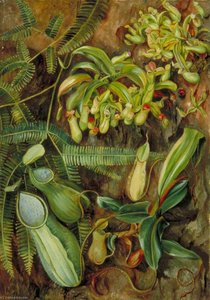
A Victorian Explorer's Botanical Reverie: Marianne North’s "North American Carnivorous Plants" Marianne North’s “North American Carnivorous Plants,” painted in 1870, is more than a botanical illustration; it’s a vibrant testament to the spirit of a V...
The history of botanical art is also a history of movement and exploration. Marianne North, a Victorian pioneer who refused the constraints of the domestic drawing room, traveled from the rainforests of Brazil to the gardens of Japan to document the world's biodiversity. Her canvases do not merely illustrate plants; they breathe with the humidity of the environments she traversed. In works such as North American Carnivorous Plants, she captured the raw, untamed spirit of distant lands, providing a permanent record of ecosystems that have since been irrevocably altered.
Bringing this sense of adventure into a modern space allows for a connection to the wider world. Integrating pieces that suggest different climates and geographies—from the deep emeralds of a jungle floor to the sun-drenched tones of an Australian bush—creates a curated, global atmosphere. It transforms a room from a static enclosure into a window onto the extraordinary. This spirit of discovery is what makes botanical art a perennial choice for those seeking to enrich their surroundings with a sense of scale and wonder.
The Curated Conservatory: Framing Botanical History for Modern Spaces
Admire Marianne North’s stunning botanical masterpiece depicting palm trees in Buitenzorg Botanic Garden (Java). Explore this vibrant 1876 painting and discover the beauty of tropical flora.
The final act of arranging botanical art lies in the presentation, where the old masters' traditions meet contemporary design. The challenge for the modern decorator is to honor the historical weight of these subjects without descending into the overly sentimental or the dated. Just as the great glasshouses of the Victorian era were feats of both engineering and elegance, the framing of a print determines its architectural impact. A heavy, ornate frame may transport a viewer back to a nineteenth-century parlor, whereas a thin black profile or a natural light oak frame allows the subject to exist in the present.
In professional procurement, consistency is the key to a cohesive aesthetic. Utilizing matching frames for a group of three or five pieces establishes a gallery-like discipline across a large wall. Whether employing the bold, graphic impact of a single oversized canvas or the rhythmic flow of a multi-panel arrangement, the objective is to create an intentional environment. At AllPaintingsStore.com, we facilitate this process by providing high-quality, hand-painted reproductions and museum-grade prints that allow for the seamless integration of historical beauty into the most modern of architectural contexts.
Explore the captivating world of Jan Wijnants and Dutch Golden Age still life painting. Discover symbolism, masterful techniques & lasting influence on floral art history. Learn more!
Journey through the vibrant world of Marianne North. Explore 25 iconic botanical masterpieces that blend Victorian adventure with scientific beauty. Find museum-quality art reproductions and decor inspiration for your home. Discover all masterpieces on AllPaintingsStore.com.
Explore the exquisite world of botanical realism. From scientific precision to Impressionist light, discover how master artists capture nature's true essence through timeless, hand-painted oil reproductions and historical insights for the discerning art lover.




 Potted Plants
 Hendrick Gerritsz Pot
 Department of Plant Sciences
 North American Carnivorous Plants
 Palms in the Botanic Garden, Buitenzorg, Java