The Eternal Blueprint: How Roman Grandeur Defined Western Art
 Timeless Glory: Capturing the Majesty of the Roman Empire Through Art
The Eternal Blueprint: How Roman Grandeur Defined the Language of Western Art Echoes of Antiquity: How Roman Grandeur Shaped the World’s Greatest Art Masterpieces The Roman Blueprint: Establishing the Canon of Proportion and Power Equestrian statue o...
Sculpting Authority: The Commanding Presence of Imperial Portraiture
 Equestrian statue of Marcus Aurelius
Captivating Subject and Iconic Representation This remarkable bronze sculpture captures the commanding presence of a Roman emperor on horseback, embodying strength, leadership, and divine authority. The figure, likely representing Marcus Aurelius, ex...
In the realm of sculpture, the Roman spirit found its most potent expression through the depiction of leadership and divine right. The *Augustus of Primaporta* captures this sense of command. Carved from white Parian marble and standing over two meters tall, the statue depicts the first emperor in the act of *adlocutio*, addressing his troops. His highly decorated cuirass features Apollo, Diana, Pax, Tellus, Sol, and Caelus, using religious iconography to communicate political legitimacy. Found in 1863 at the Villa of Livia, this marble work is thought to be a replica of a lost bronze original.
The *Portrait of the Four Tetrarchs* offers a different visual language. While the Augustus statue emphasizes an idealized, individual presence through a *contrapposto* pose, this 4th-century porphyry sculpture from Asia Minor presents a more collective form of rule. Located at Saint Mark's Basilica in Venice, the Tetrarchs utilize a more rigid, stylized language to represent the four co-rulers of the empire. This shift from the individual to the institutional marks a departure from the naturalism of the early empire. Today, these works allow us to trace the changing face of imperial power through the evolution of stone and pigment.
Vibrant Legacies: The Intimacy and Preservation of Roman Wall Paintings
--- title: Painting in ancient Rome - Wikipedia url: https://en.wikipedia.org/wiki/Painting_in_ancient_Rome hostname: wikipedia.org sitename: Wikimedia Foundation, Inc. date: 2022-10-19 --- # Painting in ancient Rome **Painting in ancient Rome** is a...
While much of Roman art was intended for the public eye, a deeply intimate dimension of their culture survives through the medium of fresco. Much of our understanding of Roman domestic life is owed to the preservation provided by the eruption of Mount Vesuvius in AD 79. The ash and lava that buried Pompeii and Herculaneum acted as a protective shroud, shielding wall paintings that would otherwise have succumbed to decay. These works, ranging from the narratives of the Dionysiac Frieze of Pompeii to the botanical realism found in the Painted Garden Fresco at the Villa of Livia, offer a window into the interiors of the Roman elite.
Centuries later, the discovery of these sites forced a reevaluation of how we perceive antiquity. When archaeologists first cleared the volcanic debris, they did not find only ruins, but a preserved sense of color and space. This sudden exposure to the past mirrors the way a single archaeological find can alter an entire historical narrative. These paintings were often created using the fresco technique, where pigments were applied directly to wet plaster, making the art part of the architecture itself. The subject matter spanned from mythological scenes involving Polyphemus and Galatea to terrestrial depictions of gardens. This tradition was indebted to Greek antecedents, particularly the linear styles of the Ionian Greeks, yet it evolved into a specific Roman blend of decorative elegance and narrative complexity. These fragments remind us that even within a civilization defined by massive stone monuments, there existed an appreciation for the light and intimacy of the domestic sphere.
Echoes of the Empire: Neoclassical Revivals and the Pursuit of Order
 Neoclassical Art: The Ultimate Guide to Timeless Power, Precision, and the Classical Ideal
The Great Reset: Moving from Rococo Excess to Neoclassical Order Neoclassicism Unveiled: The Timeless Elegance of Order, Reason, and Classical Antiquity The Enlightenment Catalyst: From Rococo Excess to Rational Restraint The Revival of Antiquity: Ex...
Architectural Majesty: From Monumental Arches to the Beauty of Ruins
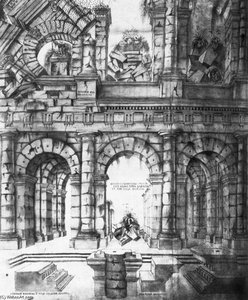 Ruins of the Ancient Roman Theater of Marcellus
Ruins of the Ancient Roman Theater of Marcellus: A Testament to Time’s Passage The drawing by Giuliano da Sangallo, titled “Ruins of the Ancient Roman Theater of Marcellus,” transcends mere architectural representation; it embodies a profound meditat...