The Golden Age: Historical Context and the Rise of Spanish Hegemony Spanish Golden Age The Spanish Golden Age (Spanish: Siglo de Oro [ˈsiɣlo ðe ˈoɾo] 'Golden Century') was a period of intense artistic, literary, and intellectual flourishing in Spain ...
To understand the visual language of the seventeenth century in Spain, one must first acknowledge the profound tension that defined the era. The Siglo de Oro was not merely a period of aesthetic innovation; it was a time when the wealth of a global empire met the austere, inward-looking spiritual intensity of the Counter-Reformation. This duality created a landscape where light did not simply illuminate a scene but served to define its very existence. In the hands of the Spanish masters, light became a tool of weight and substance.
This era finds its historical echo in the architectural restraint of Juan de Herrera. Just as his structures sought to balance monumental presence with gravity, the painters of this age moved away from the distortions of Mannerism toward a visual language rooted in truth. They did not seek to please the intellect with complex allegories alone; they sought to move the soul through the palpable presence of form. The light in a Spanish Baroque canvas carries a physical density, as if the brightness itself possesses mass.
Tenebrism and Truth: The Sculptural Power of Shadow
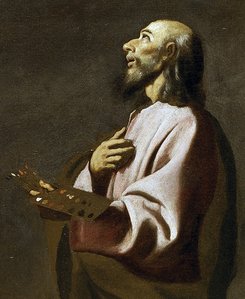
Echoes of Devotion: The Group of Artists Influenced by Francisco de Zurbarán The story of this collective – a “Group of Artists Influenced by Francisco de Zurbarán” – isn’t one of shared studios or manifestos, but rather a compelling resonance. It's ...
At the technical heart of this movement lies a revolution of shadow. While many contemporary European styles utilized soft transitions to create atmosphere, the Spanish school embraced tenebrism—a more extreme expression of chiaroscuro. This technique involves bold, often harsh contrasts that allow an artist to carve form out of nothingness. By plunging large portions of the canvas into deep, impenetrable darkness, the painter directs the viewer’s gaze with surgical precision, forcing an encounter with the illuminated subject.
We see this sculptural approach in the works of Francisco de Zurbarán. His ability to render the heavy folds of monastic robes and the stark textures of flesh through dramatic light creates a sense of profound stillness. The shadow is not merely an absence of light; it is a structural element that provides volume and three-dimensional presence. This mastery of darkness ensures that every highlighted edge feels tactile, as if one could reach out and touch the rough weave of a burlap sack or the smooth skin of a saint.
The Courtly Gaze: Portraiture as Psychological Depth
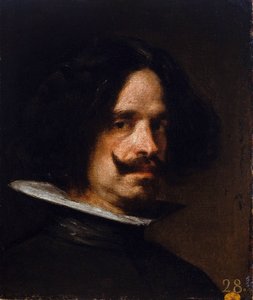
A Glimpse into Genius: Diego Velázquez’s 1640 Self-Portrait Diego Velázquez's *Self-Portrait* of 1640 is more than a likeness; it’s a profound statement about artistry, status, and the very act of seeing. Measuring just 46 x 38 cm, this intimate pain...
As the Spanish Golden Age progressed, the use of light shifted from the purely religious to the deeply human. In the royal court of King Philip IV, Diego Velázquez transformed the tradition of portraiture. He moved away from the rigid, idealized formality of earlier eras, opting instead for an unflinching realism. His portraits do not merely present a likeness; they capture a psychological state. Through the subtle manipulation of light across a brow or the shadow beneath an eye, he imbued his subjects with a sense of melancholy and intelligence.
This depth is perhaps most evident in his 1640 Self-Portrait. Here, the artist uses chiaroscuro to sculpt his own features against a dark background, creating an intimate dialogue between the sitter and the observer. The light does not flatter; it reveals. This commitment to truthfulness—depicting even the most powerful monarchs as men burdened by responsibility—established a new standard for the genre, where the character of the subject is found in the interplay of light and shadow rather than in the opulence of their attire.
From Bodegones to Grandeur: The Evolution of Genre Painting
Introduction Diego Velázquez, one of the most renowned painters of the Spanish Golden Age, created a masterpiece of Baroque genre painting in his work "The Lunch" (c. 1617). This captivating piece showcases Velázquez's exceptional skills in combining...
The roots of this dramatic style were planted in the humble settings of the bodegón. These early kitchen scenes, such as Velázquez’s Old Woman Frying Eggs, demonstrate a remarkable ability to capture textures—the glint of oil, the coarseness of bread, the translucency of an eggshell—using stark, Caravaggesque lighting. These works brought a sense of dignity to everyday life, elevating the mundane to the level of high art through meticulous observation and light.
This evolution from the domestic to the grand is mirrored in the development of larger-scale compositions. As artists moved from the small-scale realism of Seville to the monumental demands of the Madrid court, they carried this sensitivity to texture with them. Whether painting a simple meal in The Lunch or complex historical scenes, the fundamental principle remained: use light to ground the subject in reality. The transition from the quietude of a kitchen scene to the complexity of courtly life was bridged by this unwavering dedication to the physical properties of the visible world.
Architectural Echoes: Gravity and Ornament in Baroque Spain
A Journey Through Baroque Splendor: The Hospital de San Bernardo Nestled in the historic heart of Seville, Spain, the Hospital de los Venerables – or Hospital de San Bernardo – stands as a testament to the artistic fervor and religious devotion of th...
The tension between restraint and decoration found its most literal expression in Spanish architecture. While the later Churrigueresque style would eventually introduce an almost capricious level of surface ornamentation, the earlier period was defined by a more classicizing approach. This architectural gravity provided the necessary stage for the dramatic paintings of the age. The heavy, stone-clad structures of the era provided a sense of permanence that matched the weight of the oil pigments on canvas.
This relationship is visible in spaces like the Hospital de San Bernardo in Seville. Here, the architecture provides a framework of light and shadow through its courtyards and soaring facades, much like a painted composition. The interplay of sunlight on stone and the deep shadows cast by arches creates an immersive environment that echoes the tenebrism found in the paintings housed within such institutions. The architecture does not merely contain the art; it participates in the same dramatic dialogue of light and dark.
A Living Lineage: The Enduring Influence of the Spanish Masters
A Living Legacy of Spanish Artistry In the vibrant, historic heart of Madrid, where the echoes of tradition meet the pulse of modern creativity, lies the Asociación Española de Pintores y Escultores (AEPE) . Founded in 1910, this venerable institutio...
The legacy of the Spanish Baroque is not a static relic of the past but a continuous thread in the fabric of Western art. The innovations of Velázquez and Zurbarán provided a foundation for later movements, from the realism of the 19th century to the expressive distortions of modern masters like Picasso and Francis Bacon. Their ability to find truth in the shadows continues to inform how we perceive depth, texture, and human emotion in visual media today.
For those seeking to bring this sense of historical weight into contemporary spaces, the tradition remains accessible through high-quality reproductions. At AllPaintingsStore.com, we specialize in providing professional-grade, hand-painted oil reproductions that respect these classical techniques. Whether you are a procurement manager for a hotel chain or an interior designer for a corporate office, our service offers the scale and reliability required for large-scale projects. We provide everything from custom multi-panel splits to large-format murals, all executed by artists trained in academic traditions. With our streamlined order management, pre-shipment photo approval, and global logistics via DHL and FedEx, we ensure that the dramatic legacy of the Spanish masters can be integrated into any modern architectural vision with efficiency and precision.
Immerse yourself in the dramatic world of Francisco de Zurbarán. Explore 25 iconic Spanish Baroque masterpieces defined by intense tenebrism and spiritual realism. Find inspiration for museum-quality art reproductions and decor. Discover all masterpieces on AllPaintingsStore.com.
Immerse yourself in the dramatic world of Francisco de Zurbarán. Explore 25 iconic Spanish Baroque masterpieces defined by intense tenebrism and spiritual realism. Find inspiration for museum-quality art reproductions and decor. Discover all masterpieces on AllPaintingsStore.com.


 Spanish Baroque Art: Mastering Chiaroscuro and the Dramatic Grandeur of the Golden Age
 Group Of Artists Influenced By Francisco De Zurbarán
 Self-Portrait
 The Lunch
 Hospital de San Bernardo
 Asociación Española de Pintores y Escultores