The Master of Pastoral Serenity
Adriaen van de Velde stands as a pivotal figure in the Dutch Golden Age, a period defined by an unparalleled flourishing of artistic innovation and observational precision. Born in Amsterdam in 1636, he was immersed from birth in a lineage of profound artistic talent. As the son of the celebrated marine painter Willem van de Velde the Elder and the brother of the renowned maritime master Willem van de Velde the Younger, Adriaen was destined for greatness within the vibrant milieu of seventeenth-century Dutch art. However, rather than following his brother’s path toward the turbulent seas and maritime vistas, Adriaen sought a different kind of tranquility. He turned his gaze toward the earth, honing his skills in the studio of Jan Wynants, where he mastered the delicate nuances of landscape composition and learned to capture the subtle, atmospheric effects that breathe life into a canvas.
His artistic evolution was further enriched by a profound connection to the works of Philip Wouwerman. This mentorship instilled in him a deep appreciation for animal painting, a specialty that would become his hallmark. Van de Velde possessed a remarkable ability to blend meticulous observation with a poetic, artistic imagination. He became instrumental in advancing the genre of Italianate landscape painting, introducing figures into landscapes with such grace and naturalism that his techniques were later adopted by luminaries such as Hobbema and Ruysdael. His work often features rolling meadows teeming with life—sheep, cattle, and goats—executed with a silvery coloring and a commitment to realism that transports the viewer to a timeless, idyllic world.
Technique and Artistic Vision
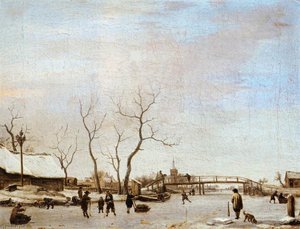
The brilliance of Van de Velde’s oeuvre lies in his ability to evoke emotion through light and texture. His landscapes are not merely depictions of scenery but are atmospheric experiences. Whether he was painting a Mountainous Landscape with Cows or the intimate details of A Goat and a Kid, his brushwork conveyed a sense of peace and permanence. He utilized a palette that could shift from warm, sun-drenched tones to the cool, silvery light characteristic of the Dutch atmosphere, creating depth and a palpable sense of air within his compositions.
Beyond his celebrated pastoral scenes, Van de Velde demonstrated a surprising versatility that showcased his command over different narrative modes. His talent was not limited to the natural world; he also ventured into religious iconography, most notably seen in his creation of The Descent from the Cross for a Roman Catholic hidden church in Amsterdam. This ability to pivot from the secular beauty of a stone bridge or a rural meadow to the profound gravity of sacred subjects speaks to an artist of immense technical range and intellectual depth.
Legacy and Historical Significance
Throughout his career, Van de Velde was a collaborative spirit, working alongside other masters of his era such as Jan van der Heyden and Frederik de Moucheron. His dedication to the refinement of animal depiction helped elevate the status of genre painting within the Dutch hierarchy of subjects. His influence can be traced through the development of the landscape tradition, as he bridged the gap between the rugged realism of early Dutch masters and the more idealized, classical Italianate styles that would follow.
Though his life was tragically short, ending in 1672, the impact of his approximately two hundred surviving works remains profound. He left behind a legacy of:
- Mastery of Light: An unparalleled ability to capture the fleeting, atmospheric qualities of the Dutch sky and landscape.
- Animal Portraiture: Elevating livestock and pastoral animals from mere background elements to central, soulful subjects of art.
- Genre Innovation: Integrating human figures into landscapes in a way that felt organic, narrative, and deeply integrated into the environment.
Today, Adriaen van de Velde is remembered not just as a painter of scenes, but as a poet of the landscape, whose work continues to offer a window into the tranquil, sunlit heart of the Dutch Golden Age.
Questions & Answers
In which historical period did Adriaen van de Velde work?
Adriaen van de Velde worked in the Early-Modern period. The period situates the artist's activity in history.
What are the birthplace and birth year of Adriaen van de Velde?
Adriaen van de Velde was born in Amsterdam in 1636.
Which artworks by Adriaen van de Velde are the most viewed?
A Stats page exists for Adriaen van de Velde, presenting statistics about the artist's artworks on this website.