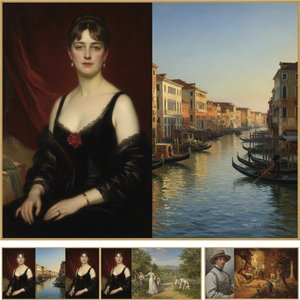
Early Life and Artistic Foundations
Andrew John Henry Way, born in Washington, D.C., in 1826, emerged from a milieu steeped in the burgeoning artistic spirit of 19th-century America. His initial foray into the world of painting began under the tutelage of John Peter Frankenstein in Cincinnati, where he laid the groundwork for his future endeavors. This early training was followed by studies with Alfred Jacob Miller in Baltimore, further refining his skills and introducing him to a broader range of artistic techniques. However, it was Way’s decision to embark on an extended period of study in Europe – first Paris, then Florence – that truly catalyzed his development as an artist. These years spent immersed in the Old Masters provided him with a profound understanding of composition, color theory, and the subtleties of light and shadow, shaping his aesthetic sensibilities for decades to come.A Pivotal Shift: From Portraiture to Still Life
Upon returning to Baltimore in 1854, Way initially established himself as a portrait painter, diligently capturing the likenesses of prominent citizens. Yet, his artistic trajectory underwent a significant transformation around 1859. A chance encounter with the renowned German-American artist Emanuel Leutze proved pivotal. Leutze’s discerning eye recognized Way's latent talent for still life painting, and his encouragement spurred Way to redirect his focus entirely towards this genre. This wasn’t merely a change in subject matter; it represented a deeper exploration of form, texture, and the evocative power of everyday objects. He began to meticulously render fruit, particularly grapes, with an almost photographic realism that captivated viewers.Mastering *Trompe l'oeil* and Achieving Recognition
Way quickly distinguished himself as a master of *trompe l’oeil*, the art of deceiving the eye into perceiving painted objects as three-dimensional realities. His still lifes, especially his depictions of grapes, were celebrated for their astonishing detail and luminosity. He often identified specific grape varieties – Black Hamburg, Flammé de Tokay, Gros Colmo – adding a layer of authenticity to his illusions. This meticulous attention to detail wasn’t simply about technical skill; it was about elevating the commonplace to the level of art, imbuing humble fruit with a sense of dignity and beauty. His dedication culminated in a medal for excellence at the Centennial Exposition of 1876, solidifying his reputation as one of America's leading still life painters.Community Involvement and Lasting Legacy
Beyond his individual artistic achievements, Way actively contributed to the burgeoning art community of Baltimore. He was a founding member of both the Maryland Academy of Fine Arts in 1871 and the Charcoal Club of Baltimore in 1885, fostering collaboration and providing platforms for local artists to showcase their work. His paintings continue to grace the collections of prestigious institutions such as the Addison Gallery of American Art, the Smithsonian American Art Museum, and The Walters Art Museum—most notably his celebrated *Bunch of Grapes*. Way’s legacy extends beyond his technical prowess; he demonstrated a profound ability to find beauty in the ordinary, transforming simple subjects into captivating works of art that continue to resonate with audiences today. His work offers a glimpse into 19th-century American life and the evolving aesthetic sensibilities of a nation striving for artistic independence.Questions & Answers
How many artworks by Andrew John Henry Way are available to browse?
You can browse 2 artworks by Andrew John Henry Way on the All Artworks page.
Is there a complete list of Andrew John Henry Way's artworks?
Every work by Andrew John Henry Way on this website can be browsed from the artist's All Artworks page.
Where are Andrew John Henry Way's artworks grouped by keywords?
The By Keywords page of Andrew John Henry Way groups the artist's artworks by their keywords.