A Life Transformed by Light and Color
The journey of George Hitchcock is one of the most remarkable transitions in American art history, moving from the rigid structures of law to the fluid, luminous world of Impressionism. Born in Providence, Rhode Island, Hitchcock’s early path seemed destined for the courtroom rather than the canvas. After graduating from Brown University and completing his studies at Harvard Law School, he practiced as a lawyer until the age of twenty-nine. It was only then that he abandoned the legal profession to pursue a formal education in the fine arts, seeking a new language through color and light.
His artistic training took him across the Atlantic, where he immersed himself in the prestigious traditions of Europe. He studied at the Heatherley's School of Fine Art in London before moving to Paris to become a pupil of Gustave Boulanger and Jules-Joseph Lefebvre at the Académie Julian. These formative years under the guidance of masters allowed him to refine a technique that would eventually bridge the gap between classical academic training and the burgeoning Impressionist movement.
From Religious Symbolism to Dutch Landscapes
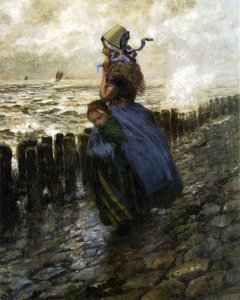
Hitchcock’s stylistic evolution is a fascinating study in changing perspectives. In the early stages of his career, he established a reputation through large-scale religious paintings. These works were characterized by their profound gravity, often depicting biblical subjects dressed in contemporary peasant attire, rendered in a silvery, muted light. However, as his time in Europe progressed, particularly during his long residency in the Netherlands, his palette underwent a dramatic transformation.
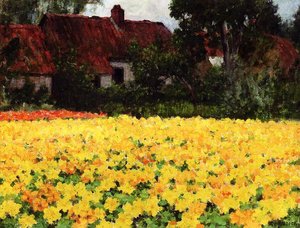
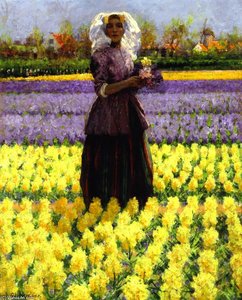
Settling near Egmond aan Zee, Hitchcock moved away from the somber tones of his earlier works toward a more vibrant, sunlit approach. He became captivated by the Dutch landscape, specifically the brilliant colors of tulip fields and the charm of local village life. His later paintings are celebrated for their:
- Vibrant Color Palettes: Capturing the intense hues of blooming flowers and sun-drenched meadows.
- Impressionistic Brushwork: Utilizing loose, expressive strokes to convey movement and atmosphere.
- Luminous Light: Mastering the interplay of sunlight on the Dutch countryside.
Legacy and Artistic Influence
Though he lived much of his life abroad, Hitchcock’s influence resonated deeply within both European and American art circles. He was not merely a solitary painter but a catalyst for community, establishing an "Art Summer School" near Egmond aan Zee. This initiative fostered a group of artists known informally as the Egmondse School, which included notable figures such as Gari Melchers. His ability to attract students and fellow artists to his estate, Huis Schuylenburgh, speaks to his role as a central figure in the regional art scene.
His accolades were numerous and reflected his high standing in the international community. He was honored as a chevalier of the French Legion of Honour and held memberships in prestigious bodies such as the Vienna Academy of Arts and the Munich Secession Society. Today, his legacy is preserved in some of the world's most esteemed institutions, including the Chicago Art Institute, the Detroit Institute of Arts, and the Smithsonian American Art Museum. His life remains a testament to the power of reinvention and the enduring beauty of the natural world.
Questions & Answers
How many artworks by George Hitchcock are available to browse?
You can browse 40 artworks by George Hitchcock on the All Artworks page.
Can I study George Hitchcock's use of color across all works?
The Palette Genome of George Hitchcock is a page that presents the color profile of the artist's body of work.
Where can I see all artworks by George Hitchcock?
Every work by George Hitchcock on this website can be browsed from the artist's All Artworks page.