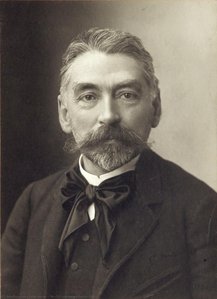
Félix Nadar: A Pioneer of Photography
Early Life and Beginnings
- Born: Gaspard-Félix Tournachon on April 5, 1820, in Paris (though some sources suggest Lyon).
- His father, Victor Tournachon, was a printer and bookseller.
- Initially studied medicine but abandoned it due to financial constraints after his father’s death.
- Nadar, as he became known, began his career as a caricaturist and novelist, contributing to various newspapers.
From Caricature to Photography
- Began experimenting with photography around 1853.
- Opened his first photographic studio in 1854 at 113 rue St. Lazare, later moving to 35 Boulevard des Capucines in 1860.
- Quickly gained recognition for his striking and psychologically insightful portraits.
- Rejection of Convention: Nadar eschewed the opulent backdrops common in portraiture, preferring natural light and a focus on the sitter’s personality.
Pioneering Aerial Photography
- In 1858, Nadar became the first person to take aerial photographs using balloons.
- Overcame technical challenges related to developing photographic plates at altitude by inventing a gas-proof cotton cover for his balloon baskets.
- Also pioneered artificial lighting in photography, notably within the Paris Catacombs.
- Le Géant: Commissioned the construction of a massive balloon named “Le Géant” (The Giant) in 1863, inspiring Jules Verne’s *Five Weeks in a Balloon*.
Major Achievements and Influences
- Portraiture: Photographed numerous prominent figures including Victor Hugo, Charles Baudelaire, Sarah Bernhardt, and Gustave Courbet.
- Established the world’s first airmail service during the Siege of Paris (1870-71) using balloon flights.
- Hosted the first Impressionist exhibition in his studio in 1874, providing a crucial platform for emerging artists.
- Published what is considered the first photo-interview in 1886, featuring chemist Michel Eugène Chevreul.
Later Life and Legacy
- Moved his studio to Marseille from 1895 to 1909.
- Died on March 20, 1910, in Paris and is buried in Père Lachaise Cemetery.
- His son, Paul Nadar, continued the studio’s operations after his death.
- Quand j’étais photographe: Published a memoir reflecting on his life and work, offering valuable insights into 19th-century photography.
- Historical Significance: Nadar's innovative techniques and artistic vision profoundly impacted the development of photography as an art form. His portraits remain iconic representations of Parisian intellectual and artistic circles.