Money-Back Guarantee · 30 days Free Worldwide Delivery
446,261artworks 30,640artists 4,753museums 32languages
Country
Currency
Language
Atelier · Est. 2015 · Paris, France
AllPaintingsStore
allpaintingsstore.com
Account Wishlist Cart

robert campin (master of flemalle)

1375 - 1444

Quick Facts

  • Born: 1375, Valenciennes, France
  • Movements:
    • early netherlandish
    • early netherlandish painting
  • Copyright status: Public domain
  • Art period: Renaissance
  • Died: 1444
  • Vibe:
    • serene
    • calm
  • Lifespan: 69 years
  • Works on APS: 95
  • Room fit: living room
  • Gift suitability: other-none
  • Top-ranked work: Mérode Altarpiece
  • More…
  • Museums on APS:
    • Hermitage Museum
    • Hermitage Museum
    • Hermitage Museum
    • Hermitage Museum
    • Hermitage Museum
  • Also known as: Master Of Flémalle
  • Nationality: France
  • Typical colors: espresso
  • Emotional tone: reflective
  • Mediums:
    • oil on canvas
    • oil on panel
  • Top 3 works:
    • Mérode Altarpiece
    • Mérode Altarpiece (Nativity)
    • Mérode Altarpiece (detail)
  • Creative periods: early netherlandish
  • Best occasions:
    • accent
    • statement
    • reflective
  • Color intensity:
    • balanced
    • vivid

Art Quiz

There is only one correct answer for each question.

Question 1:
What artistic technique is Robert Campin known for pioneering?
Question 2:
Which masterpiece showcases Campin's masterful depiction of everyday life and profound symbolism?
Question 3:
Campin collaborated closely with Jan van Eyck in establishing what artistic movement?
Question 4:
Robert Campin’s paintings often featured serene scenes and conveyed complex emotions. Where is the Mérode Altarpiece currently housed?
Question 5:
Campin’s portrait of a man exemplifies the characteristics of what artistic style?

Robert Campin (Master of Flémalle): A Pioneer of Netherlandish Realism

Robert Campin, also known as the Master of Flémalle, stands as a pivotal figure in the burgeoning artistic landscape of 15th-century Belgium – specifically Tournai. Born around 1375 in Valenciennes, his life remains shrouded in relative obscurity compared to contemporaries like Jan van Eyck, yet his contribution to the stylistic evolution of Early Netherlandish painting is undeniable and profoundly influential. He achieved renown as a master painter within Tournai for over three decades, establishing himself as the foremost artistic talent of his time and shaping the visual culture of the region.

Early Life and Artistic Training

Details concerning Campin’s formative years are scarce, reflecting the limitations of archival records during the period. However, it is believed he received his initial training in Valenciennes, where he honed his skills under the tutelage of Jean Fouquet, a fellow artist known for his expressive portraits and meticulous detail. This exposure to Fouquet's artistic sensibilities undoubtedly instilled in Campin a dedication to realism and psychological depth – qualities that would become hallmarks of his oeuvre.

The Style of Flémalle: Innovation and Symbolism

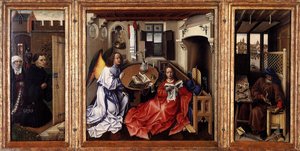
Campin’s distinctive style, dubbed “the style of Flémalle,” represents a crucial step away from the Gothic traditions prevalent earlier in the century. Unlike many artists of his era who adhered to stylized representations, Campin embraced oil painting techniques with remarkable boldness, marking him as one of the earliest adopters of this transformative medium. This innovation allowed for unprecedented luminosity and textural richness, capturing nuances of light and shadow that would have been impossible with tempera paint. Furthermore, Campin’s paintings are characterized by a profound engagement with symbolism – a hallmark of Netherlandish art during this period. Scenes depicting domestic life were imbued with hidden meanings relating to faith, morality, and the complexities of human emotion. Consider his celebrated “Mérode Altarpiece,” where every element—from the drapery folds to the floral motifs—serves as a conduit for theological contemplation. The meticulous observation of natural detail combined with symbolic resonance distinguishes Campin’s work from its predecessors and establishes him as a visionary artist ahead of his time.

Notable Works: Reflections of Renaissance Ideals

Campin's artistic legacy rests upon several masterpieces that exemplify the burgeoning humanist spirit of the Early Renaissance. Among these stand out: * **The Mérode Altarpiece:** Completed in 1427, this monumental triptych housed at the Metropolitan Museum of Art remains a cornerstone of Netherlandish art history. Its depiction of the Nativity scene is rendered with breathtaking realism and imbued with symbolic references to Mary’s humility and Christ’s divine incarnation. * **The Blessing Christ and Praying Virgin:** Painted in 1424, currently residing at the Philadelphia Museum of Art, this devotional panel showcases Campin's mastery of portraiture and his ability to convey palpable emotion. The figures are rendered with remarkable anatomical accuracy, capturing subtle expressions of piety and tenderness. * **Portrait of a Man:** This enigmatic portrait, considered one of the earliest examples of Renaissance portraiture, exemplifies Campin’s commitment to psychological realism. The sitter's gaze is direct and contemplative, inviting viewers to engage in an intimate dialogue with the subject.

Influence and Legacy

Robert Campin’s pioneering use of oil painting techniques and his profound engagement with symbolism profoundly impacted subsequent generations of artists. Alongside Jan van Eyck, he initiated a stylistic revolution that would reshape the visual culture of Europe. His meticulous observation of nature combined with expressive psychological portrayal established him as a precursor to Renaissance ideals – realism, humanism, and intellectual inquiry—solidifying his place among the most influential painters of the 15th century. AllPaintingsStore.com offers exceptional reproductions of Campin’s masterpieces, allowing enthusiasts worldwide to appreciate the enduring beauty and significance of this artistic innovator.