George Graham: A Yorkshire Landscape Soul
George Graham (1881-1949) wasn’t a name that immediately resonates within the grand halls of art history, yet his canvases hold a quiet beauty—a deeply felt connection to the rolling hills and evocative skies of West Yorkshire and Sussex. Born in Leeds, he began his artistic journey not with formal training, but with an innate observation of the world around him, a sensitivity honed by the industrial landscape of his youth. This early exposure would profoundly shape his later work, imbuing it with a unique blend of realism and a subtle, almost melancholic, romanticism.
Graham’s artistic path wasn't one of dramatic shifts or revolutionary movements. He was a member of the Yorkshire Artists’ Society and the Sussex Painters, groups that valued traditional landscape painting techniques and a commitment to depicting the beauty of their respective regions. This affiliation provided him with a supportive community and access to shared artistic principles. However, Graham possessed an individual style—a careful rendering of light and shadow, a masterful use of color to capture atmospheric effects, and a remarkable ability to convey the sense of place within his scenes.
Early Influences and Artistic Development
While he lacked extensive formal training, Graham’s artistic development was undoubtedly influenced by several key figures. His early years in Leeds exposed him to the works of local artists who focused on depicting industrial life alongside natural beauty. This juxtaposition—the grit of industry against the serenity of the countryside—became a recurring theme in his paintings. Furthermore, he spent considerable time in Sussex, particularly around the coast and the South Downs, absorbing the light and color of that region. The dramatic skies and undulating landscapes of Sussex became a significant source of inspiration.
A pivotal connection in Graham’s artistic journey was his friendship with Fred Lawson, a fellow Yorkshire artist known for his vibrant depictions of rural life. Lawson encouraged Graham to develop his own unique style, emphasizing observation and capturing the essence of the landscape rather than simply replicating it. This mentorship proved invaluable, helping Graham refine his technique and find his own voice as an artist.
A Palette of Light and Shadow
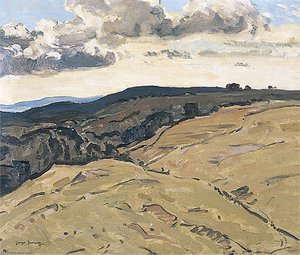
Graham’s paintings are characterized by a remarkable sensitivity to light and atmosphere. He wasn't interested in creating photographic representations of the landscape; instead, he sought to capture the *feeling* of being there—the warmth of the sun on the hillsides, the coolness of a misty morning, the drama of an approaching storm. His use of color was particularly noteworthy – muted greens, browns, and blues dominated his palette, creating a sense of depth and realism. He skillfully employed atmospheric perspective, using lighter tones to represent distant objects and darker tones for those closer to the viewer.
His technique involved layering thin washes of paint to build up texture and create subtle gradations of color. Graham’s brushstrokes were often loose and expressive, conveying a sense of movement and spontaneity. He wasn't afraid to experiment with different techniques, incorporating dry brushing and scumbling to achieve the desired effects.
Notable Works and Legacy
Among Graham’s most celebrated works are his depictions of the Yorkshire Dales, particularly the dramatic landscapes surrounding Haworth Moor. Paintings like “West Burton Moor” and “The Pennines at Sunset” capture the rugged beauty and timelessness of these iconic locations. Similarly, his Sussex paintings—such as “Coastal View near Brighton” and “Downland Landscape”—evoke the sense of vastness and tranquility that defines the region.
While Graham’s work didn't achieve widespread fame during his lifetime, it has since been recognized for its quiet beauty and understated charm. His paintings are held in public collections, including the Yorkshire Sculpture Park, and continue to be appreciated by art lovers who value traditional landscape painting. George Graham’s legacy lies not in grand pronouncements or revolutionary innovations, but in his ability to capture the soul of the English countryside—a testament to the power of observation, sensitivity, and a deep connection to place.
Questions & Answers
How many artworks by George Graham are available to browse?
You can browse 36 artworks by George Graham on the All Artworks page.
Where can I see George Graham's artworks in chronological order?
George Graham's artworks can be seen in chronological order on the artist's Artwork Timeline page.
How do I find works by George Graham on a specific theme?
The By Keywords page of George Graham groups the artist's artworks by their keywords.