Money-Back Guarantee · 100 days Free Worldwide Delivery
449,564artworks 30,613artists 4,660museums 32languages
Catalogue entry

Pieta

1949. , 39.0 x 46.0 cm.

Fig. 1. Abraham Rattner, Pieta, 1949. Shown as the reproduction you are specifying: , .

§ 1Catalogue data

Dimensions
39.0 x 46.0 cm

§ 2Abstract

Collectible Description

Artist Biography

Abraham Rattner (1895-1978): American Expressionist painter known for vibrant canvases exploring religious themes & surrealism. WWI camouflage artist, featured in major museums.

§ 3Commentary

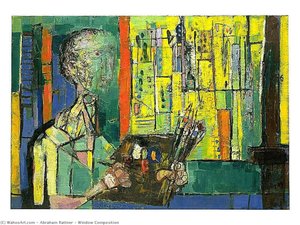
The Pieta by Abraham Rattner is a captivating oil on canvas painting that showcases the artist's unique style and contribution to the world of art. Created in 1949, this masterpiece measures 39 x 46 cm and is a quintessential example of Expressionism, a movement that emphasizes the expression of intense emotions.

Artist Background

Abraham Rattner was an American artist born in 1895 and died in 1978. He is known for his bold and expressive paintings that often depict religious themes. The Pieta is one of his most notable works, showcasing his ability to convey deep emotions through his art.

The Painting

The Pieta is a large oil on canvas depiction of the Pieta scene, with Mary holding Jesus in her arms while he lays dead. The painting is characterized by its vibrant colors and intricate details, with a focus on the emotional expression of the figures. The overall composition of the painting is quite intricate, with a lot of attention given to each individual figure and their interactions within the scene.
For art lovers, AllPaintingsStore.com offers a wide range of handmade oil painting reproductions, including the Pieta by Abraham Rattner. These reproductions are created by skilled artists who use high-quality materials to ensure that the final product is both beautiful and durable.

Importance of the Painting

The Pieta by Abraham Rattner is an important work of art that showcases the artist's unique style and contribution to the world of art. It is a testament to the power of art to evoke emotions and create a sense of connection with the viewer. For more information on Abraham Rattner and his works, visit AllPaintingsStore.com.
  • The Pieta is a masterpiece of emotional depth and expression.
  • The painting is characterized by its vibrant colors and intricate details.
  • Abraham Rattner was an American artist known for his bold and expressive paintings.

In conclusion, the Pieta by Abraham Rattner is a captivating oil on canvas painting that showcases the artist's unique style and contribution to the world of art. Its emotional depth and intricate details make it a must-see for art lovers. Visit AllPaintingsStore.com to learn more about this masterpiece and to explore other works of art by Abraham Rattner.

Questions & Answers

What color intensity does "Pieta" by Abraham Rattner have?

The color intensity of "Pieta" is monochromatic. Intensity describes how strong the colors appear.

How do I download the image of "Pieta" by Abraham Rattner?

The image of "Pieta" by Abraham Rattner can be downloaded from the artwork's Download page: a high-resolution digital image download.

How do contrast and harmony combine in "Pieta"?

The color composition of "Pieta" by Abraham Rattner combines a gentle contrast with a discordant palette harmony.

§ 4The artist

Abraham Rattner

Abraham Rattner

1895 - 1978, United States of America

Quick facts about Abraham Rattner

  • Full Name: Abraham Rattner
  • Nationality: American
  • Date Of Birth: 1895
  • Date Of Death: 1978
  • Place Of Birth: Poughkeepsie, United States of America
  • Artistic Movement Or Style: Expressionism, Surrealism
  • Artists Who Influenced This Artist:
    • Claude Monet
    • Georges Rouault
    • Pablo Picasso
  • Artists Or Movements Influenced By This Artist: ['American Expressionism']

Artist Biography

A Life Painted in Expression: The World of Abraham Rattner

Abraham Rattner, born in Poughkeepsie, New York, in 1895, was an artist whose life and work were deeply interwoven with the tumultuous currents of the 20th century. His journey, spanning from the battlefields of World War I to the vibrant art scenes of Paris and New York, forged a unique artistic voice—one characterized by bold expressionism, spiritual yearning, and a hauntingly beautiful use of color. Rattner’s early ambition leaned toward architecture, initially pursued at George Washington University, but his true calling lay in painting, leading him to further studies at the Corcoran School of Art and the Pennsylvania Academy of the Fine Arts. This foundational training would prove crucial as he navigated the evolving landscape of modern art.

From Camouflage to Canvas: War and Artistic Awakening

The outbreak of World War I dramatically altered Rattner’s path. Recruited by Homer Saint-Gaudens for the U.S. Army's American Camouflage Corps, he served in France, a formative experience that would indelibly mark his artistic vision. Participating in significant battles like the Second Battle of the Marne, Château-Thierry, and Belleau Wood, Rattner wasn’t merely an observer of conflict; he was actively engaged in concealing it—a paradoxical role for an artist whose later work would be defined by its raw emotional honesty. A severe back wound sustained during his service brought lifelong physical discomfort, but also a profound sensitivity to the fragility of life and the enduring power of the human spirit. This experience instilled within him themes of vulnerability and resilience that resonated throughout his oeuvre. Following the war, a Cresson Traveling Fellowship provided Rattner with the opportunity to return to France, this time not as a soldier, but as an artist seeking inspiration and honing his craft.

The Parisian Years: A Crucible of Style

Paris in the 1920s was a magnet for artists from around the globe, and Rattner fully immersed himself in its dynamic art scene. He studied at several prestigious academies—the École des Beaux-Arts, Academies Julian, Ransom, and Grande Chaumière—absorbing influences from masters like Claude Monet, Georges Rouault, and Pablo Picasso. However, he didn’t simply mimic these artists; instead, he synthesized their lessons into a distinctive style that was uniquely his own. His Parisian period saw the development of an expressionist approach characterized by rich, often somber colors, distorted forms, and surreal imagery. Religious themes began to emerge as central motifs in his work, reflecting a deep spiritual questioning and a fascination with the mysteries of faith. These weren’t traditional religious paintings; rather, they were intensely personal explorations of belief, doubt, and the human condition.

Return to America & Lasting Legacy

The looming threat of Nazism forced Rattner's return to New York City in 1940. He didn’t remain static upon his arrival; he embarked on a cross-country journey with writer Henry Miller, documenting their experiences and further enriching his artistic perspective. Rattner also dedicated himself to teaching, sharing his knowledge and passion at institutions like The New School, Yale University, and Columbia University. His artwork gained recognition in prominent museums such as the Art Institute of Chicago, the Whitney Museum of American Art, and the Albright-Knox Art Gallery, solidifying his place within the canon of American art. Beyond painting, Rattner’s artistic talents extended to stained glass; he designed the breathtaking east wall of the Chicago Loop Synagogue in 1960—a masterpiece celebrated for its exceptional beauty and spiritual resonance. Today, The Leepa-Rattner Museum of Art in Tarpon Springs, Florida, stands as a testament to his enduring legacy, housing a significant collection of his works alongside those of his contemporaries. Abraham Rattner’s art bridges the gap between European modernism and American expressionism, offering viewers a powerful glimpse into the soul of an artist who lived through—and reflected upon—a century of profound change. His unique blend of religious symbolism, surreal imagery, and vibrant colors continues to captivate and inspire, ensuring his place as a significant figure in 20th-century art history.

§ 5Comparanda

§ 6Questions

§ 7Cite this entry

AllPaintingsStore.com, “Abraham Rattner, Pieta (1949)”, https://allpaintingsstore.com/en/art/abraham-rattner-pieta-AR2J3L-en/ArtistReproduction/ (accessed 7 October 2026).

§ 8The reproduction

Hand Made Oil Reproduction

Hand-painted oil on canvas in your size and frame, made to order by our artists. ( Switch to Print Switch to Digital Image)

It is specified on the order sheet in the margin; the present state of that sheet reads as follows.

Pieta

Reproduction Medium

Reproduction Size

-

Elite Senior Artist

More detail, finesse, and extra production time

-

Reproduction Frame

-

-

For artworks or reproductions larger than 105 cm (approximately 41 inches) on any side, the frame will be shipped as a kit, disassembled. This method ensures safe delivery and prevents damage during transport.

Professional assembly required - this is not a DIY product.
The kit must be assembled and the canvas stretched by an experienced professional framer, using wood glue (not supplied), a canvas stretching plier and clamps to hold the bars square while the glue dries. Incorrect assembly or uneven canvas tension can permanently damage the artwork and is not covered by our warranty.

  • All solid wood bars are included, precisely cut to size.

  • Assembled with the screws provided, plus wood glue for the corner joints, which is not supplied and must be sourced by your framer.

  • Professional tools are required and not included: a canvas stretching plier (tensioner) and clamps to hold the bars square while the glue dries.

Important:
The corner joints require wood glue, the bars must be held with clamps until the glue is fully dry, and tightening the canvas on the assembled frame requires a canvas stretching plier. None of these are included in the kit. Please arrange an experienced professional framer before ordering this size.

Nameplate

-

-

Protective Varnish

Glossy Varnish (enhances colors, protects against light/moisture)

-

Customize My Artwork

Examples of what can be changed: Replace face with customer photo; Add pet (e.g., replace cat with dog); Include hidden message in background; Change background landscape or elements.

-

Urgent

Worldwide Delivery () in 3/4 weeks instead of standard 5 weeks. (4 November). No compromise on quality.

-

Express Shipping

Worldwide Delivery () in 5 weeks. (11 November).

Included

Total Price

$ 258

Included with every order

  • Free Worldwide Express Shipping
  • High-Quality Linen Canvas
  • Full Shipping Insurance
  • Customs Tax Refund Guarantee
  • True Color Matching Guarantee
  • 100-Day Return Policy (Defects Only)
  • 100% Money-Back Guarantee
  • Bulk Discount Offer
Order sheet