Money-Back Guarantee · 100 days Free Worldwide Delivery
449,564artworks 30,613artists 4,660museums 32languages
Catalogue entry

Nativity

1504. Woodcut, 183.0 x 120.0 cm. Staatliche Museen zu Berlin.

Fig. 1. Albrecht Dürer, Nativity, 1504. Shown as the reproduction you are specifying: , .

§ 1Catalogue data

Dimensions
183.0 x 120.0 cm

§ 2Abstract

Collectible Description

Albrecht Dürer’s "Nativity" (1504) – a stunning black & white engraving of a bustling medieval market scene. Explore Northern Renaissance realism, intricate detail & symbolic depth.

Artist Biography

Explore the art of Albrecht Dürer, a German Renaissance master! Discover iconic engravings like Melencolia I and detailed self-portraits – a pivotal figure in art history.

§ 3Commentary

A Window into Medieval Life: The Soul of Nuremberg

In the quiet precision of Albrecht Dürer’s 1504 engraving, The Nativity, we find much more than a mere retelling of a biblical event; we are granted an intimate passage into the beating heart of the Northern Renaissance. This masterpiece serves as a meticulously crafted snapshot of fifteenth-century Nuremberg—a city then brimming with unprecedented ambition and artistic fervor. Dürer does not simply depict a holy scene; he embeds the divine within the palpable, bustling reality of his own urban world. As one gazes upon the intricate lines, the viewer is transported to a crowded marketplace where the sacred meets the secular, and where the monumental architecture of a fortified town wall stands as a silent witness to the unfolding miracle.

The composition is a triumph of spatial storytelling. Dürer employs a sophisticated, somewhat flattened perspective that nonetheless breathes life into the scene through the clever overlapping of forms and subtle tonal shifts. The square is alive with movement: merchants hawking their wares, shoppers navigating the throng, and the gentle presence of animals like donkeys and oxen that ground the spiritual narrative in the earthy textures of everyday existence. This sense of urban reality is what makes the piece so captivating for the modern eye; it captures a moment of profound stillness amidst a whirlwind of human activity, creating a tension between the eternal and the ephemeral.

Mastery of Line and the Illusion of Texture

To behold this work is to witness the pinnacle of printmaking technique. Dürer’s genius lies in his ability to communicate immense complexity using nothing but the stark, decisive language of black ink on paper. Through the masterful application of hatching, cross-hatching, and stippling—techniques he refined during his formative years under Michael Wolgemut—he achieves a breathtaking illusion of texture and volume. One can almost feel the rough, weathered surface of the stone walls, the heavy weight of woven fabrics, and the organic roughness of wooden planks.

Every line serves a dual purpose: to define shape and to manipulate light. There is no explicit use of color to guide the eye; instead, Dürer relies on varying line densities to create shadows that suggest depth and form. This monochromatic precision lends the artwork a timeless, sculptural quality. For the collector or interior designer, this technical brilliance offers a sophisticated aesthetic that transcends trends. The interplay of light and shadow provides a rhythmic visual interest that can anchor a room, offering a sense of historical weight and intellectual depth to any curated space.

Symbolism and Emotional Resonance

Beyond its technical prowess, The Nativity is rich with the humanist ideals that defined Dürer’s era. The presence of architectural grandeur—the arches, windows, and imposing walls—speaks to the power and authority of the civic structures of Nuremberg, yet these are juxtaposed with the humble elements of the Nativity itself. Even a simple well within the composition serves as a potent symbol of life and essential sustenance, reflecting the vital resources of medieval urban existence. The artwork invites a contemplative emotional response, balancing the grandeur of the setting with the intimacy of the subject matter.

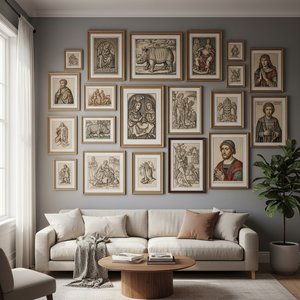
For those seeking to bring a piece of art history into their homes, a high-quality reproduction of this engraving offers more than just decoration; it offers a conversation. It is an invitation to pause and reflect on the intersection of faith, commerce, and human industry. Whether placed in a quiet study or as a focal point in a contemporary gallery-style living room, Dürer’s work radiates a sense of enduring stability and profound beauty, making it an incomparable choice for those who value art that speaks to both the eye and the soul.

Questions & Answers

How is "Nativity" situated historically?

The art-historical classification of "Nativity" by Albrecht Dürer is Northern Renaissance, in the Renaissance period.

How was "Nativity" made, and how big is it?

The medium of "Nativity" by Albrecht Dürer is woodcut, and its recorded dimensions are 183 x 120 cm.

Is "Nativity" by Albrecht Dürer a well-known artwork?

"Nativity" by Albrecht Dürer has an iconic popularity level. This classification reflects how widely the work is recognized.

§ 4The artist

Albrecht Dürer

Albrecht Dürer

1471 - 1528, Italy

Quick facts about Albrecht Dürer

  • Full Name: Albrecht Dürer
  • Nationality: German
  • Date Of Birth: 1471
  • Date Of Death: 1528
  • Place Of Birth: Nuremberg, Italy
  • Notable Artworks:
    • Apocalypse Series
    • Melencolia I
    • Saint Jerome in his Study
  • Artistic Movement Or Style: German Renaissance
  • Artists Who Influenced This Artist:
    • Leonardo da Vinci
    • Raphael
    • Giovanni Bellini
  • Artists Or Movements Influenced By This Artist: Northern Renaissance

Artist Biography

A Life Forged in Nuremberg: The Early Years and Apprenticeship

Albrecht Dürer, a name synonymous with the German Renaissance, emerged from the bustling artisan city of Nuremberg in 1471. His father, Albrecht Dürer the Elder, was a successful goldsmith who had immigrated from Hungary, bringing with him a lineage steeped in craftsmanship. It was within this environment—the scent of metal and the meticulous precision of handiwork—that young Albrecht’s artistic inclinations first took root. Though his father envisioned a similar path for him, apprenticing him initially in the family trade, it soon became undeniable that Albrecht possessed an exceptional gift for drawing. At thirteen, he transitioned to the workshop of Michael Wolgemut, Nuremberg's leading artist at the time. This was no mere technical training; it was immersion into a world of illuminated manuscripts, painted panels, and—crucially—the burgeoning art of woodcut illustration. The sheer volume of work produced by Wolgemut’s workshop, including the extensive illustrations for the *Nuremberg Chronicle*, provided Dürer with an unparalleled foundation in design, composition, and the mechanics of image-making. A remarkable silverpoint self-portrait from 1484, created when he was barely a teenager, stands as astonishing evidence of his precocious talent—a testament to a burgeoning artistic identity already taking shape.

The Italian Influence and Artistic Maturation

Dürer’s ambition extended far beyond the confines of Nuremberg. Driven by an insatiable curiosity and a desire to master the art of painting, he embarked on his first journey to Italy in 1494. This was not simply a sightseeing trip; it was a pilgrimage to the heart of the Renaissance. He encountered the works of masters like Raphael, Giovanni Bellini, and Leonardo da Vinci—artists who were redefining the possibilities of form, perspective, and human expression. The impact of this exposure was profound. Dürer absorbed the classical motifs, harmonious compositions, and subtle sfumato techniques that characterized Italian art, yet he never abandoned his Northern European sensibility for meticulous detail and symbolic depth. A second sojourn to Italy between 1505 and 1507 further solidified these influences, allowing him to study ancient Roman ruins and refine his understanding of anatomy and proportion. This synthesis of Northern precision and Italian grace became the hallmark of Dürer’s unique artistic style.

Mastering the Mediums: Painting, Engraving, and Woodcut

Dürer was a master of multiple mediums, each offering him distinct avenues for creative expression. His paintings, though fewer in number than his prints, demonstrate a remarkable command of oil paint and an ability to capture both physical likeness and psychological depth. Works like the *Feast of the Rose Garlands* reveal a vibrant palette influenced by Venetian colorism. However, it was in the realm of printmaking—particularly engraving and woodcut—that Dürer truly revolutionized artistic practice. He elevated these techniques from mere reproductive methods to independent art forms, capable of conveying complex narratives and profound emotions. The *Apocalypse* series (1498), a collection of fourteen woodcuts illustrating the Book of Revelation, showcased his mastery of this medium despite its inherent limitations. Later engravings like *Melencolia I* (1514) and *Saint Jerome in His Study* (1514) are testaments to his unparalleled skill—intricate compositions filled with symbolic meaning and executed with breathtaking precision. He didn’t just depict reality; he imbued it with layers of intellectual and spiritual significance.

A Theorist and Innovator: The Legacy of Albrecht Dürer

Dürer was not merely an artist; he was a scholar, a theorist, and an innovator who sought to understand the underlying principles governing artistic creation. He believed in the mathematical foundations of art and dedicated himself to establishing a scientific approach to representation. His treatises on geometry, proportion, and human anatomy—most notably *Four Books of Human Proportion* (1528)—were groundbreaking for their time, demonstrating his commitment to rigorous observation and rational analysis. These writings were not simply academic exercises; they were intended to elevate the status of artists from mere craftsmen to intellectual practitioners. Dürer’s legacy extends far beyond his individual artworks. He bridged the gap between Northern European traditions and Italian Renaissance ideals, introducing classical motifs into Northern art while maintaining its distinctive character. His theoretical contributions helped establish a new framework for artistic practice, inspiring generations of artists with his technical skill, innovative spirit, and profound vision. He remains, to this day, one of the most important figures in the history of Western art.

Influences and Enduring Impact

  • Michael Wolgemut: Dürer’s initial mentor, providing foundational skills in drawing, painting, and woodcut techniques.
  • Leonardo da Vinci: Inspired Dürer's exploration of anatomy, perspective, and sfumato—the subtle blending of tones.
  • Raphael: Influenced Dürer’s compositional harmony and idealized forms.
  • Giovanni Bellini: Contributed to Dürer's understanding of color and Venetian painting traditions.

Dürer’s influence reverberates through centuries of art history. His meticulous realism, his innovative use of printmaking, and his theoretical writings continue to inspire artists and scholars alike. He demonstrated that art could be both technically masterful and intellectually rigorous—a legacy that continues to shape the artistic landscape today. His work stands as a testament to the power of observation, the pursuit of knowledge, and the enduring human desire to create beauty and meaning.

§ 5Comparanda

§ 6Questions

Quick Facts

  • Artist: Albrecht Dürer
  • Year: 1504
  • Title: Nativity
  • Artistic style: Realistic engraving
  • Location: Private Collection
  • Medium: Engraving

§ 7Cite this entry

AllPaintingsStore.com, “Albrecht Dürer, Nativity (1504)”, https://allpaintingsstore.com/en/art/albrecht-durer-nativity-8EWBYZ-en/ArtistReproduction/ (accessed 8 October 2026).

§ 8The reproduction

Hand Made Oil Reproduction

Hand-painted oil on canvas in your size and frame, made to order by our artists. ( Switch to Print Switch to Digital Image)

It is specified on the order sheet in the margin; the present state of that sheet reads as follows.

Nativity

Reproduction Medium

Reproduction Size

-

Elite Senior Artist

More detail, finesse, and extra production time

-

Reproduction Frame

-

-

For artworks or reproductions larger than 105 cm (approximately 41 inches) on any side, the frame will be shipped as a kit, disassembled. This method ensures safe delivery and prevents damage during transport.

Professional assembly required - this is not a DIY product.
The kit must be assembled and the canvas stretched by an experienced professional framer, using wood glue (not supplied), a canvas stretching plier and clamps to hold the bars square while the glue dries. Incorrect assembly or uneven canvas tension can permanently damage the artwork and is not covered by our warranty.

  • All solid wood bars are included, precisely cut to size.

  • Assembled with the screws provided, plus wood glue for the corner joints, which is not supplied and must be sourced by your framer.

  • Professional tools are required and not included: a canvas stretching plier (tensioner) and clamps to hold the bars square while the glue dries.

Important:
The corner joints require wood glue, the bars must be held with clamps until the glue is fully dry, and tightening the canvas on the assembled frame requires a canvas stretching plier. None of these are included in the kit. Please arrange an experienced professional framer before ordering this size.

Nameplate

-

-

Protective Varnish

Glossy Varnish (enhances colors, protects against light/moisture)

-

Customize My Artwork

Examples of what can be changed: Replace face with customer photo; Add pet (e.g., replace cat with dog); Include hidden message in background; Change background landscape or elements.

-

Urgent

Worldwide Delivery () in 3/4 weeks instead of standard 5 weeks. (5 November). No compromise on quality.

-

Express Shipping

Worldwide Delivery () in 5 weeks. (12 November).

Included

Total Price

$ 308

Included with every order

  • Free Worldwide Express Shipping
  • High-Quality Linen Canvas
  • Full Shipping Insurance
  • Customs Tax Refund Guarantee
  • True Color Matching Guarantee
  • 100-Day Return Policy (Defects Only)
  • 100% Money-Back Guarantee
  • Bulk Discount Offer
Order sheet