


 Preview
 Send
Send Share
Share
 Details
 Guide
Guide

 Download
 Similars
 X-Ray
X-Ray Diaporama
 Q&A
Q&A Stats
Statsbathers

- 132.0 x 195.0 cm


 Read More
Giclée / Art Print
Museum-quality giclée or canvas print with fast production and flexible finish options. ( Buy Hand Made Painting Switch to Digital Image)




P118B $10

P118H $10

P118W $10

P438Z $10

P508JH $12

P508YH $12

P805H $10

P805Z $10

P919BZ $10

P919G $10

P919XJ $10

P959ZH $10

P968JZ $12

W106C $8

W218G $10

W218JH $8

W218Y $10

W307PJ $10

W316G $10

W316PJ $8

W316Y $10

W398PJ $8

W4111J $10

W500HY $15

W500JH $15

W692G $12

W849H $8

W940BG $15

W953PJ $8




Pick from our preset sizes that match the artwork's original proportions.

Type the width and the height you need, to fit your frame or your wall. A print can only be cut, never made bigger than the picture, so a size with a different shape loses a part of the image. We send you a digital mockup to approve before we print anything. The picture shown on this page does not show the real cut — only the mockup does.
Worldwide Delivery () in 2 weeks instead of standard 4/5 weeks. (13 November)

Free Worldwide Express Shipping

High-Quality Linen Canvas

Full Shipping Insurance

Customs Tax Refund Guarantee

True Color Matching Guarantee

100-Day Return Policy (Defects Only)

100% Money-Back Guarantee

Bulk Discount Offer
 Glass option is only available in size under 110 CM

bathers
Giclée / Art Print
Reproduction Size
-


Total Price
$ 65
The Vibrant Spirit of Fauvism
To stand before André Derain's Bathers is to step directly into the exhilarating heart of the early twentieth century art revolution. This painting, executed in 1907, is not merely a depiction of figures by water; it is a pure explosion of color and emotion rendered through the lens of Fauvism. The very air around the canvas seems charged with the energy of bold pigment. Derain, a key figure alongside Henri Matisse, harnessed this nascent movement to break violently with academic tradition. Instead of meticulously rendering reality, he prioritized feeling, allowing color itself to become the primary subject matter. Observe how the blues and greens of the background foliage do not simply represent trees; they vibrate with an internal life, supporting the drama unfolding among the three figures.
Composition and Captivating Form
The composition draws the eye through a naturalistic yet highly stylized tableau. Three nude women are positioned within what appears to be a lush, sun-dappled grove. The arrangement is dynamic; there is a sense of narrative unfolding between them—a moment caught in time. On the left, one figure seems poised in motion, bathed in warm oranges and yellows that sing against the cooler backdrop. In the center, another stands with a quiet dignity, while the third completes an intimate grouping on the right. The brushwork itself is a masterclass in spontaneity. It is loose, visible, and utterly expressive, giving the entire scene an immediacy that modern viewers crave. This technique ensures that every viewing reveals new textures and rhythms.
A Palette of Pure Emotion
What elevates Bathers beyond mere decoration is its audacious use of color. The palette is anything but subtle; it is a joyous confrontation of bright reds, vivid blues, and saturated yellows. These are not colors chosen for their natural accuracy, but for their emotional resonance. Fauvism taught artists that color could be structural, psychological, and purely decorative. When considering this piece for your space, understand that the vibrancy inherent in Derain's choices will act as a powerful focal point, injecting an undeniable zest into any room, whether it is a grand salon or a sunlit drawing-room.
Historical Echoes and Enduring Appeal
This work sits at a pivotal crossroads in art history. It was a radical declaration against the staid conventions that preceded it, paving the way for much of modern art to follow. For the collector or designer, owning a reproduction of Bathers is acquiring more than just an image; it is embracing a moment of artistic rebellion. The painting speaks to the avant-garde spirit—a desire to feel deeply and express boldly. It suggests that beauty can be found not in perfect imitation, but in passionate interpretation.
Questions & Answers
Where does "bathers" fall in André Derain's career?
"bathers" belongs to the Early Modern of André Derain's career. This classification relates the work to the artist's development.
Can I watch "bathers" as a full-screen slideshow?
"bathers" by André Derain can be viewed as a slideshow on the artwork's Diaporama page.
Can I use augmented reality to see "bathers" by André Derain in my room?
"bathers" by André Derain can be previewed on your own wall with the artwork's AR Preview page, using augmented reality on a compatible device.
Related Artworks




Artist Biography
Early Life, Family and Training
In the year 1880, André Derain entered the world in Chatou, a village nestled within the Yvelines region of France. His early years were shaped by the quiet landscapes of the Île-de-France, where a natural curiosity for the surroundings began to take root. By 1895, he had already commenced studying on his own, seeking to understand the visual world through his own eyes rather than through formal instruction. This period of self-directed exploration allowed him to develop a personal way of seeing before the rigors of an academy could impose their will upon him.
The path of a painter was not his only consideration. In 1898, he sought a more structured education, briefly studying to become an engineer at the Académie Camillo. It was within these academic halls that his life took a decisive turn; he attended painting classes under Eugène Carrière and there encountered Henri Matisse. This meeting would change the course of his life, pulling him away from the precision of engineering and toward the expressive possibilities of the canvas. His ambitions were strong, yet his progress was interrupted by the duties of citizenship. From September 1901 until 1904, he fulfilled his military service in Commercy, a period of separation that paused his burgeoning artistic development.
The Fauvist Revolution and Collioure
The summer of 1905 brought a sudden, bright change to the lives of André Derain and Henri Matisse. They traveled together to the fishing town of Collioure, a place where the light seemed to demand a new way of seeing. In this coastal setting, the artist began to move away from the traditional rules of representation. His work from 1905 to 1906 was defined by a riotous colourism that shocked those accustomed to more subtle tones. He used simplified drawings and an exaggerated use of color to capture the essence of the landscape, favoring intense, unmixed hues over the naturalistic shades of the world.
This radical approach to painting sparked a fierce reaction from the public and the press. The artists were met with such astonishment that they were dubbed Les Fauves, or the wild beasts. This name, though intended to mock their perceived lack of discipline, was embraced by the group. Derain’s canvases during these years did not seek to replicate the scenery as a photograph might, but instead used color as a direct expression of feeling. The brushwork was bold and the palettes were startling, marking a departure from everything that had come before.
- Landscape at Collioure (1905)
- Fishing Boats, Collioure (1905)
- The Lighthouse at Collioure (1905)
The London Paintings and Commissions
In March 1906, the art dealer Ambroise Vollard saw a new direction for the artist and sent him to London. This was no mere excursion, but a deliberate commission to capture the essence of a city that had long been the subject of many painters. Derain arrived in the English capital and began to see the urban landscape through a lens of intense color, moving away from the quietude of the French countryside. He sought to translate the energy of the metropolis into something felt rather than merely seen.
The artist produced a series of thirty paintings during this period, turning his attention to the Thames and the heavy architecture of the city. He did not seek to replicate the gray mists often associated with the river; instead, he used bold hues to depict the movement of the water and the silhouettes of the bridges. His vision of the city was a radical departure from the atmospheric studies of those who had come before him. He focused on the structural weight of the landmarks and the shifting light of the urban environment.
- Charing Cross Bridge, London
- London Bridge
- Houses of Parliament at Night, London
- Charing Cross Bridge
These works remained among his most popular creations, as they offered a fresh perspective on an established setting. By focusing on the Thames and the Tower Bridge, he captured a sense of modernity and restless movement. The thick application of paint and the unconventional palette allowed him to portray the city as a living, breathing entity of light and shadow.
Evolution Towards Classicism and Gothic Style
As the years passed, the wilder impulses of his youth began to settle. Around 1907, a change took hold of his hand and eye, and his work grew more austere. The unrestrained colors that once defined his canvases gave way to a more disciplined approach. This shift was not a sudden break but a gradual movement toward structure and form. He sought a different kind of truth, one found in the quiet strength of composition rather than the shock of color.
By the years 1911 to 1914, he entered a phase that many have called his gothic period. During this time, his interest in the Old Masters and classical forms became more pronounced. He moved away from the loud, unmixed pigments of his earlier years, seeking instead a more controlled and intellectually rigorous way of seeing. This was a time of searching, where he looked back to the foundations of art to find a new way forward.
The Great War changed the landscape of his life and his art once more. Following the conflict, he emerged as a leader of a movement known as the Return to order. This new classicism sought stability and clarity in an era of profound change. He became a central figure in this revival, helping to guide the direction of art toward a more structured and traditional aesthetic. His work reflected this desire for order, embracing a sense of permanence that had been absent during his more experimental years.
- Harlequin and Pierrot, 1924
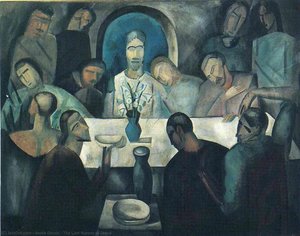
- The Last Supper of Jesus, 1911
Later Years and Death
As the years passed, the artist’s interests expanded beyond the canvas and into the theatrical realm. In 1919, he turned his creative gaze toward the stage, designing the ballet La Boutique Fantasque for the Ballets Russes. This foray into set and costume design revealed a sense of rhythm and spectacle that complemented his evolving aesthetic. His ability to command attention through form and color continued to be recognized by his peers, leading to him being named a recipient of the Carnegie Prize in 1928.
The later decades of his life were marked by a continued pursuit of a new classicism, a departure from the wilder impulses of his youth. He remained active in the art world, even as the political landscape of Europe shifted around him. He eventually passed away on 8 September 1954, leaving behind a body of work that had traversed many different modes of expression.
Legacy and Influence
The ripples of the Fauvist movement, which André Derain helped establish alongside Henri Matisse, reached far beyond the initial shock of their color choices. By breaking the traditional bonds of how color relates to the physical world, he helped clear a path for the structural innovations of Cubism and the emotional intensity found in modern expressionism. His restless search for a new visual language meant that the lessons learned in the sun-drenched landscapes of Collioure eventually traveled north, influencing the development of German Expressionism. He did not merely paint; he helped redefine the very purpose of the brushstroke.
His influence remained a constant presence for subsequent generations of artists who sought to balance the raw energy of his early years with the structured discipline of his later work. Even as his own style shifted toward a more austere and classical approach, the radical spirit of his youth continued to resonate. He proved that an artist could move between the wild, unmixed hues of his youth and a more controlled, intellectual rigor without losing their creative truth. This adaptability ensured that his presence in the history of modern art remained undeniable, even as the movements he helped birth evolved into entirely new forms.
- Charing Cross Bridge, London
- Harlequin and Pierrot
- The Last Supper of Jesus

André Derain
1880 - 1954 , France
Quick Facts
- Artistic Movement Or Style:
- Fauvism
- New Classicism
- Artists Or Movements Influenced By This Artist: ['Expressionism']
- Artists Who Influenced This Artist:
- Van Gogh
- Cézanne
- Full Name: André Derain
- Nationality: French
- Notable Artworks:
- Mountains at Collioure
- London Bridge
- Harlequin and Pierrot
- Place Of Birth: Chatou, France
- Date Of Birth: 1880
- Date Of Death: 1954
Related Articles

Wild Color & Raw Emotion: Top 10 Masterpieces of Fauvism
Immerse yourself in the wild colors of Fauvism. Explore 10 iconic masterpieces by Matisse and Derain that redefined modern art through bold emotion. Find inspiration for your collection with museum-quality reproductions at AllPaintingsStore.com. Discover all masterpieces on AllPaintingsStore.com

Mastering Light: The 25 Most Iconic Landscapes by Jean-Baptiste-Camille Corot
Immerse yourself in the serene landscapes of Jean-Baptiste-Camille Corot. Explore 25 iconic masterpieces of the Barbizon school, from misty forests to golden light. Find inspiration for museum-quality art reproductions and decor. Discover all masterpieces on AllPaintingsStore.com.

Masterpieces of Color: The Top 25 Henri Matisse Artworks
Immerse yourself in the vibrant world of Henri Matisse. Explore our curated list of 25 iconic Fauvist masterpieces, from bold oil paintings to delicate cutouts. Find inspiration for your collection with museum-quality reproductions. Discover all masterpieces on AllPaintingsStore.com.


