


 Preview
 Send
Send Share
Share
 Details
 Guide
Guide

 Download
 Similars
 X-Ray
X-Ray Diaporama
 Q&A
Q&A Stats
StatsCrosses (Twelve)


 Read More
Get a print-ready file that goes far beyond the web preview. Every digital image we sell comes from a high-resolution master in our stock database — usually 5,000 to 15,000 pixels wide — so you can print large, crop tightly, or reproduce fine detail with confidence.
No file leaves our studio untouched. A digital expert checks the colors against the original painting and corrects them if needed, then improves clarity and detail with professional retouching tools — always staying faithful to the artist's brushwork and style. The result is an image that looks like the painting, not like a filtered scan.
You approve before you're done: our expert sends the image by e-mail within 72 hours for your review. Not satisfied? Ask for improvements or corrections, or request a refund if the quality falls short.
This is the quality relied on by publishers, design studios, galleries and print shops.
Digital Image
Download a high-resolution file for personal display, printing, and creative projects. ( Switch to Print Buy Hand Made Painting)
Included in Every Digital Image Order
Expert Digital Delivery, Guaranteed
When you choose AllPaintingsStore.com, you're not just getting an image - you're receiving a professionally enhanced digital artwork, crafted with precision and backed by a satisfaction guarantee. Here's everything that comes with your order, automatically:

Fast Email Delivery
Your high-resolution digital image file will be emailed to you within 72 hours of ordering - ready for immediate use.

AI-Enhanced Digital File
Your artwork is professionally optimized using advanced AI tools and manual editing, ensuring maximum detail, clarity, and color accuracy.

Free Lifetime Re-Delivery
Accidentally deleted or lost your file? No worries - we'll resend it to you anytime, free of charge.

No Import Fees - Ever
Enjoy your artwork instantly with zero customs, duties, or delivery fees - digital downloads are always tax-free.

Color Accuracy Guarantee
We ensure your digital image reflects the original colors as closely as possible using professional tools and color management.

100-Day Satisfaction Guarantee
If you're not satisfied with your digital image, we'll revise it or refund 100% within 100 days - no questions asked.

100% Money-Back Guarantee
Not satisfied? Get a full refund within 100 days of receiving your digital file - no questions asked.

Bulk Order Discounts
Buy 3 images, save 10% - Buy 5, save 15% - Buy 10+, save 20%. Great for creative projects, galleries, and agencies.
A Symphony of Repetition: Exploring Andy Warhol’s ‘Crosses (Twelve)’
Andy Warhol's 'Crosses (Twelve)' stands as a deceptively simple yet profoundly resonant testament to the artist’s mastery of repetition and his unwavering fascination with mass production. Created in 1982, this monochrome painting embodies Warhol’s signature Pop Art style—a deliberate rejection of traditional artistic conventions in favor of embracing imagery derived from popular culture and advertising. The artwork itself is comprised of twelve crosses meticulously arranged on a grid pattern, each cross varying subtly in size and position to create an arresting visual rhythm. This seemingly repetitive motif isn't merely decorative; it’s imbued with layers of meaning that speak to Warhol’s exploration of themes like faith, mortality, and the pervasive influence of media on our perceptions.- Style: Warhol’s Pop Art style is characterized by its bold flatness, vibrant color palettes (though here absent), and appropriation of imagery from everyday life—specifically comic books and advertising campaigns.
- Technique: Warhol employed a silkscreen printing process, meticulously transferring ink onto canvas through stencils. This technique ensured consistency across all twelve prints, highlighting the artist’s commitment to industrial precision while simultaneously elevating the artwork beyond mere craftmanship.
Historical Context and Warhol's Artistic Vision
The painting emerged during Warhol’s prolific period of artistic experimentation following his groundbreaking success with Campbell Soup cans and Marilyn Monroe portraits. By 1982, Warhol had established himself as a global icon—a celebrity artist who blurred the lines between art and commerce. This era witnessed an increasing dialogue between high art and popular culture, fueled by advancements in printing technology and a growing awareness of mass media’s impact on society. Warhol consciously responded to these developments by distilling complex ideas into recognizable symbols—the cross itself representing Christian faith but also serving as a visual shorthand for universal concepts like duality and balance.Symbolism Beyond the Grid
The deliberate repetition of crosses isn't simply about aesthetic appeal; it’s a powerful symbolic gesture. Warhol frequently utilized repetition to convey ideas of universality and permanence—concepts he believed resonated deeply with audiences grappling with existential questions. The grid pattern reinforces this notion, suggesting an ordered cosmos governed by underlying principles. However, the subtle variations in cross size and placement introduce an element of unpredictability, hinting at the inherent complexities within seemingly straightforward systems. This juxtaposition speaks to Warhol’s astute observation that even the most familiar images can hold hidden depths of meaning.Emotional Impact and Artistic Legacy
Despite its austere aesthetic—the absence of color contributes to a sense of quiet contemplation—'Crosses (Twelve)' possesses an undeniable emotional resonance. The artwork invites viewers to consider questions about faith, identity, and the human condition. Warhol’s masterful manipulation of repetition elevates it beyond mere visual stimulation, prompting introspection and fostering a connection with the artist’s broader artistic concerns. Today, reproductions of ‘Crosses (Twelve)’ continue to inspire designers and collectors alike—serving as reminders that beauty can be found in simplicity and that art possesses the capacity to communicate profound truths about our world.Questions & Answers
How does the subject of "Crosses (Twelve)" relate to Andy Warhol's usual themes?
"Crosses (Twelve)" depicts grid pattern, repetition, color palette, geometric art, andy warhol, silhouettes, minimalism, while Andy Warhol's recorded themes are mass production, iconic imagery, serial art, repetitive forms, celebrity culture. Comparing the two shows how the work relates to the artist's usual subjects.
What aliases or alternate names does Andy Warhol have?
Andy Warhol appears under the alternate names Andrew Warhola Jr., Andrew Warhola.
What does the 1982 date of "Crosses (Twelve)" correspond to in Andy Warhol's career?
"Crosses (Twelve)", created in 1982, belongs to the Mature of Andy Warhol's career.


Artist Biography
The Industrial Roots of a Visual Language
Born Andrew Warhola Jr. in 1928 within the industrial landscape of Pittsburgh, Pennsylvania, the man who would become Andy Warhol spent much of his early years shaped by confinement and quiet observation. A childhood bout with Sydenham's chorea, or St. Vitus’ Dance, kept him indoors for long stretches. During these periods, he turned to the imagery provided by his mother: comic books and movie magazines. These were the first seeds of a visual vocabulary that would later embrace the mass-produced. He eventually moved toward formal training at the Carnegie Institute of Technology, earning a degree in Pictorial Design in 1949.
His arrival in New York City marked a transition from the private world of sketches to the public sphere of commercial illustration. Working for names such as Tiffany & Co., Vogue, and Harper's Bazaar, he mastered the precision required by advertising. This period of professional service instilled in him an understanding of how images are manufactured and distributed. He learned the mechanics of the brand before he ever attempted to deconstruct it.
The Factory and the Mechanics of Fame
By the 1960s, his focus shifted from illustrating products to treating the products themselves as subjects. Through the adoption of the silkscreen printing process, he introduced a method that mirrored the repetitive nature of consumer culture. This technique allowed for a detachment from the hand of the artist, favoring a flattened, mechanical aesthetic. His studio, known as The Factory, became a central point for a specific New York social circle. It was a space where musicians, poets, and film personalities gathered, often blurring the lines between their private lives and their public personas.
His work during these years explored several distinct themes:
- The commodification of everyday objects, such as his 1962 depictions of Campbell’s Soup Cans.
- The construction of celebrity through portraits of figures like Marilyn Monroe and Elizabeth Taylor.
- The darker side of the American experience, including his series on car crashes and electric chairs.
This era was not without physical consequence. In 1968, a radical feminist writer named Valerie Solanas entered his Manhattan studio and shot him, leaving him with lasting injuries. This event altered the trajectory of his studio life, moving it toward a more business-oriented enterprise.
Cinema and the Expanded Image
Beyond the canvas, Warhol was an active filmmaker who produced over 600 films between 1963 and 1968. Many of these were experimental or static in nature. He utilized long, unblinking takes in works like Sleep and Empire to challenge how an audience consumes moving images. His filmic output often featured his "superstars," a group of personalities from the Factory scene who became part of the cultural fabric of the time.
His influence reached into the music industry through his management of The Velvet Underground. He even designed the famous banana cover for their debut album, further merging the boundaries between fine art and popular media. By the time of his death in 1987, he had moved through various media—photography, publishing, and television—leaving behind a body of work that interrogated the very nature of what it means to be seen in a media-saturated age.
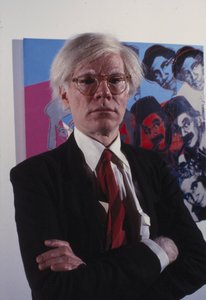
Andy Warhol
1928 - 1987 , United States of America
Quick Facts
- Artistic Movement Or Style: Pop Art
- Artists Or Movements Influenced By This Artist:
- Conceptualism
- Performance Art
- Full Name: Andrew Warhola Jr.
- Notable Artworks:
- Campbell's Soup Cans
- Marilyn Diptych
- Coca-Cola (3)
- Gold Marilyn
- Brillo Box sculptures
- Place Of Birth: Pittsburgh, United States of America
- Date Of Birth: 1928
- Date Of Death: 1987