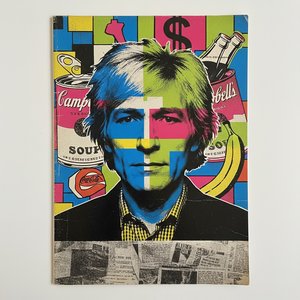
1970. Silkscreen.

§ 1Catalogue data


This Artwork Is Under Copyright Protection
The artwork displayed on this page is protected by copyright law, which means we cannot legally create or sell an identical reproduction. This protection is enforced under international agreements such as the Berne Convention and by national laws, including those outlined by the U.S. Copyright Law - Title 17.
As a respectful and legal alternative, we offer custom, hand-painted artworks inspired by the original. Our skilled and professional artists carefully study the original's style, mood, and artistic essence to create a new, unique piece that evokes the same feeling - while remaining an original creation in its own right.
This method fully complies with copyright regulations because it does not involve copying or duplicating the protected artwork. Instead, it is a creative reinterpretation - a new painting that is influenced by the original but not identical to it.
 Read more
§ 2Abstract
Collectible Description
Explore Andy Warhol’s ‘Flowers’ – a vibrant Pop Art collage of stylized blooms. Silkscreen beauty & mass production explore everyday themes. A must-see masterpiece!
Artist Biography
Pop Art icon Andy Warhol created the legendary Campbell’s Soup Cans. Discover his vibrant world of celebrity and consumer culture today.
§ 3Commentary
A Celebration of the Everyday: Andy Warhol’s “Flowers”
Andy Warhol's "Flowers," created in 1970, is arguably one of the most recognizable and enduring images of the Pop Art movement. More than just a depiction of floral beauty, this work encapsulates Warhol’s revolutionary approach to artmaking – elevating commonplace subjects to iconic status and challenging traditional notions of artistic value. This series wasn't simply about flowers; it was initially commissioned as illustrations for a fabric company, demonstrating Warhol’s blurring of the lines between fine art and commercial design.Composition & Technique: Silkscreening the Mundane
“Flowers” is presented as a collage of four distinct images, each showcasing different flower varieties – often hibiscus or magnolias – against vividly colored backgrounds. The arrangement isn’t rigidly symmetrical; instead, there's a deliberate sense of slight misalignment and repetition that contributes to its dynamic energy. Warhol masterfully employed silkscreen printing, a technique he famously popularized. This method allowed for the mass production of images with subtle variations in color and registration, intentionally rejecting the idea of a unique, hand-crafted artwork. The flat planes of color and crisp lines are hallmarks of this process, creating an aesthetic that is both bold and deliberately impersonal. The use of vibrant hues – pinks, yellows, blues, and purples – further enhances the visual impact and contributes to the work’s overall sense of optimism.Pop Art & Cultural Context
“Flowers” exists firmly within the context of Pop Art, a movement that emerged in the 1950s as a reaction against Abstract Expressionism's perceived elitism. Pop Art embraced popular culture, consumerism, and mass media as legitimate subjects for artistic exploration. Warhol’s choice of flowers – readily available, commercially produced, and often associated with decorative arts – perfectly embodies this ethos. He wasn’t interested in portraying the inherent beauty of nature; rather, he was fascinated by the flower *as an image*, its ubiquity in advertising, wallpaper patterns, and everyday life. This work reflects a society increasingly saturated with mass-produced goods and imagery.Symbolism & Emotional Resonance
While seemingly straightforward, “Flowers” carries layers of symbolic meaning. The repetition inherent in the silkscreen process can be interpreted as a commentary on consumer culture’s relentless cycle of production and consumption. The flowers themselves, traditionally symbols of beauty, fragility, and life, are presented in a detached, almost mechanical manner, prompting viewers to question their own perceptions of these concepts. Despite this detachment, the vibrant colors and recognizable subject matter evoke a sense of joy and optimism – a playful engagement with the world around us. The inclusion of a bird in some variations adds an element of unexpected whimsy.Legacy & Interior Design Considerations
Andy Warhol’s influence on contemporary art is immeasurable. “Flowers” remains one of his most celebrated works, continuing to inspire artists and captivate audiences worldwide. Its enduring appeal also makes it a popular choice for interior design. The bold colors and graphic simplicity lend themselves well to modern and contemporary spaces. A reproduction of "Flowers" can serve as a striking focal point in a living room, bedroom, or office, adding a touch of iconic artistry and playful sophistication.- Ideal for: Modern, Contemporary, Pop Art-inspired interiors.
- Color Palette: Complements spaces with bold color schemes or provides a vibrant contrast to neutral palettes.
- Placement Suggestions: Above a sofa, in a dining room, or as a statement piece in an entryway.
Questions & Answers
What is the format of "Flowers"?
The format of "Flowers" is square. This is useful when planning where a reproduction will be placed.
In what period was "Flowers" by Andy Warhol made?
The historical period of "Flowers" by Andy Warhol is Modern. This classification situates the work in art history.
Where can I see a preview of "Flowers"?
To preview a reproduction of "Flowers" by Andy Warhol, open the artwork's Preview page.


 Switch to Print


 For artworks or reproductions larger than 105 cm (approximately 41 inches) on any side, the frame will be shipped as a kit, disassembled. This method ensures safe delivery and prevents damage during transport.