Money-Back Guarantee · 100 days Free Worldwide Delivery
449,587artworks 30,613artists 4,660museums 32languages
Catalogue entry

Self-Portrait (Camouflage)

1986. Acrylic On Canvas, 203.0 x 203.0 cm.

Fig. 1. Andy Warhol, Self-Portrait (Camouflage), 1986. Shown as the reproduction you are specifying: , .

§ 1Catalogue data

Dimensions
203.0 x 203.0 cm

§ 2Abstract

Collectible Description

Andy Warhol's striking 'Self-Portrait (Camouflage)' blends pop art with military aesthetics – a haunting exploration of fame, identity, and illusion through screen printing.

Artist Biography

Pop Art icon Andy Warhol created the legendary Campbell’s Soup Cans. Discover his vibrant world of celebrity and consumer culture today.

§ 3Commentary

Andy Warhol's Self-Portrait (Camouflage): A Study in Identity and Illusion

  • Title: Self-Portrait (Camouflage)
  • Artist: Andy Warhol
  • Date: 1986
  • Size: 203 x 203 cm
  • Medium: Screenprint on canvas

Subject and Style: Pop Art Meets Military Aesthetics

This striking diptych, "Self-Portrait (Camouflage)," exemplifies Andy Warhol's signature Pop Art style. The artwork presents a close-up portrait of the artist himself, instantly recognizable by his iconic glasses, juxtaposed against a complex camouflage pattern. This unexpected pairing creates a compelling visual tension – the familiar face of a celebrity icon set against the backdrop of military concealment. Warhol’s deliberate use of bold colors and graphic repetition, hallmarks of Pop Art, further emphasizes this contrast. The work reflects Warhol's fascination with mass media, consumer culture, and the blurring lines between high art and popular imagery. It is a quintessential example of his ability to elevate everyday subjects into powerful artistic statements.

Technique: Screen Printing and Serial Reproduction

Warhol’s mastery of screen printing (also known as silkscreening) is central to understanding this piece. The technique, borrowed from commercial printing processes, allowed Warhol to mass-produce images with a consistent aesthetic. This deliberate embrace of mechanical reproduction was a key element of his artistic philosophy, challenging traditional notions of authorship and originality in art. The flat, uniform application of color and the crisp edges characteristic of screen printing contribute to the artwork’s distinctive visual impact. The camouflage pattern itself is meticulously rendered through layers of ink, demonstrating Warhol's technical skill even within his seemingly impersonal process.

Historical Context and Symbolism: Fame, Anonymity, and Late-Era Warhol

Created in 1986, just a year before Warhol’s death, "Self-Portrait (Camouflage)" carries a poignant resonance. The camouflage pattern is rich with symbolic meaning. It suggests concealment, disguise, or an attempt to blend into the crowd – themes that resonate with Warhol's own complex persona as a celebrity shrouded in mystery. The military imagery also evokes notions of power, protection, and perhaps even vulnerability. Considering Warhol’s prolific career exploring fame and its discontents, this self-portrait can be interpreted as a reflection on his own enduring legacy and the paradoxical nature of being both universally recognized and perpetually elusive. The work is often seen as a late-career exploration of identity, mortality, and the ever-shifting landscape of celebrity culture.

Emotional Impact: A Haunting Reflection on Identity

"Self-Portrait (Camouflage)" evokes a sense of quiet unease and introspection. While Warhol’s portraits are typically vibrant and celebratory, this piece possesses a more subdued and haunting quality. The camouflage pattern creates a barrier between the viewer and the artist, suggesting a deliberate distancing or perhaps even a feeling of isolation. The overall effect is both visually arresting and conceptually layered, prompting reflection on themes of identity, representation, and the complexities of fame in a mass-mediated world. It’s a powerful reminder of Warhol's enduring influence and his ability to capture the zeitgeist of his time with remarkable insight and artistic innovation.

Questions & Answers

How is the mood of "Self-Portrait (Camouflage)" by Andy Warhol described?

"Self-Portrait (Camouflage)" by Andy Warhol is described as dramatic in mood. This classification can help match the work to a setting.

How much light do the colors of "Self-Portrait (Camouflage)" appear to reflect?

The colors of "Self-Portrait (Camouflage)" show a soft shadow luminance.

Is "Self-Portrait (Camouflage)" by Andy Warhol a painting, a drawing or a print?

"Self-Portrait (Camouflage)" by Andy Warhol is classified as wall art. The category describes the kind of artwork the original is.
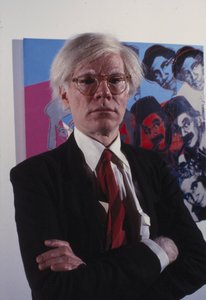
§ 4The artist

Andy Warhol

Andy Warhol

1928 - 1987, United States of America

Quick facts about Andy Warhol

  • Artistic Movement Or Style: Pop Art
  • Artists Or Movements Influenced By This Artist:
    • Conceptualism
    • Performance Art
  • Full Name: Andrew Warhola Jr.
  • Notable Artworks:
    • Campbell's Soup Cans
    • Marilyn Diptych
    • Coca-Cola (3)
    • Gold Marilyn
    • Brillo Box sculptures
  • Place Of Birth: Pittsburgh, United States of America
  • Date Of Birth: 1928
  • Date Of Death: 1987

Artist Biography

The Industrial Roots of a Visual Language

Born Andrew Warhola Jr. in 1928 within the industrial landscape of Pittsburgh, Pennsylvania, the man who would become Andy Warhol spent much of his early years shaped by confinement and quiet observation. A childhood bout with Sydenham's chorea, or St. Vitus’ Dance, kept him indoors for long stretches. During these periods, he turned to the imagery provided by his mother: comic books and movie magazines. These were the first seeds of a visual vocabulary that would later embrace the mass-produced. He eventually moved toward formal training at the Carnegie Institute of Technology, earning a degree in Pictorial Design in 1949.

His arrival in New York City marked a transition from the private world of sketches to the public sphere of commercial illustration. Working for names such as Tiffany & Co., Vogue, and Harper's Bazaar, he mastered the precision required by advertising. This period of professional service instilled in him an understanding of how images are manufactured and distributed. He learned the mechanics of the brand before he ever attempted to deconstruct it.

The Factory and the Mechanics of Fame

By the 1960s, his focus shifted from illustrating products to treating the products themselves as subjects. Through the adoption of the silkscreen printing process, he introduced a method that mirrored the repetitive nature of consumer culture. This technique allowed for a detachment from the hand of the artist, favoring a flattened, mechanical aesthetic. His studio, known as The Factory, became a central point for a specific New York social circle. It was a space where musicians, poets, and film personalities gathered, often blurring the lines between their private lives and their public personas.

His work during these years explored several distinct themes:

  • The commodification of everyday objects, such as his 1962 depictions of Campbell’s Soup Cans.
  • The construction of celebrity through portraits of figures like Marilyn Monroe and Elizabeth Taylor.
  • The darker side of the American experience, including his series on car crashes and electric chairs.

This era was not without physical consequence. In 1968, a radical feminist writer named Valerie Solanas entered his Manhattan studio and shot him, leaving him with lasting injuries. This event altered the trajectory of his studio life, moving it toward a more business-oriented enterprise.

Cinema and the Expanded Image

Beyond the canvas, Warhol was an active filmmaker who produced over 600 films between 1963 and 1968. Many of these were experimental or static in nature. He utilized long, unblinking takes in works like Sleep and Empire to challenge how an audience consumes moving images. His filmic output often featured his "superstars," a group of personalities from the Factory scene who became part of the cultural fabric of the time.

His influence reached into the music industry through his management of The Velvet Underground. He even designed the famous banana cover for their debut album, further merging the boundaries between fine art and popular media. By the time of his death in 1987, he had moved through various media—photography, publishing, and television—leaving behind a body of work that interrogated the very nature of what it means to be seen in a media-saturated age.

§ 5Comparanda

§ 6Questions

Quick Facts

  • Year: 1986
  • Title: Self-Portrait (Camouflage)
  • Movement: Pop Art
  • Subject or theme: Celebrity, Anonymity, Military imagery
  • Notable elements or techniques:
    • Camouflage pattern
    • Silkscreening

Art Quiz

There is only one correct answer for each question.

Question 1:
What artistic movement is Andy Warhol’s ‘Self-Portrait (Camouflage)’ most closely associated with?
Question 2:
The camouflage pattern in the artwork primarily symbolizes:
Question 3:
What printing technique is most evident in the artwork’s creation?
Question 4:
Approximately when was ‘Self-Portrait (Camouflage)’ created?

§ 7Cite this entry

AllPaintingsStore.com, “Andy Warhol, Self-Portrait (Camouflage) (1986)”, https://allpaintingsstore.com/en/art/andy-warhol-self-portrait-camouflage-D2DSTF-en/ArtistReproduction/ (accessed 4 October 2026).

§ 8The reproduction

Hand Made Oil Reproduction

Hand-painted oil on canvas in your size and frame, made to order by our artists. ( Switch to Print Switch to Digital Image)

It is specified on the order sheet in the margin; the present state of that sheet reads as follows.

Self-Portrait (Camouflage)

Reproduction Medium

Reproduction Size

-

Elite Senior Artist

More detail, finesse, and extra production time

-

Reproduction Frame

-

-

For artworks or reproductions larger than 105 cm (approximately 41 inches) on any side, the frame will be shipped as a kit, disassembled. This method ensures safe delivery and prevents damage during transport.

Professional assembly required - this is not a DIY product.
The kit must be assembled and the canvas stretched by an experienced professional framer, using wood glue (not supplied), a canvas stretching plier and clamps to hold the bars square while the glue dries. Incorrect assembly or uneven canvas tension can permanently damage the artwork and is not covered by our warranty.

  • All solid wood bars are included, precisely cut to size.

  • Assembled with the screws provided, plus wood glue for the corner joints, which is not supplied and must be sourced by your framer.

  • Professional tools are required and not included: a canvas stretching plier (tensioner) and clamps to hold the bars square while the glue dries.

Important:
The corner joints require wood glue, the bars must be held with clamps until the glue is fully dry, and tightening the canvas on the assembled frame requires a canvas stretching plier. None of these are included in the kit. Please arrange an experienced professional framer before ordering this size.

Nameplate

-

-

Protective Varnish

Glossy Varnish (enhances colors, protects against light/moisture)

-

Customize My Artwork

Examples of what can be changed: Replace face with customer photo; Add pet (e.g., replace cat with dog); Include hidden message in background; Change background landscape or elements.

-

Urgent

Worldwide Delivery () in 3/4 weeks instead of standard 5 weeks. (2 November). No compromise on quality.

-

Express Shipping

Worldwide Delivery () in 5 weeks. (9 November).

Included

Total Price

$ 258

Included with every order

  • Free Worldwide Express Shipping
  • High-Quality Linen Canvas
  • Full Shipping Insurance
  • Customs Tax Refund Guarantee
  • True Color Matching Guarantee
  • 100-Day Return Policy (Defects Only)
  • 100% Money-Back Guarantee
  • Bulk Discount Offer
Order sheet