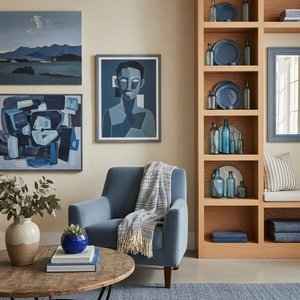
Acrylic On Canvas.

§ 1Catalogue data


This Artwork Is Under Copyright Protection
The artwork displayed on this page is protected by copyright law, which means we cannot legally create or sell an identical reproduction. This protection is enforced under international agreements such as the Berne Convention and by national laws, including those outlined by the U.S. Copyright Law - Title 17.
As a respectful and legal alternative, we offer custom, hand-painted artworks inspired by the original. Our skilled and professional artists carefully study the original's style, mood, and artistic essence to create a new, unique piece that evokes the same feeling - while remaining an original creation in its own right.
This method fully complies with copyright regulations because it does not involve copying or duplicating the protected artwork. Instead, it is a creative reinterpretation - a new painting that is influenced by the original but not identical to it.
 Read more
§ 2Abstract
Collectible Description
Explore 'untitled (9187)' by Andy Warhol – a captivating portrait with striking blue tones and subtle star motifs, embodying the Pop Art master's iconic style.
Artist Biography
Pop Art icon Andy Warhol created the legendary Campbell’s Soup Cans. Discover his vibrant world of celebrity and consumer culture today.
§ 3Commentary
A Glimpse Beyond the Surface: Decoding Andy Warhol’s Untitled Portrait
Andy Warhol's *untitled (9187)* is a captivating enigma, a work that draws you in with its stark simplicity and then holds your gaze with an unsettling beauty. The painting presents a close-up of a man’s head against a deep blue backdrop punctuated by scattered stars – a cosmic setting for a decidedly human subject. While the identity of the sitter remains unknown, adding to the piece's mystique, it is undeniably characteristic of Warhol’s fascination with portraiture and his exploration of celebrity, identity, and the constructed nature of image itself. The man’s features are rendered with a deliberate ambiguity; he isn’t idealized or romanticized, but rather presented as a somewhat detached figure, almost mask-like in its stillness. This is further emphasized by the application of makeup, which subtly alters his appearance, blurring the lines between authenticity and artifice.The Echoes of Pop and Persona
To understand *untitled (9187)*, one must consider Warhol’s pivotal role within the Pop Art movement. Emerging in the 1950s as a reaction against Abstract Expressionism's intensely personal and often angst-ridden style, Pop Art embraced popular culture – advertising, comic books, consumer products – as its subject matter. Warhol, however, went further, elevating everyday objects and individuals to iconic status through his signature silkscreen technique. Though the exact method used for *untitled (9187)* is unconfirmed without detailed provenance, it likely employs elements of this process: layering colors, utilizing photographic imagery transferred onto canvas, and embracing a degree of mechanical reproduction. This deliberate removal of the artist’s hand was not about lacking skill, but rather a commentary on mass production and the diminishing value of originality in a consumer-driven society. The blue background with stars evokes a sense of manufactured glamour, reminiscent of stage lighting or a film set – hinting at the performative nature of identity that Warhol so often explored.Superstars and the Search for Meaning
Warhol’s studio, “The Factory,” was a magnet for an eclectic mix of personalities he dubbed "superstars"—individuals who embodied the spirit of experimentation and rebellion in 1960s New York. Figures like Edie Sedgwick, Nico, and Viva became both muses and collaborators, their images endlessly reproduced in Warhol’s paintings, films, and photographs. While *untitled (9187)* doesn't depict a readily recognizable “superstar,” it shares the same spirit of fascination with individual persona. The subject’s gaze is directed downwards, creating an introspective mood. Is he lost in thought? Disillusioned by fame? Or simply presenting a carefully curated facade to the world? Warhol leaves these questions unanswered, inviting viewers to project their own interpretations onto the canvas. This ambiguity is key to the work's enduring power; it’s not about *who* the man is, but rather what he represents – our collective anxieties and aspirations in an age of image saturation.A Lasting Legacy: Warhol’s Influence Today
Andy Warhol irrevocably changed the landscape of art, challenging traditional notions of authorship, originality, and artistic value. His work continues to resonate with contemporary audiences because it speaks to fundamental questions about identity, celebrity, and the power of visual culture. *untitled (9187)*, in its quiet intensity, exemplifies this enduring legacy. It’s a piece that rewards close observation, prompting us to consider the layers of meaning hidden beneath the surface. For collectors and interior designers alike, a reproduction of this work offers not just an aesthetic statement but also a conversation starter – a subtle yet powerful reminder of Warhol's profound impact on our world. The painting’s cool blue tones and enigmatic subject matter would lend themselves beautifully to modern or minimalist interiors, adding a touch of intellectual sophistication and artistic intrigue.Questions & Answers
Where should a reproduction of "untitled (9187)" by Andy Warhol be hung?
The square format of "untitled (9187)" by Andy Warhol is recommended for a living room. Format and space together guide the placement of a reproduction.
How is "untitled (9187)" recommended to be printed - what size, what orientation?
A print of "untitled (9187)" by Andy Warhol is recommended at a large size in square orientation.
Is "untitled (9187)" typical of what Andy Warhol usually created?
"untitled (9187)" depicts portraiture, celebrity, warhol, minimalism, blue background, stars, makeup, while Andy Warhol's recorded themes are pop art influence, celebrity image, mass production critique, warhol style, portrait exploration. Comparing the two shows how the work relates to the artist's usual subjects.


 Switch to Print


 For artworks or reproductions larger than 105 cm (approximately 41 inches) on any side, the frame will be shipped as a kit, disassembled. This method ensures safe delivery and prevents damage during transport.