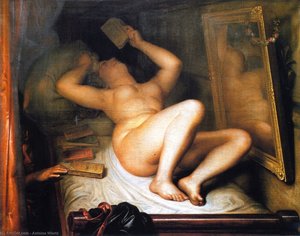
1853. Acrylic On Canvas, 125.0 x 155.0 cm. Musée Wiertz.

§ 1Catalogue data
 Acrylic On Canvas
- WallArt
- Romanticism
 1853
1853 125.0 x 155.0 cm
 Musée Wiertz
§ 2Abstract
Collectible Description
Antoine Wiertz's 'The Novel Reader' (1853) captures a captivating scene of a woman lost in literature, showcasing the artist’s dramatic Romantic style and hinting at hidden depths within this iconic masterpiece.
 Read More
Artist Biography
Antoine Wiertz (1806-1865) was a Belgian Romantic painter & sculptor famed for dramatic, monumental works exploring history, religion, and the macabre. A precursor to Symbolism, his unique style blends classical techniques with lurid imagery.
§ 3Commentary
A Glimpse into the Soul: Antoine Wiertz’s *The Novel Reader*
Antoine Wiertz's 1853 painting, *The Novel Reader*, isn’t merely a depiction of a woman lost in literature; it’s a potent distillation of Romanticism’s anxieties and aspirations. Captured with dramatic intensity and a touch of unsettling ambiguity, the work invites us to contemplate the solitary nature of reading, the allure of escape, and the subtle dance between intellect and emotion. Wiertz, a figure often relegated to the fringes of the Belgian art scene during his lifetime, created an image that resonates powerfully today, speaking to our own relationship with stories and the quiet moments of introspection they offer.
The painting immediately commands attention through its scale – measuring 125 x 155 cm – and its bold composition. A nude woman, draped in a simple robe, lies on her bed, completely absorbed in a book held delicately in her hand. The room itself is bathed in a muted light, creating an atmosphere of intimate seclusion. Yet, the inclusion of a mirror above the bed introduces a crucial element: a second figure mirroring the pose of the reader, also lost in their own literary world. This doubling effect subtly suggests that reading isn’t a purely solitary act; it's a shared experience, a communion with ideas and characters that transcends individual boundaries.
The Romantic Palette and Dramatic Technique
Wiertz was deeply influenced by the Baroque masters, particularly Peter Paul Rubens, whose dynamic compositions and expressive use of color he adopted for his own work. *The Novel Reader* exemplifies this influence through its dramatic lighting, rich textures, and a sense of palpable energy. The artist employs a loose, impasto technique – applying thick layers of oil paint directly to the canvas – which lends the scene a tactile quality, emphasizing the physicality of the figures and the materiality of the room. Notice how the brushstrokes themselves seem to vibrate with emotion, conveying both the woman’s absorption and the subtle tension within the composition.
The color palette is deliberately restrained, dominated by earthy tones – browns, ochres, and muted reds – that contribute to the painting's overall sense of intimacy. However, these subdued hues are punctuated by flashes of brighter color in the book itself and the surrounding details, drawing our eye to the central subject and highlighting the transformative power of literature.
Symbolism and a Hint of Unease
Beyond its immediate visual appeal, *The Novel Reader* is laden with symbolic meaning. The nude figure represents not just physical beauty but also vulnerability and intellectual curiosity. The book itself symbolizes knowledge, escape, and the potential for self-discovery. The mirror, however, introduces a layer of complexity. It suggests that reading isn’t simply an act of individual contemplation; it's a dialogue with another version of oneself, a confrontation with alternative realities. And then there is the shadowy figure reflected in the mirror – a subtle hint of darkness, perhaps representing temptation or the potential for distraction.
The inclusion of the vase and scattered books further reinforces this symbolic richness, suggesting a space dedicated to intellectual pursuits and artistic appreciation. The painting’s overall mood isn't one of serene tranquility; there’s an underlying current of unease, as if the woman is caught in a delicate balance between pleasure and peril.
A Legacy of Eccentric Genius
Antoine Wiertz remains a somewhat enigmatic figure in art history. Despite his undeniable talent and innovative style, he faced considerable criticism and struggled to gain widespread recognition during his lifetime. His work was often dismissed as overly dramatic or even morbid, reflecting the anxieties of a society grappling with rapid social and political change. However, today, Wiertz is increasingly appreciated for his unique vision and his ability to capture the emotional intensity of Romanticism. *The Novel Reader* stands as a testament to his artistic skill and his profound understanding of the human condition – a captivating image that continues to resonate with viewers centuries after its creation.
Questions & Answers
How old was Antoine Wiertz when creating "The Novel Reader" in 1853?
When "The Novel Reader" was created in 1853, Antoine Wiertz - born in 1806 - was 47 years old.
What is "The Novel Reader" made with, and in which style?
In "The Novel Reader", the acrylic on canvas technique meets the Romanticism movement.
What is the format of "The Novel Reader"?
The format of "The Novel Reader" is landscape. This is useful when planning where a reproduction will be placed.


 Switch to Print


 For artworks or reproductions larger than 105 cm (approximately 41 inches) on any side, the frame will be shipped as a kit, disassembled. This method ensures safe delivery and prevents damage during transport.