Money-Back Guarantee · 100 days Free Worldwide Delivery
449,564artworks 30,613artists 4,660museums 32languages
Catalogue entry

untitled (8028)

Acrylic On Canvas.

Fig. 1. Caravaggio, untitled (8028). Shown as the reproduction you are specifying: , .

§ 1Catalogue data

§ 2Abstract

Collectible Description

'Untitled (8028)' embodies Caravaggio's Baroque aesthetic, capturing a biblical narrative with profound emotional depth and masterful use of tenebrism. Its detailed depiction of figures and setting underscores Caravaggio’s commitment to realism.

Artist Biography

Baroque master Caravaggio defined tenebrism with works like Cardsharps. Discover the dramatic power of his revolutionary realism today.

§ 3Commentary

A Vision of Suffering and Divine Grace

Michelangelo Merisi da Caravaggio, a name synonymous with the visceral power of Baroque painting, was born in Milan in 1571, a period defined by both artistic dynamism and profound social anxieties. His formative years were tragically marked by loss; plague swept through his hometown, claiming the lives of his father and grandfather when he was just six years old—experiences that instilled within him an unwavering empathy for human vulnerability and resilience—themes which would become central to his oeuvre. Early training under Simone Peterzano, a former pupil of Titian, provided him with foundational Renaissance skills, yet it was in Rome, arriving around 1592, that Caravaggio truly blossomed, albeit amidst considerable hardship. The city’s vibrant artistic milieu fostered experimentation and challenged established conventions, offering him the space to forge his distinctive style—a style characterized by its uncompromising realism and masterful manipulation of chiaroscuro, or dramatic lighting—that would irrevocably alter the course of art history.
  • Subject Matter: The painting depicts a poignant religious scene centered around a woman cradling her infant son, positioned against a backdrop of shadowy figures engaged in an act of compassion.
  • Style: Caravaggio’s signature tenebrism—the stark contrast between light and dark—dominates the composition, creating an atmosphere of intense drama and psychological depth. This technique elevates the scene beyond mere depiction, immersing the viewer in a realm of heightened emotion.

Technique and Innovation

Caravaggio’s revolutionary approach to painting stemmed from his meticulous observation of human anatomy and his masterful use of pigment—primarily oil paints—applied with impasto, creating textured surfaces that capture the physicality of his subjects. He eschewed idealized representations favored by Renaissance artists, opting instead for unflinching realism, portraying figures with palpable emotion and capturing subtle nuances of expression. This commitment to naturalism was bolstered by Caravaggio’s innovative use of light, which he employed not merely as illumination but as a tool for storytelling—drawing the eye directly to key elements within the composition and conveying profound spiritual significance. The artist's meticulous attention to detail extended beyond mere anatomical accuracy; he painstakingly rendered fabrics, textures, and facial expressions with astonishing precision, achieving an unprecedented level of visual fidelity.
  • Material: Oil paint on canvas
  • Technique: Impasto (thickly applied paint) combined with chiaroscuro lighting

Historical Context and Symbolism

Painted circa 1606-1607, *Untitled (8028)* emerged during Caravaggio’s Roman period—a time of considerable artistic ferment and papal patronage. The painting reflects the Baroque preoccupation with religious fervor and emotional intensity, mirroring the broader cultural landscape of the era. The woman’s posture conveys tenderness and maternal devotion, symbolizing the nurturing role of faith in safeguarding humanity. Simultaneously, the shadowy figures surrounding her represent judgment and divine providence—a reminder that earthly existence is subject to a higher power. The horse, prominently featured in the background, serves as an emblem of strength and nobility, subtly reinforcing the painting’s overarching message of spiritual fortitude. Symbolism: Maternal devotion, Divine Judgment, Spiritual Resilience

Emotional Resonance

Caravaggio's masterpiece transcends mere visual representation; it compels viewers to confront profound questions about compassion, faith, and mortality. The dramatic interplay of light and darkness evokes a visceral response—a feeling of unease mingled with awe—drawing the spectator into the emotional core of the scene. The artist’s ability to convey psychological complexity is remarkable, capturing not only physical appearance but also inner turmoil—a testament to Caravaggio's unparalleled skill in communicating human experience. *Untitled (8028)* remains a powerful reminder that art can illuminate the deepest recesses of the human spirit and inspire contemplation on matters of faith and morality.

Questions & Answers

Where does "untitled (8028)" sit within Caravaggio's body of work?

"untitled (8028)" shares with Caravaggio's other works its Baroque style and the recorded themes: dramatic realism & emotion, religious piety & passion, catholic propaganda era, revolutionary baroque style.

What is the color identity of "untitled (8028)" by Caravaggio?

The color identity of "untitled (8028)" by Caravaggio: an earthy palette, dominated by espresso (#583929).

How does the subject of "untitled (8028)" relate to Caravaggio's usual themes?

Caravaggio's recurring themes include dramatic realism & emotion, religious piety & passion, catholic propaganda era, revolutionary baroque style; "untitled (8028)" focuses on religious scene, biblical narrative, human suffering, dramatic lighting, christ figure, torture, faithfulness.
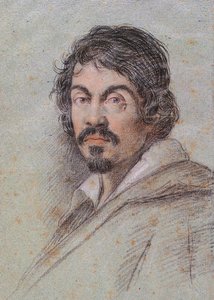
§ 4The artist

Caravaggio

Caravaggio

1571 - 1610, Spain

Quick facts about Caravaggio

  • Artistic Movement Or Style: Baroque, Tenebrism
  • Artists Or Movements Influenced By This Artist:
    • Caravaggisti
    • Rubens
    • Jusepe de Ribera
    • Gerrit van Honthorst
  • Artists Who Influenced This Artist: ['Titian']
  • Full Name: Michelangelo Merisi da Caravaggio
  • Notable Artworks:
    • The Taking of Christ
    • Saint Francis of Assisi in Ecstasy
    • The Fortune Teller
    • Supper at Emmaus
    • David with the Head of Goliath
  • Place Of Birth: Milan, Spain
  • Date Of Birth: 1571
  • Date Of Death: 1610

Artist Biography

A Life Forged in Shadow and Light

Milan, 1571. The air is heavy with the scent of plague. Young Michelangelo Merisi watches as death claims his father and grandfather in a single day. He grows up in the grip of poverty, a reality that later finds its way onto his canvases through the faces of ordinary people. By 1584, he begins an apprenticeship under Simone Peterzano, a former pupil of Titian. This training provides the technical foundation, but the spirit of the boy from Milan is already restless.

Rome, around 1592. The city is a crucible of religious fervor and intense competition. Caravaggio arrives without fixed address or provision, a penniless migrant in a landscape of grand ambitions. He finds footing through the patronage of Cardinal Francesco Maria del Monte. In the shadows of the Palazzo Madama, the artist begins to strip away the artificial elegance of Mannerism. He replaces elongated, idealized forms with something far more visceral.

The Architecture of Darkness

He rejects the polished surfaces of his contemporaries. Instead, he embraces tenebrism, a style where darkness is a physical presence rather than a mere absence of light. In works like The Cardsharps, light does not simply illuminate; it strikes. It carves figures out of an impenetrable black void. This technique, often called chiaroscuro, creates a stage-like intensity that forces the viewer to confront the raw textures of silk, skin, and bone.

His method is direct. He works alla prima, applying paint directly to the canvas without the safety net of preparatory drawings. This immediacy allows for a startling realism. He uses the people of the Roman streets—the drunks, the laborers, the outcasts—as models for the sacred. When he paints the Holy Family, they possess the dirt and weariness of the living. The divine becomes profoundly human.

  • Tenebrism: The use of violent contrasts between light and dark to command attention.
  • Realism: A commitment to depicting the physical and emotional truth of the human condition.
  • Direct Observation: Working from live models to capture unadorned, naturalistic detail.

Flight and Finality

The brilliance of his art is matched by the volatility of his temperament. A brawl in 1606 leads to a murder charge and a death sentence. The artist becomes an outlaw. He flees Rome, moving through Naples, Malta, and Sicily. Even in exile, the work continues. In Malta, he joins the Order of St. John, but his turbulent nature leads to imprisonment after a quarrel with a superior.

The end comes in 1610. While traveling from Naples back toward Rome in search of a papal pardon, he dies in Porto Ercole. The cause remains a subject of debate—fever, wounds, or perhaps lead poisoning. He leaves behind a legacy that fundamentally altered the course of Western art. His followers, the Caravaggisti, carry his shadows across Europe, ensuring that the darkness he mastered would never truly fade.

§ 5Comparanda

§ 6Questions

Quick Facts

  • Notable elements or techniques: Tenebrism, Dramatic realism
  • Subject or theme: Religious scene
  • Title: untitled (8028)
  • Artistic style: Realistic

§ 7Cite this entry

AllPaintingsStore.com, “Caravaggio, untitled (8028)”, https://allpaintingsstore.com/en/art/caravaggio-untitled-8028-9GETDD-en/ArtistReproduction/ (accessed 10 October 2026).

§ 8The reproduction

Hand Made Oil Reproduction

Hand-painted oil on canvas in your size and frame, made to order by our artists. ( Switch to Print Switch to Digital Image)

It is specified on the order sheet in the margin; the present state of that sheet reads as follows.

untitled (8028)

Reproduction Medium

Reproduction Size

-

Elite Senior Artist

More detail, finesse, and extra production time

-

Reproduction Frame

-

-

For artworks or reproductions larger than 105 cm (approximately 41 inches) on any side, the frame will be shipped as a kit, disassembled. This method ensures safe delivery and prevents damage during transport.

Professional assembly required - this is not a DIY product.
The kit must be assembled and the canvas stretched by an experienced professional framer, using wood glue (not supplied), a canvas stretching plier and clamps to hold the bars square while the glue dries. Incorrect assembly or uneven canvas tension can permanently damage the artwork and is not covered by our warranty.

  • All solid wood bars are included, precisely cut to size.

  • Assembled with the screws provided, plus wood glue for the corner joints, which is not supplied and must be sourced by your framer.

  • Professional tools are required and not included: a canvas stretching plier (tensioner) and clamps to hold the bars square while the glue dries.

Important:
The corner joints require wood glue, the bars must be held with clamps until the glue is fully dry, and tightening the canvas on the assembled frame requires a canvas stretching plier. None of these are included in the kit. Please arrange an experienced professional framer before ordering this size.

Nameplate

-

-

Protective Varnish

Glossy Varnish (enhances colors, protects against light/moisture)

-

Customize My Artwork

Examples of what can be changed: Replace face with customer photo; Add pet (e.g., replace cat with dog); Include hidden message in background; Change background landscape or elements.

-

Urgent

Worldwide Delivery () in 3/4 weeks instead of standard 5 weeks. (7 November). No compromise on quality.

-

Express Shipping

Worldwide Delivery () in 5 weeks. (14 November).

Included

Total Price

$ 258

Included with every order

  • Free Worldwide Express Shipping
  • High-Quality Linen Canvas
  • Full Shipping Insurance
  • Customs Tax Refund Guarantee
  • True Color Matching Guarantee
  • 100-Day Return Policy (Defects Only)
  • 100% Money-Back Guarantee
  • Bulk Discount Offer
Order sheet