Money-Back Guarantee · 100 days Free Worldwide Delivery
449,564artworks 30,613artists 4,660museums 32languages
Catalogue entry

untitled (7557)

Acrylic On Canvas.

Fig. 1. Claude Monet, untitled (7557). Shown as the reproduction you are specifying: , .

§ 1Catalogue data

§ 2Abstract

Collectible Description

Admire Claude Monet's 'Blue Water Lilies,' a serene landscape masterpiece from his Giverny garden series showcased on Google Art Project. Explore Impressionism’s beauty and tranquility.

Artist Biography

Claude Monet was an Impressionist master known for his Water Lilies series. Discover the beauty of his light-filled landscapes today.

§ 3Commentary

A Window into Impressionism's Soul

Claude Monet, a name synonymous with Impressionism, wasn’t merely a painter of landscapes; he was a chronicler of fleeting moments, a poet of light and color. Born in Paris on November 14, 1840, his early life took an unexpected turn when his family relocated to Le Havre, Normandy, at the age of five. While initially destined for a commercial career by his father, young Claude’s innate artistic talent quickly surfaced, manifesting first in charcoal caricatures sold locally – a testament to both his skill and entrepreneurial spirit. However, it was his encounter with Eugène Boudin that proved pivotal. Boudin didn't just teach Monet *how* to paint; he instilled within him the revolutionary idea of painting en plein air—directly from nature—a practice that would define his entire artistic journey. This formative relationship established a cornerstone for Monet’s lifelong dedication to capturing the ephemeral beauty of the natural world, a pursuit that would ultimately elevate him to the forefront of the Impressionist movement.

The Painting's Composition: Harmony and Movement

“untitled (7557)” presents a serene tableau depicting a woman seated on grass amidst a blossoming garden. The central figure—a woman knitting—is accompanied by her child, creating an intimate scene brimming with tenderness. Delicate flowers punctuate the background, establishing a lush atmosphere that invites contemplation. Notably, another person stands slightly behind the woman, partially obscured by her activity, adding depth to the composition and hinting at a narrative beyond the immediate visual elements. Monet’s masterful brushstrokes skillfully convey movement—the gentle sway of grasses, the subtle ripples on the water—harmoniously blending with the stillness of domestic life. This balanced arrangement underscores Monet's intention to portray not just what he *saw*, but how he *felt* when observing this idyllic moment in time.

Technique and Impressionistic Style

Monet’s technique is quintessential Impressionism, characterized by loose brushstrokes applied in rapid succession to capture the fleeting effects of light and atmosphere. The artist eschewed meticulous detail, prioritizing instead the conveyance of color and tonal variations—a deliberate departure from academic conventions that dominated the art world at the time. Observe how Monet utilizes broken color – applying pigment in small patches rather than blending it smoothly – to simulate the way sunlight illuminates surfaces and scatters across foliage. This technique is particularly evident in the depiction of the garden flowers, where individual petals shimmer with iridescent hues, reflecting the brilliance of the afternoon sun. The resulting image isn’t a photographic representation; instead, it's an emotional response to the sensory experience of being present in this tranquil setting.

Historical Context: Embracing Natural Light

Painted circa 1870-1871, “untitled (7557)” emerged during Monet’s formative years as an Impressionist artist. The Impressionist movement arose in Paris as a reaction against the rigid formalism of Romanticism and academic painting—a rebellion fueled by a desire to depict the world as perceived by ordinary observers. Artists like Monet championed plein air painting, rejecting studio practice in favor of working outdoors directly before their subjects. This decision was driven by scientific advancements concerning optics and color perception, which challenged established theories about how light interacts with pigment. By prioritizing observation and capturing transient impressions, Impressionists sought to convey the subjective experience of seeing—a radical innovation that fundamentally altered the course of art history.

Symbolism and Emotional Resonance

Beyond its aesthetic qualities, “untitled (7557)” carries symbolic weight. The woman knitting represents domesticity, caregiving, and the quiet beauty of everyday life – themes central to Impressionist ideals. The child symbolizes innocence and vulnerability, highlighting the importance of familial bonds within Monet’s artistic vision. Furthermore, the garden itself embodies notions of renewal and harmony—a deliberate choice reflecting Monet's fascination with capturing the transformative power of nature. Ultimately, “untitled (7557)” evokes a profound sense of peace and contentment, inviting viewers to contemplate the simple joys of human connection amidst the splendor of the natural world – emotions that resonate deeply within the viewer’s soul.

Questions & Answers

Is "untitled (7557)" by Claude Monet a painting, a drawing or a print?

"untitled (7557)" by Claude Monet is classified as wall art. The category describes the kind of artwork the original is.

Is "untitled (7557)" by Claude Monet in the public domain, and why?

"untitled (7557)" by Claude Monet is in the public domain - its copyright has expired. Copyright terms are measured from the artist's death, and Claude Monet died in 1926.

How strong are the colors of "untitled (7557)"?

The color of "untitled (7557)" is balanced soft in saturation and balanced in intensity.
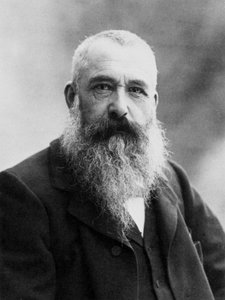
§ 4The artist

Claude Monet

Claude Monet

1840 - 1926, France

Quick facts about Claude Monet

  • Full Name: Oscar-Claude Monet
  • Nationality: French
  • Date Of Birth: 1840
  • Date Of Death: 1926
  • Place Of Birth: Paris, France
  • Notable Artworks:
    • Impression, Sunrise
    • Water Lilies
    • Haystacks
    • Rouen Cathedral
  • Artistic Movement Or Style: Impressionism
  • Artists Who Influenced This Artist:
    • Eugène Boudin
    • J.M.W. Turner
  • Artists Or Movements Influenced By This Artist: ['Modern Art']

Artist Biography

A Life Shaped by Light and Water

The story of Oscar-Claude Monet begins in the streets of Paris, though his heart was often found wandering the salt-misted air of Le Havre. As a young boy, he moved to Normandy, where his father initially hoped he would follow a path in commerce. Yet, the boy possessed a restless eye for detail, finding early success by selling charcoal caricatures to local acquaintances. It was during these formative years that a chance encounter with Eugène Boudin changed everything. Boudin did not merely offer lessons in oil paint; he introduced the young man to the practice of painting en plein air, teaching him to set his easel directly within the unpredictable elements of nature.

This early training instilled a lifelong obsession with the fleeting moment. When the Franco-Prussian War forced him into the streets of London, Monet found himself absorbing the atmospheric effects seen in the works of J.M.W. Turner. He returned to France with a new understanding of how mist and light could dissolve solid forms. In Paris, he sought formal instruction under Charles Gleyre, where he formed deep bonds with fellow painters like Auguste Renoir. These friendships were forged in a shared desire to break away from the rigid, dark constraints of the academic Salon, seeking instead a way to record the world as it was actually perceived by the eye.

The Rebellion of Impression

The year 1874 marked a turning point for this group of rebels. Dissatisfied with conservative standards, they organized their own independent exhibitions. It was during one such showing that his painting, Impression, Sunrise, gave a name to a movement that many initially viewed with derision. The term "Impressionism" emerged from the very criticism meant to mock his loose brushstrokes and unfinished appearance. Monet did not recoil from this label; he embraced it, using it to define a style centered on the subjective sensation of a scene.

His technique became a study in optical truth. He applied unmixed colors side-by-side, a method known as broken color, allowing the viewer's eye to blend the hues. He rejected traditional dark grounds, opting instead for light-colored primers that added a new brightness to his canvases. His work often focused on the following elements:

  • The use of rapid, visible brushstrokes to capture movement.
  • The study of how sunlight alters the appearance of a single subject over time.
  • The rejection of linear perspective in favor of asymmetrical, flattened arrangements influenced by Japanese prints.

Giverny and the Final Vision

In 1883, Monet settled in Giverny, creating a sanctuary that would become his most profound subject. He transformed his property into an elaborate garden, complete with a water lily pond and a Japanese bridge. This was no mere landscape; it was a living laboratory where he could observe the interplay of light on water and foliage under controlled conditions. The gardens at Giverny provided him with a steady stream of inspiration for decades.

The later years of his life were defined by the monumental Water Lilies series. These vast canvases, often painted while he struggled with cataracts, moved toward a near-abstract state where the horizon line vanished entirely. He painted the same pond repeatedly, documenting the way shadows danced across the surface at dusk or how morning mist clung to the lilies. Through these works, he achieved a sense of immersion, inviting anyone who looked upon them to lose themselves in a world of pure, shifting color. He left behind a legacy that fundamentally altered the trajectory of modern art, proving that the most transient moment could be captured through the power of paint.

§ 5Comparanda

§ 6Questions

Quick Facts

  • Subject or theme: Garden Scene
  • Title: untitled (7557)
  • Notable elements or techniques: En plein air painting
  • Artist: Claude Monet
  • Medium: Oil on Canvas

Art Quiz

There is only one correct answer for each question.

Question 1:
What artistic movement is Claude Monet primarily associated with?
Question 2:
The painting depicts a scene featuring what prominent element?
Question 3:
Monet's technique of painting *en plein air* refers to:
Question 4:
What is the primary focus of Monet's depiction in this painting?
Question 5:
Where can you find a significant collection of Claude Monet’s paintings?

§ 7Cite this entry

AllPaintingsStore.com, “Claude Monet, untitled (7557)”, https://allpaintingsstore.com/en/art/claude-monet-untitled-7557-9GETK6-en/ArtistReproduction/ (accessed 7 October 2026).

§ 8The reproduction

Hand Made Oil Reproduction

Hand-painted oil on canvas in your size and frame, made to order by our artists. ( Switch to Print Switch to Digital Image)

It is specified on the order sheet in the margin; the present state of that sheet reads as follows.

untitled (7557)

Reproduction Medium

Reproduction Size

-

Elite Senior Artist

More detail, finesse, and extra production time

-

Reproduction Frame

-

-

For artworks or reproductions larger than 105 cm (approximately 41 inches) on any side, the frame will be shipped as a kit, disassembled. This method ensures safe delivery and prevents damage during transport.

Professional assembly required - this is not a DIY product.
The kit must be assembled and the canvas stretched by an experienced professional framer, using wood glue (not supplied), a canvas stretching plier and clamps to hold the bars square while the glue dries. Incorrect assembly or uneven canvas tension can permanently damage the artwork and is not covered by our warranty.

  • All solid wood bars are included, precisely cut to size.

  • Assembled with the screws provided, plus wood glue for the corner joints, which is not supplied and must be sourced by your framer.

  • Professional tools are required and not included: a canvas stretching plier (tensioner) and clamps to hold the bars square while the glue dries.

Important:
The corner joints require wood glue, the bars must be held with clamps until the glue is fully dry, and tightening the canvas on the assembled frame requires a canvas stretching plier. None of these are included in the kit. Please arrange an experienced professional framer before ordering this size.

Nameplate

-

-

Protective Varnish

Glossy Varnish (enhances colors, protects against light/moisture)

-

Customize My Artwork

Examples of what can be changed: Replace face with customer photo; Add pet (e.g., replace cat with dog); Include hidden message in background; Change background landscape or elements.

-

Urgent

Worldwide Delivery () in 3/4 weeks instead of standard 5 weeks. (4 November). No compromise on quality.

-

Express Shipping

Worldwide Delivery () in 5 weeks. (11 November).

Included

Total Price

$ 258

Included with every order

  • Free Worldwide Express Shipping
  • High-Quality Linen Canvas
  • Full Shipping Insurance
  • Customs Tax Refund Guarantee
  • True Color Matching Guarantee
  • 100-Day Return Policy (Defects Only)
  • 100% Money-Back Guarantee
  • Bulk Discount Offer
Order sheet