.

§ 1Catalogue data

§ 2Abstract
Artist Biography
Explore the luminous landscapes of David Johnson, a Hudson River School painter known for his detailed depictions of Northeastern scenery & luminism style.
.
Explore the luminous landscapes of David Johnson, a Hudson River School painter known for his detailed depictions of Northeastern scenery & luminism style.

1827 - 1908, United States of America
David Johnson, born in New York City in 1827, wasn’t a name etched into the public consciousness during his lifetime, yet his contributions to American landscape painting are profoundly significant. He belonged to the second generation of the Hudson River School, a movement that sought to capture the sublime beauty and spirit of America's natural world – a legacy he inherited and subtly reshaped over a remarkably productive career spanning nearly five decades. Unlike some of his more flamboyant contemporaries, Johnson’s approach was characterized by quiet observation, meticulous detail, and an almost meditative quality, earning him recognition as a master of Luminism, a style emphasizing subtle tonal variations and atmospheric effects to evoke mood and atmosphere rather than dramatic spectacle.
Johnson's early artistic journey began with limited formal training. He registered at the National Academy of Design in 1845 and 1846, initially studying antique art before gravitating towards landscape painting. Crucially, he apprenticed briefly under Jasper Francis Cropsey, a pivotal figure in the Hudson River School known for his dramatic depictions of wilderness scenes. However, Johnson’s artistic philosophy leaned toward a more restrained approach, influenced by his own direct engagement with nature. His first significant work, “Hanes Fall, Kauterskill Clove” (1849), painted alongside Cropsey and John William Casilear, marked the beginning of his professional career and demonstrated his nascent talent for capturing the nuances of light and shadow in the Adirondack mountains. This early collaboration underscored a shared commitment to observing and translating nature’s complexities onto canvas – a foundation upon which Johnson would build his distinctive style.
Johnson's artistic development during the 1850s saw him refine his technique, moving away from the overtly romanticized landscapes of earlier Hudson River painters. He began to prioritize accuracy and subtlety, meticulously rendering details like tree bark, rock formations, and reflections in water. This period witnessed a shift towards Luminism – a style characterized by soft, diffused light, atmospheric perspective, and an emphasis on capturing the fleeting effects of sunlight. His paintings during this time often featured solitary figures dwarfed by the vastness of nature, evoking feelings of tranquility, contemplation, and a deep connection to the natural world. The influence of artists like Casilear and Kensett was evident, but Johnson developed his own unique voice within the Luminist framework – one marked by an almost photographic realism combined with a profound sense of atmosphere.
Notable works from this era include depictions of Lake George, where he captured the shimmering surface of the water and the surrounding forests with remarkable precision. These scenes weren’t merely representations of scenery; they were imbued with a palpable sense of mood – the cool stillness of dawn, the hazy warmth of afternoon light, the dramatic shadows cast by towering pines. Johnson's ability to translate these subtle shifts in light and atmosphere onto canvas is what truly sets his work apart.
As the 1870s unfolded, Johnson’s artistic style underwent a noticeable transformation. He began to incorporate elements of the French Barbizon School, known for its emphasis on plein air painting and the depiction of rural landscapes bathed in soft, diffused light. This stylistic shift, while initially met with mixed reactions from his colleagues within the Hudson River School, reflected a broader trend among American artists seeking to engage with European artistic developments. Johnson’s paintings during this period often featured pastoral scenes of central New York State – rolling hills, farms, and small villages – rendered in a muted palette and characterized by a sense of quiet intimacy.
Despite the Barbizon influence, Johnson never entirely abandoned his Luminist roots. His later works retained a sensitivity to light and atmosphere, but with a greater emphasis on tonal values and subtle color variations. He continued to paint iconic landscapes like “Schooley’s Mountain, New Jersey” (1874), showcasing his mastery of capturing the essence of Northeastern scenery – a testament to his lifelong dedication to observing and translating nature's beauty onto canvas.
David Johnson’s career spanned nearly half a century, during which he exhibited extensively in major American art centers, including Chicago, Boston, and Philadelphia. While he never achieved the widespread fame of some of his contemporaries, his work gained renewed appreciation in the late 20th century, largely due to the efforts of scholars who recognized his unique contribution to the Hudson River School and Luminism. Today, Johnson’s paintings are valued for their technical skill, atmospheric quality, and evocative depictions of Northeastern scenery – a quiet but enduring legacy that continues to resonate with art lovers.
His work is now housed in prestigious collections such as the Herbert F. Johnson Museum of Art at Cornell University and the Piasecka-Johnson Collection in Princeton, ensuring that his contributions to American landscape painting will be enjoyed by generations to come.

AllPaintingsStore.com, “David Johnson, Passing Storm Clouds”, https://allpaintingsstore.com/en/art/david-johnson-passing-storm-clouds-8LHR92-en/ (accessed 1 October 2026).
Hand-painted oil on canvas in your size and frame, made to order by our artists. ( Switch to Print Switch to Digital Image)
It is specified on the order sheet in the margin; the present state of that sheet reads as follows.
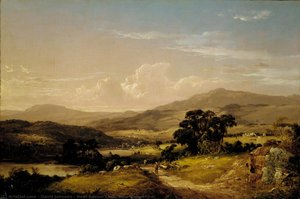
Passing Storm Clouds
Reproduction Size
More detail, finesse, and extra production time
-
For artworks or reproductions larger than 105 cm (approximately 41 inches) on any side, the frame will be shipped as a kit, disassembled. This method ensures safe delivery and prevents damage during transport.
Professional assembly required - this is not a DIY product.
The kit must be assembled and the canvas stretched by an experienced professional framer, using wood glue (not supplied), a canvas stretching plier and clamps to hold the bars square while the glue dries. Incorrect assembly or uneven canvas tension can permanently damage the artwork and is not covered by our warranty.
All solid wood bars are included, precisely cut to size.
Assembled with the screws provided, plus wood glue for the corner joints, which is not supplied and must be sourced by your framer.
Professional tools are required and not included: a canvas stretching plier (tensioner) and clamps to hold the bars square while the glue dries.
Important:
The corner joints require wood glue, the bars must be held with clamps until the glue is fully dry, and tightening the canvas on the assembled frame requires a canvas stretching plier. None of these are included in the kit. Please arrange an experienced professional framer before ordering this size.
-
Glossy Varnish (enhances colors, protects against light/moisture)
Examples of what can be changed: Replace face with customer photo; Add pet (e.g., replace cat with dog); Include hidden message in background; Change background landscape or elements.
Worldwide Delivery () in 3/4 weeks instead of standard 5 weeks. (29 October). No compromise on quality.
Worldwide Delivery () in 5 weeks. (5 November).
Included with every order


 Read More


 For artworks or reproductions larger than 105 cm (approximately 41 inches) on any side, the frame will be shipped as a kit, disassembled. This method ensures safe delivery and prevents damage during transport.