Money-Back Guarantee · 100 days Free Worldwide Delivery
449,564artworks 30,613artists 4,660museums 32languages
Catalogue entry

Au Prado

Acrylic On Canvas. Detroit Institute of Arts.

Fig. 1. Édouard Manet, Au Prado. Shown as the reproduction you are specifying: , .

§ 1Catalogue data

§ 2Abstract

Collectible Description

Explore Édouard Manet's 'Au Prado,' a captivating etching depicting Parisian street life with figures strolling beneath an umbrella – a masterful blend of realism and artistic innovation.

Artist Biography

Manet bridged Realism and Impressionism with Olympia. Discover the revolutionary works of this Parisian master.

§ 3Commentary

A Snapshot of Parisian Life Captured in Monochrome

Édouard Manet’s “Au Prado,” etched in 1869, isn't merely a depiction of a street scene; it’s a deliberate provocation—a quiet rebellion against the artistic conventions of its time. The etching captures a moment of everyday existence: figures strolling along Parisian pavement beneath a sheltering umbrella, their movements rendered with remarkable precision and subtly imbued with an atmosphere of understated observation. This seemingly simple composition holds profound significance within the broader context of Impressionism’s burgeoning challenge to academic painting.
  • Subject Matter: The scene portrays ordinary Parisians engaged in commonplace activities—a woman carrying a handbag, men discussing matters with serious expressions. Manet eschewed grand narratives or mythological subjects favored by his contemporaries, opting instead for realism that felt disconcertingly honest.
  • Style & Technique: Manet’s masterful use of etching demonstrates an acute understanding of tonal variation and texture. The artist skillfully employs hatching and cross-hatching to create depth and form, mimicking the effects of light and shadow—a technique honed by his admiration for Caravaggio and Velázquez. Unlike oil paint, which strives for luminous color, etching achieves its impact through careful manipulation of black ink on paper, resulting in a strikingly graphic aesthetic.

Historical Context: Impressionism's Quiet Dissidence
  • The etching emerged during the height of Impressionism’s ascendancy, a movement that championed capturing fleeting moments and sensory impressions rather than idealized representations. Artists like Monet and Renoir were pushing boundaries, rejecting academic formulas in favor of looser brushstrokes and vibrant hues. Manet positioned himself at the forefront of this artistic revolution, subtly undermining established norms without overtly proclaiming his defiance.
  • The etching’s appearance coincided with a period of social upheaval in Paris—the Franco-Prussian War had just concluded, reshaping Europe's political landscape. This context informs the artwork’s mood; it’s not celebratory or dramatic but rather contemplative, reflecting the anxieties and uncertainties of the era.
  • Symbolism Beyond Surface Appearance
  • The umbrella itself is more than just a practical accessory; it symbolizes protection—both physical and emotional. Perhaps representing resilience in the face of adversity, it subtly underscores the vulnerability inherent in human experience. The woman’s gaze directs towards the viewer, inviting engagement and prompting reflection on our own role as observers within the unfolding drama of life.
  • Manet's deliberate choice of monochrome reinforces this symbolic dimension. By stripping away color, he focuses attention on form and texture—elements that convey emotion and psychological nuance more powerfully than chromatic hues alone.
  • Emotional Impact: A Moment Frozen in Time
  • “Au Prado” resonates with viewers not through grand gestures but through its quiet intimacy. It evokes a sense of melancholy, capturing the transient beauty of everyday life—a poignant reminder that moments pass quickly and leave indelible impressions on our consciousness. The etching’s understated elegance speaks to Manet's belief in art as a vehicle for conveying profound truths about human existence.
  • Ultimately, Manet’s “Au Prado” stands as a testament to the power of observation—a celebration of realism that anticipates the expressive potential of Impressionism and continues to captivate audiences today. Its reproduction offers an opportunity to appreciate the artist's genius and immerse oneself in the evocative atmosphere of Parisian life during a pivotal moment in art history.
  • Questions & Answers

    Can I see an X-ray view of "Au Prado" by Édouard Manet?

    The X-Ray view of "Au Prado" by Édouard Manet is on the artwork's X-Ray page: an interactive examination of the image through eleven optical layers.

    What medium is "Au Prado" by Édouard Manet executed in?

    "Au Prado" is executed in acrylic on canvas.

    Where can I see a preview of "Au Prado"?

    The Preview page of "Au Prado" lets you preview the artwork before ordering.
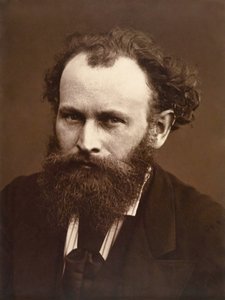
    § 4The artist

    Édouard Manet

    Édouard Manet

    1832 - 1883, France

    Quick facts about Édouard Manet

    • Full Name: Édouard Manet
    • Nationality: French
    • Date Of Birth: 1832
    • Date Of Death: 1883
    • Place Of Birth: Paris, France
    • Notable Artworks:
      • Le Déjeuner sur l'herbe
      • Olympia
      • A Bar at the Folies-Bergère
    • Artistic Movement Or Style: Realism, Impressionism
    • Artists Who Influenced This Artist:
      • Caravaggio
      • Diego Velázquez
      • Gustave Courbet
    • Artists Or Movements Influenced By This Artist:
      • Claude Monet
      • Pierre-Auguste Renoir
      • Edgar Degas
      • Impressionism

    Artist Biography

    The Architect of Modernity

    To look at a canvas by Édouard Manet is to witness the precise moment when the polished illusions of the past collapsed under the weight of contemporary reality. He did not seek to decorate the walls of the bourgeoisie; he sought to confront them. While his contemporaries often retreated into mythological safety, Manet forced the viewer to acknowledge the grit and the glare of 19th-century Paris. His work functions as a blunt instrument that dismantled the academic hierarchy of subjects. He stripped away the comfortable distance provided by historical allegory, replacing it with the unsettling directness of a woman staring back from a modern street or a café.

    The impact of his technique remains visible in every brushstroke that prioritizes the physical reality of paint over the illusion of depth. He rejected the seamless, invisible finish demanded by the Salon, opting instead for facture—a visible, energetic application of pigment. By using stark contrasts and a flattened pictorial space, he reminded anyone looking at his work that they were observing a constructed image on a flat surface. This was not an error in perspective; it was a deliberate rejection of the window-like transparency that had dominated Western art since the Renaissance.

    A Rebellion Rooted in Tradition

    Manet’s radicalism was not born from ignorance of the past, but from a deep, analytical study of it. His time spent copying Old Masters in the Louvre provided him with a technical foundation that he would later use to subvert tradition. He drew heavily from the bold compositions and light manipulation found in the works of Caravaggio and Velázquez. From the Spanish masters, he learned how to utilize black as a positive color and how to employ fluid brushwork to suggest form without excessive detail. This was not an imitation of the past, but a dissection of it.

    His early life in Paris suggested a path far removed from the studio. Born into a comfortable family, his father initially pushed for a career in the navy or law. After failing his entrance exams for the naval academy, Manet turned toward the arts under the instruction of Thomas Couture. This tension between his bourgeois origins and his revolutionary output created a unique friction in his work. He possessed the social standing to navigate Parisian intellectual circles, yet he used that access to promote an aesthetic that many found vulgar or incompetent.

    The Scandal of the Real

    The mid-1860s provided the stage for Manet’s most significant confrontations with the public. The 1863 Salon des Refusés became a site of intense controversy, largely due to his inclusion in the exhibition of rejected works. His painting Le Déjeuner sur l'herbe shocked audiences not merely because of its nudity, but because of its lack of mythological context. The figures were undeniably modern, stripped of the divine or the ancient, leaving only the raw presence of contemporary Parisians. This refusal to idealize his subjects was met with widespread condemnation from critics who found his realism too blunt.

    This pattern of provocation continued with Olympia in 1865. By reimagining Titian’s Venus of Urbino through the lens of a contemporary prostitute, Manet stripped away the protective layer of myth. The subject did not invite a gaze of admiration for a goddess; she demanded recognition of a person. This period of his career established the fundamental shift from Realism toward the beginnings of Impressionism. His influence on the movement was structural rather than purely stylistic:

    • He championed the use of alla prima painting, or wet-on-wet technique, to capture immediate atmospheric effects.
    • He introduced a flattened perspective that challenged the mathematical precision of academic composition.
    • He utilized strong, contrasting tones to create a sense of modern, fragmented light.

    The Enduring Verdict

    Manet’s career was cut short by his death in 1883, yet the trajectory of art had already been irrevocably altered. He acted as the essential bridge between the heavy, grounded themes of Realism and the fleeting, light-focused explorations of the Impressionists. While he never fully adopted the label of an Impressionist and continued to seek recognition from the official Salon, his methods provided the vocabulary for the avant-garde. He proved that the artist's duty was not to provide a beautiful escape, but to document the complexities and contradictions of the era.

    § 5Comparanda

    § 6Questions

    Quick Facts

    • Influences:
      • Caravaggio
      • Velázquez
    • Location: Private Collection
    • Artist: Édouard Manet
    • Movement: Realism
    • Medium: Etching

    § 7Cite this entry

    AllPaintingsStore.com, “Édouard Manet, Au Prado”, https://allpaintingsstore.com/en/art/edouard-manet-au-prado-D3VTZ8-en/ArtistReproduction/ (accessed 6 October 2026).

    § 8The reproduction

    Hand Made Oil Reproduction

    Hand-painted oil on canvas in your size and frame, made to order by our artists. ( Switch to Print Switch to Digital Image)

    It is specified on the order sheet in the margin; the present state of that sheet reads as follows.

    Au Prado

    Reproduction Medium

    Reproduction Size

    -

    Elite Senior Artist

    More detail, finesse, and extra production time

    -

    Reproduction Frame

    -

    -

    For artworks or reproductions larger than 105 cm (approximately 41 inches) on any side, the frame will be shipped as a kit, disassembled. This method ensures safe delivery and prevents damage during transport.

    Professional assembly required - this is not a DIY product.
    The kit must be assembled and the canvas stretched by an experienced professional framer, using wood glue (not supplied), a canvas stretching plier and clamps to hold the bars square while the glue dries. Incorrect assembly or uneven canvas tension can permanently damage the artwork and is not covered by our warranty.

    • All solid wood bars are included, precisely cut to size.

    • Assembled with the screws provided, plus wood glue for the corner joints, which is not supplied and must be sourced by your framer.

    • Professional tools are required and not included: a canvas stretching plier (tensioner) and clamps to hold the bars square while the glue dries.

    Important:
    The corner joints require wood glue, the bars must be held with clamps until the glue is fully dry, and tightening the canvas on the assembled frame requires a canvas stretching plier. None of these are included in the kit. Please arrange an experienced professional framer before ordering this size.

    Nameplate

    -

    -

    Protective Varnish

    Glossy Varnish (enhances colors, protects against light/moisture)

    -

    Customize My Artwork

    Examples of what can be changed: Replace face with customer photo; Add pet (e.g., replace cat with dog); Include hidden message in background; Change background landscape or elements.

    -

    Urgent

    Worldwide Delivery () in 3/4 weeks instead of standard 5 weeks. (3 November). No compromise on quality.

    -

    Express Shipping

    Worldwide Delivery () in 5 weeks. (10 November).

    Included

    Total Price

    $ 258

    Included with every order

    • Free Worldwide Express Shipping
    • High-Quality Linen Canvas
    • Full Shipping Insurance
    • Customs Tax Refund Guarantee
    • True Color Matching Guarantee
    • 100-Day Return Policy (Defects Only)
    • 100% Money-Back Guarantee
    • Bulk Discount Offer
    Order sheet