Money-Back Guarantee · 100 days Free Worldwide Delivery
449,564artworks 30,613artists 4,658museums 32languages
Catalogue entry

Reading

1865. Acrylic On Canvas. Musée d'Orsay.

Fig. 1. Édouard Manet, Reading, 1865. Shown as the reproduction you are specifying: , .

§ 1Catalogue data

§ 2Abstract

Collectible Description

Artist Biography

Manet bridged Realism and Impressionism with Olympia. Discover the revolutionary works of this Parisian master.

§ 3Commentary

A Moment of Quiet Contemplation: Édouard Manet’s ‘Reading’

Édouard Manet's “Reading,” completed in 1879, isn’t merely a portrait; it’s a distillation of Impressionist ideals and a subtle commentary on the evolving social landscape of Paris. Captured with masterful brushwork at the Musée d’Orsay, this painting transcends its seemingly simple subject matter—a woman absorbed in reading—to deliver a profound statement about observation, stillness, and the complexities of modern life.

The Style and Technique: Impressionistic Brilliance

Manet eschewed the academic conventions that dominated French art during his time, prioritizing capturing fleeting moments of light and color rather than meticulously recreating reality. His technique exemplifies the core tenets of Impressionism. Loose, visible brushstrokes—characteristic of Monet and Renoir—blend seamlessly to create an atmospheric haze around the woman’s figure. The artist skillfully utilizes tonal variations to sculpt form, subtly emphasizing the contours of her face and torso without resorting to harsh outlines. Notice how Manet employs a muted palette dominated by earthy tones – browns, ochres, and creams – reflecting the diffused light filtering through the window and contributing to the painting's serene mood.

Historical Context: Challenging Tradition

Painted during a period of significant artistic experimentation, “Reading” stands as a defiant gesture against the rigid formalism of Salon art. The Impressionists sought to depict everyday life with honesty and immediacy, rejecting idealized representations in favor of capturing the sensory experience of the present. Manet’s decision to portray a woman alone—a departure from traditional genre paintings that often depicted aristocratic ladies engaged in social activities—was itself groundbreaking. It signaled a shift towards portraying ordinary subjects with psychological depth, mirroring the burgeoning interest in exploring inner life and emotion within the intellectual circles of Paris.

Symbolism: Beyond Appearance

While superficially depicting a commonplace scene, “Reading” is laden with symbolic significance. The woman’s posture – seated calmly with her hands clasped in her lap—represents introspection and contemplation. The book symbolizes knowledge, learning, and escape from worldly concerns. Furthermore, the presence of two figures in the background subtly underscores the idea that even amidst solitude, one remains connected to the broader human experience. Manet's careful composition invites viewers to consider not just what is seen but also what is felt—a hallmark of Impressionist art’s ability to evoke emotion and provoke thought.

Emotional Impact: Tranquility and Reflection

“Reading” succeeds in conveying a palpable sense of tranquility and quiet reflection. The painting’s muted colors, combined with the woman's serene gaze, create an atmosphere of stillness that draws the viewer inward. It speaks to the universal desire for respite from the pressures of daily life and encourages contemplation on matters of significance. Owning a reproduction of this iconic artwork allows you to bring this moment of contemplative beauty into your home—a testament to Manet’s enduring legacy as one of Impressionism's most influential figures.

Questions & Answers

Is "Reading" by Édouard Manet a painting, a drawing or a print?

"Reading" by Édouard Manet is classified as wall art. The category describes the kind of artwork the original is.

Does "Reading" have an augmented reality preview?

"Reading" by Édouard Manet can be previewed on your own wall with the artwork's AR Preview page, using augmented reality on a compatible device.

Does "Reading" by Édouard Manet use strong contrasts or soft harmonies?

In "Reading", a statement contrast is paired with a strong color unity harmony.
§ 4The artist

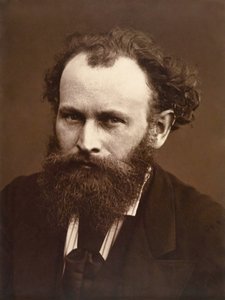
Édouard Manet

Édouard Manet

1832 - 1883, France

Quick facts about Édouard Manet

  • Artistic Movement Or Style: Realism, Impressionism, Avant-garde
  • Artists Or Movements Influenced By This Artist:
    • Impressionism
    • Avant-garde
    • Claude Monet
    • Berthe Morisot
    • Edgar Degas
    • Gauguin
  • Artists Who Influenced This Artist:
    • Caravaggio
    • Diego Velázquez
    • Francisco Goya
    • Titian
    • Raphael
    • Frans Hals
    • Peter Paul Rubens
  • Full Name: Édouard Manet
  • Nationality: French
  • Notable Artworks:
    • Olympia
    • Le Déjeuner sur l'herbe
    • A Bar at the Folies-Bergère
  • Place Of Birth: Paris, France
  • Date Of Birth: 1832
  • Date Of Death: 1883

Artist Biography

Early Life, Family and Training

Édouard Manet was born in Paris on January 23, 1832. He grew up in an affluent household, the eldest son of a man who held a position in the French Ministry of Justice. His father had envisioned a different path for him, one involving the navy or the law. The boy attempted to follow this direction, but he failed the entrance exams for the naval academy twice. This failure redirected his focus toward the studio. He eventually presented his father with a portfolio of paintings to prove his commitment to the arts, finally gaining the permission needed to study formally.

From 1850 to 1856, he trained in the studio of Thomas Couture. While he learned the technical foundations of academic painting there, his eyes often wandered toward the Louvre. He spent much of his time in those galleries, standing before the canvases of the Old Masters and copying their methods. He studied the way they handled light and form, absorbing the lessons of the past while preparing to find his own way. This period of intense study provided the technical grounding that would support his later departures from tradition.

Technique and Artistic Style

The surface of a canvas reveals a deliberate departure from the polished, invisible finish required by the Salon. Instead of smoothing away the evidence of the brush, there is a visible, energetic application of pigment known as facture. This approach prioritizes the physical reality of the paint itself. By using the alla prima or wet-on-wet technique, the colors are laid down while still fresh, capturing an immediate quality that avoids the slow, layered buildup of traditional academic methods. This method allows for a certain spontaneity in how light and atmosphere are recorded.

There is a noticeable flatness in the way forms are constructed. A loose handling of the paintbrush avoids the heavy modeling used to create deep, three-dimensional illusions. Instead, the pictorial space often feels compressed. This effect is heightened by the use of strong, contrasting tones. Rather than relying on gradual color scales to define shape, the work often uses stark shifts in value to suggest the fragmented, modern light of the city. This rejection of mathematical perspective and seamless blending creates a sense of immediacy, as if the image is being assembled directly before the eye.

The Scandal of Modern Subjects

The mid-1860s brought a series of confrontations with the public eye. In 1863, the Salon des Refusés provided a stage for works that the official juries had rejected. Among these was Le Déjeuner sur l'herbe, a painting that caused an immediate stir. It did not rely on the usual mythological or biblical excuses to present nudity; instead, it placed a nude woman in a picnic setting alongside two fully clothed men. This refusal to provide a historical or divine context left the viewer with nothing but the raw presence of contemporary life.

The tension only increased in 1865 with the exhibition of Olympia. This work was considered the most shocking piece in the Salon. It took the composition of Titian’s Venus of Urbino and stripped away the protective layer of myth, replacing a goddess with a contemporary prostitute. She did not look away or invite a gaze of admiration; she stared back with a directness that many found unsettling. Critics focused their anger on this lack of idealization and the bluntness of the subject matter.

Beyond the choice of subjects, the way the paint was applied drew heavy criticism. Many observers attacked the visible, energetic brushwork and the lack of a polished, seamless finish. They saw errors in perspective and a failure to follow the traditional rules of decorum. What some called incompetence, others recognized as a deliberate choice to show the reality of the paint on the canvas rather than a window into a dream.

Key Works and Major Paintings

In 1861, he produced The Spanish Singer, a work that earned him an honorable mention at the Salon. The painting shows a model in Andalusian costume, holding a guitar in a way that suggests the chords are being pressed by a left-handed player, even though the instrument is strung for a right-handed one. This small, deliberate error sits alongside a stereotypical Spanish still life placed near the model's feet.

His brushwork often addressed the immediate and the political. In 1867, he painted The Execution of the Emperor Maximilian of Mexico. Later, as his health began to decline in the late 1870s, his focus shifted toward smaller, more intimate subjects. By 1882, he had completed A Bar at the Folies-Bergère, a painting that captures the atmosphere of a modern café with a sense of psychological ambiguity. Near the end of his life, around 1883, he turned his attention to still lifes, such as Two roses on a tablecloth.

  • The Spanish Singer (1861)
  • The Execution of the Emperor Maximilian of Mexico (1867)
  • A Bar at the Folies-Bergère (1882)
  • Two roses on a tablecloth (about 1883)

Circle, Rivals and Influences

His brushwork carries the weight of the masters he studied in the Louvre. He looked toward the dramatic light of Caravaggio and the fluid, dark tones of Velázquez to find a way forward. From Goya, he took a certain directness that bypassed the need for polished, academic finishes. These were not mere studies; they were the tools he used to dismantle the expectations of the Salon. He preferred the presence of a single, strong color over the gradual blending of tones.

In the cafes and intellectual circles of Paris, he moved among the very people who would redefine the era. He shared spaces and ideas with Claude Monet and Edgar Degas, men who were also pushing against the boundaries of what a painting could be. His personal life was equally intertwined with the avant-garde; his sister-in-law was the artist Berthe Morisot. While he often sought the approval of the official institutions, his true peers were those working in the shadows of the established academies.

He found an early, vocal defender in a writer who saw the future in his controversial canvases. This supporter published a glowing account of his work, helping to frame his place in a changing art world. Even when the public reacted with hostility to his modern subjects, this support provided a necessary counterweight to the critics who found his style unfinished or his themes improper. He remained a figure caught between the old world of the Academy and the new, restless energy of the streets.

§ 5Comparanda

§ 6Questions

Quick Facts

  • Subject or theme: Portraiture
  • Artist: Édouard Manet
  • Title: Reading
  • Influences:
    • Caravaggio
    • Velázquez
  • Artistic style: Realist

Art Quiz

There is only one correct answer for each question.

Question 1:
What is the primary subject matter depicted in Édouard Manet’s ‘Reading’?
Question 2:
The painting utilizes Impressionist brushwork, characterized by:
Question 3:
Where is Édouard Manet’s ‘Reading’ currently housed?
Question 4:
What is notable about the woman’s pose and gaze in ‘Reading’?
Question 5:
What artistic movement did Édouard Manet exemplify?

§ 7Cite this entry

AllPaintingsStore.com, “Édouard Manet, Reading (1865)”, https://allpaintingsstore.com/en/art/edouard-manet-reading-8YDQQS-en/ArtistReproduction/ (accessed 12 October 2026).

§ 8The reproduction

Hand Made Oil Reproduction

Hand-painted oil on canvas in your size and frame, made to order by our artists. ( Switch to Print Switch to Digital Image)

It is specified on the order sheet in the margin; the present state of that sheet reads as follows.

Reading

Reproduction Medium

Reproduction Size

-

Elite Senior Artist

More detail, finesse, and extra production time

-

Reproduction Frame

-

-

For artworks or reproductions larger than 105 cm (approximately 41 inches) on any side, the frame will be shipped as a kit, disassembled. This method ensures safe delivery and prevents damage during transport.

Professional assembly required - this is not a DIY product.
The kit must be assembled and the canvas stretched by an experienced professional framer, using wood glue (not supplied), a canvas stretching plier and clamps to hold the bars square while the glue dries. Incorrect assembly or uneven canvas tension can permanently damage the artwork and is not covered by our warranty.

  • All solid wood bars are included, precisely cut to size.

  • Assembled with the screws provided, plus wood glue for the corner joints, which is not supplied and must be sourced by your framer.

  • Professional tools are required and not included: a canvas stretching plier (tensioner) and clamps to hold the bars square while the glue dries.

Important:
The corner joints require wood glue, the bars must be held with clamps until the glue is fully dry, and tightening the canvas on the assembled frame requires a canvas stretching plier. None of these are included in the kit. Please arrange an experienced professional framer before ordering this size.

Nameplate

-

-

Protective Varnish

Glossy Varnish (enhances colors, protects against light/moisture)

-

Customize My Artwork

Examples of what can be changed: Replace face with customer photo; Add pet (e.g., replace cat with dog); Include hidden message in background; Change background landscape or elements.

-

Urgent

Worldwide Delivery () in 3/4 weeks instead of standard 5 weeks. (9 November). No compromise on quality.

-

Express Shipping

Worldwide Delivery () in 5 weeks. (16 November).

Included

Total Price

$ 258

Included with every order

  • Free Worldwide Express Shipping
  • High-Quality Linen Canvas
  • Full Shipping Insurance
  • Customs Tax Refund Guarantee
  • True Color Matching Guarantee
  • 100-Day Return Policy (Defects Only)
  • 100% Money-Back Guarantee
  • Bulk Discount Offer
Order sheet